Airport Taxi Transfer Service

Airport Taxi Transfer Service Booking Guide 2026: Travel Comfortably and Arrive on Time

Are you planning your next trip and worrying about reaching the airport on time? Or perhaps you are imagining the end of a long flight, when all you want is a clean, comfortable car waiting outside instead of a stressful search for a taxi.

Booking an airport taxi transfer service in advance is one of the simplest ways to make the beginning and end of a journey feel calm and organized. It gives you a confirmed pickup plan, a vehicle suited to your group and luggage, a clear price, and a direct contact before you travel.

A professional airport taxi transfer service is more than a car moving between two places. It involves checking your flight details, coordinating the pickup time, choosing the right vehicle, agreeing on the destination, and staying prepared if the flight schedule changes.

This guide explains how to book the right service, what information to provide, and how Atum Trip helps travelers arrange comfortable airport pickups and drop-offs with punctual service and transparent pricing.

What Is an Airport
Taxi Transfer Service?

An airport taxi transfer service is prearranged private transportation between an airport and a hotel, home, Nile cruise, business address, or another agreed destination. It normally covers one of two journeys:

  • Airport pickup: A driver meets you after arrival
    and takes you directly to your destination.
  • Airport drop-off: A vehicle collects you from your
    accommodation or another location and takes you to the airport before
    departure.

You can also arrange a round-trip transfer, confirming both your arrival and departure transport with the same provider.

Unlike searching for a taxi after landing, a pre-booked airport taxi is organized around details supplied in advance. Your provider knows the flight number, travel date, destination, passenger count, luggage requirements, and contact number. You also know the agreed price and how to communicate when you arrive.

Pre-booked
airport taxi or a taxi from the rank?

A taxi found after arrival may be suitable for a spontaneous journey, but the vehicle, luggage capacity, waiting time, and fare may not be confirmed before you meet the driver.

A pre-booked airport taxi transfer provides a planned pickup, an agreed vehicle category, direct communication, flight monitoring, and a fixed quotation. This makes it particularly useful for families, late-night arrivals, early departures, and first-time visitors.

Why Should
You Book Your Airport Taxi Transfer Service  in Advance?

Avoid
searching for transport after a tiring flight

Passport control, baggage collection, and airport formalities can feel exhausting after several hours in the air. When transportation has already been arranged, you do not need to compare unfamiliar options or negotiate a fare while carrying your luggage.

Know the price before you
travel

Unclear pricing creates unnecessary anxiety, particularly when you are visiting a destination for the first time. A reliable provider gives you a fixed, transparent price before confirmation and explains what the price covers.

Reserve
a vehicle that fits your passengers and luggage

A sedan may be comfortable for one or two travelers but unsuitable for a family with several large bags. Sharing accurate passenger and luggage information allows the provider to arrange an appropriate car or air-conditioned van.

Reduce the risk of a
late airport arrival

For a departure transfer, the scheduled flight time is only one part of the calculation. You must also allow for the road journey, airline check-in, security procedures, possible traffic, and a reasonable safety margin. Advance coordination makes it easier to select a sensible pickup time.

What
Makes a Professional Airport Taxi Transfer Service Different?

Absolute commitment to
punctuality

Timing is fundamental to every airport taxi transfer service. For an arrival, the vehicle should be prepared according to the flight information. For a departure, the pickup should leave enough time for the traveler to complete airport procedures without rushing.

At Atum Trip, punctuality begins before the vehicle moves. We review the flight time, pickup point, destination, passenger details, and planned route. The arrangements are confirmed with the guest so that both sides understand the meeting time and location.

Comfort, cleanliness, and
peace of mind

Comfort begins with knowing who will meet you and how to contact the team. Atum Trip coordinates every airport taxi transfer service using modern, clean, air-conditioned vehicles. The cars are cleaned and sanitized to provide a pleasant environment, while the vehicle category is selected according to the agreed number of travelers and the amount of luggage.

If you are traveling with young children, elderly guests, a wheelchair, a stroller, or unusual baggage, mention it during booking. Advance notice gives the team time to confirm whether the necessary arrangement is available.

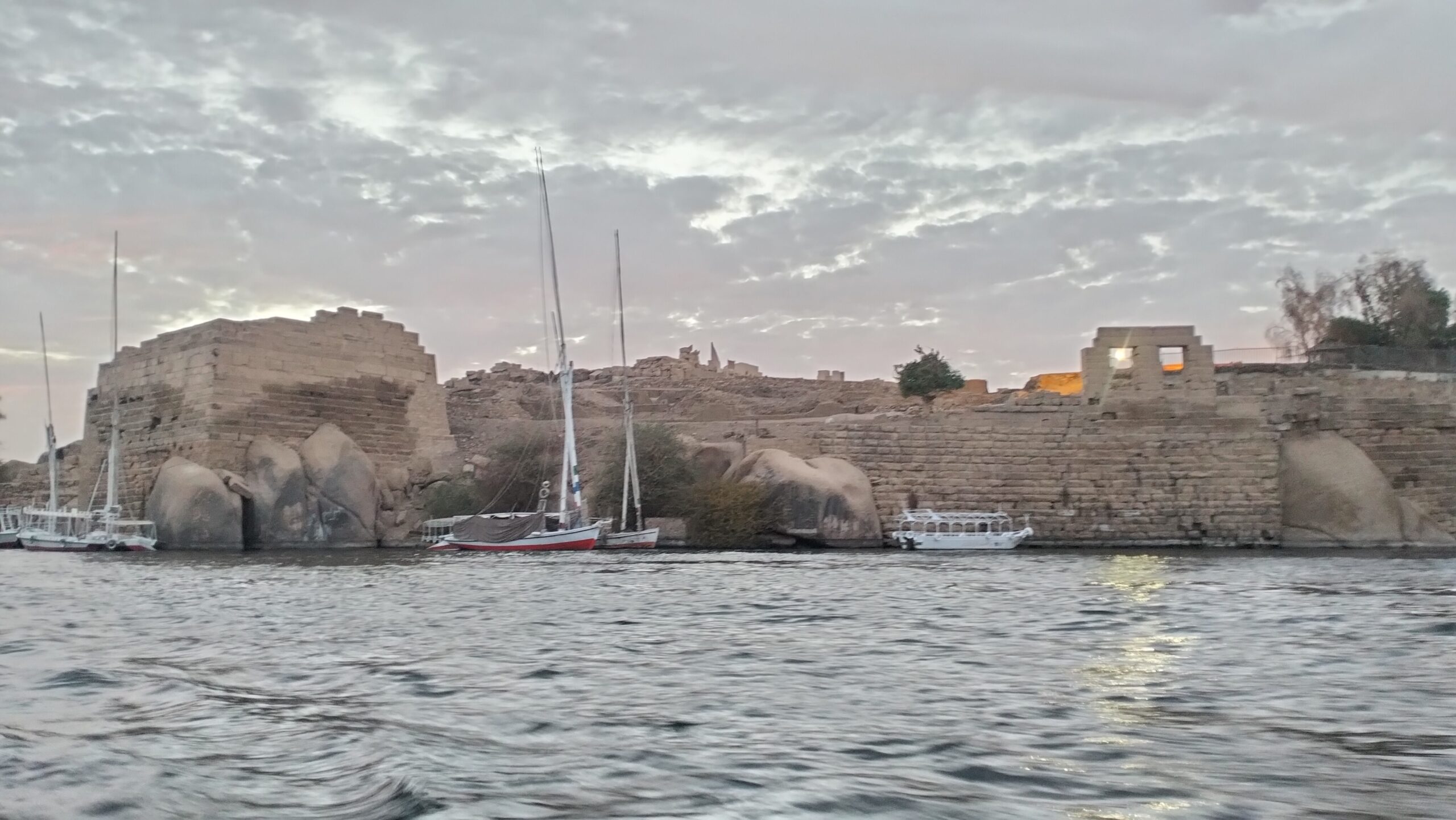
Private transfer cars at Aswan Airport for an airport taxi transfer service
Atum Trip private transfer cars ready at Aswan Airport.

Flight tracking using
your flight number

Aircraft can land earlier or later than scheduled. For this reason, your flight number is an essential part of an airport taxi transfer service booking. It allows the team to monitor the available flight status and coordinate the expected pickup time rather than relying only on the original timetable.

Flight monitoring works best together with direct communication. Keep your phone connected after landing when possible, and inform the team if the airline changes the flight number, route, or arrival airport.

Fixed and transparent prices

You should understand the price and the service before confirming an airport taxi transfer service. Atum Trip provides a clear price based on the journey details supplied during booking, without unexpected charges at the end of the agreed route.

Transparency also means explaining the scope of the booking: the pickup point, destination, vehicle category, passenger and luggage allowance, and whether the service is one-way or round-trip.

If the guest later requests a substantial change—such as a different destination or an additional stop—any effect on the price should be explained before the change is carried out whenever possible.

How
to Book an Airport Taxi Transfer Service Step by Step

Step 1: Choose the type of
transfer

Decide whether you need an airport pickup, an airport drop-off, or both. State the airport, city, pickup point, and final destination clearly.

If your journey begins or ends in Aswan, consult the Egyptian Ministry of Civil Aviation’s official Aswan International Airport page for airport information, then share your flight details when booking your airport taxi transfer service.

Step 2: Send your
flight and travel details

For an arrival pickup, the provider will normally need:

  • Arrival date
  • Flight number
  • Scheduled arrival time
  • Lead passenger’s name
  • Number of adults and children
  • Number of large bags and any special luggage
  • Hotel, Nile cruise, home, or final destination
  • A working WhatsApp number

For an airport drop-off, send the departure date and time, flight number, pickup address, passenger count, luggage information, and the time you would like to reach the terminal. The transfer team can help you estimate a suitable collection time, but you should always follow the airline’s official check-in instructions.

Step 3: Select the right
vehicle

Do not calculate vehicle size by seats alone. Luggage occupies significant space. A sedan can be an efficient choice for solo travelers, couples, or small parties with limited baggage. A van offers more space for families, groups, and passengers traveling with several suitcases.

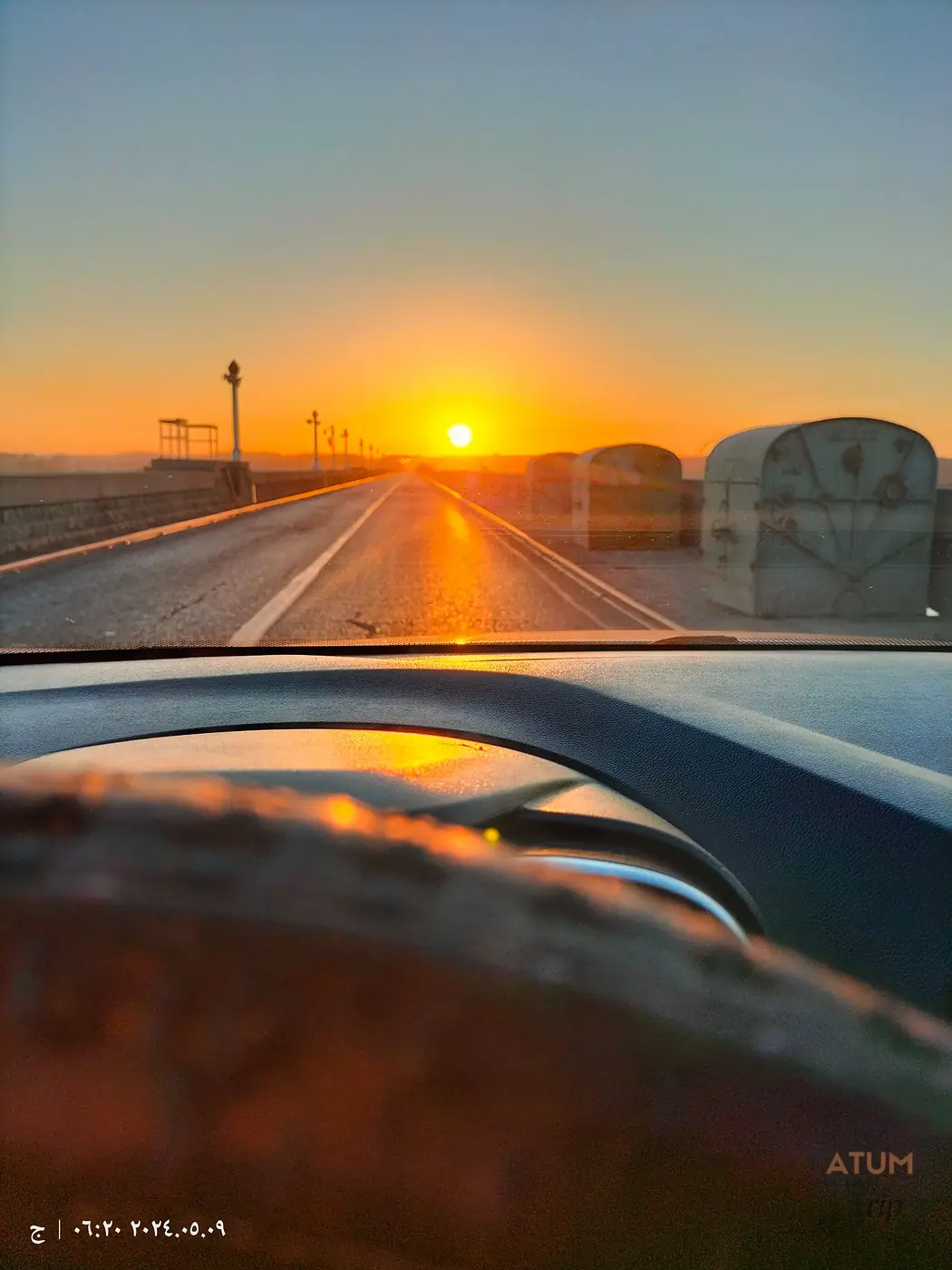
Private transfer road at sunset in Aswan
A private transfer journey on the road near Aswan at sunset.

Step 4: Review the
complete arrangement

Before you confirm, check:

  • Pickup date, time, and exact location
  • Final destination
  • Vehicle type or category
  • Passenger and luggage numbers
  • Agreed price and inclusions
  • Contact and meeting instructions

Step 5: Keep the
confirmation message

Save the booking confirmation and contact number on your phone. If your flight, hotel, passenger count, or luggage changes, send the update as early as possible so the arrangements can be reviewed before the service.

Airport Pickup:
What Happens When You Arrive?

After landing, you will normally complete passport procedures and collect your baggage before reaching the meeting point. A dependable airport taxi transfer service uses flight tracking to help the transfer team prepare for the aircraft’s arrival, but the time required to leave the terminal can vary because of immigration, baggage delivery, or airport procedures.

Your confirmation message should explain how to meet or contact the driver. If you cannot find the driver immediately, do not move to a different terminal area without communicating. Send a WhatsApp message or call the confirmed number and describe the terminal, exit, or nearby sign.

Once you meet, your luggage is placed in the vehicle and the private journey begins toward the agreed destination. If you are traveling to a Nile cruise or a property with several entrances, provide the complete name and an accurate map location in advance.

Airport Drop-Off:
How Can You Avoid Being Late?

An airport taxi transfer service for departure should be planned before the vehicle arrives.

Check how early your airline requires you to be at the airport, then add the road travel time and a sensible margin for unexpected conditions. International flights often require more time than domestic journeys, but the airline and airport instructions are always the final reference.

Prepare your luggage and documents before pickup. If you are leaving a hotel, complete checkout in good time. If the vehicle will collect you from a Nile cruise, island meeting point, or location with restricted road access, coordinate the exact meeting place beforehand.

Notify the team immediately if the airline changes your departure. Flight monitoring is useful, but your direct update is particularly important when a flight receives a new number or the entire itinerary changes.

Common Airport Taxi Transfer service
Booking Mistakes

Sending the wrong flight
time

Travelers sometimes send the departure time instead of the arrival time, or overlook that a flight landing shortly after midnight arrives on the following calendar date. Send the complete itinerary and double-check the date, time, and flight number.

Forgetting to mention
luggage

A car may have enough seats but insufficient luggage space. Mention large suitcases, strollers, wheelchairs, sports equipment, or other unusual items before the vehicle is confirmed.

Leaving the booking
until the last minute

Short-notice airport taxi transfer service requests may sometimes be possible, but early booking provides more time to check the information and reserve the most suitable vehicle, especially during busy periods.

However, we accept bookings for last-minute Airport Taxi Transfer Service (subject to availability).

Choosing only by the lowest
price

When comparing an airport taxi transfer service, price matters, but it should be considered together with punctuality, vehicle condition, communication, clarity of inclusions, and whether the journey is private or shared. An unclear low quote can become inconvenient or more expensive later.

Not reporting changes

A different hotel, flight number, destination, group size, or luggage quantity may affect the plan. The earlier you communicate a change, the easier it is to adjust the service.

Why Choose Atum
Trip for Your Airport Taxi Transfer Service ?

Atum Trip is a local transportation agency in Aswan specializing in organizing private transportation services to and from the airport, as well as select transportation services throughout Aswan and Upper Egypt.

Our goal is to keep every journey clear from the first message until arrival.

Our airport taxi transfer service includes the following advantages:

  • Careful scheduling and commitment to punctual pickup
  • Modern, clean, sanitized, air-conditioned vehicles
  • Flight monitoring using the flight number supplied by the guest
  • Fixed and transparent prices agreed before the service
  • Sedan and van options according to passengers and luggage
  • Simple WhatsApp communication for confirmation and updates
  • Local coordination for destinations across Aswan and selected Upper
    Egypt routes

Visit our Aswan Airport Taxi Transfer service page to review the pickup and drop-off service, then send your flight details to receive an appropriate quotation.

Ready to arrange your ride? Send your flight number,
travel date, destination, passenger count, and luggage details through
WhatsApp. We will help you coordinate a comfortable and clearly priced
transfer.

Planning Your Stay in Aswan?

Your travel planning does not have to end at the airport. Aswan moves at a distinctive rhythm shaped by the Nile, islands, temples, markets, desert landscapes, and Nubian culture. Choosing what to see before arrival helps you use your time more comfortably.
Read our detailed guide to the best things to do in Aswan. It introduces important temples, islands, the Nubian Museum, Nubian villages, nature experiences, and practical ideas for different interests. Combining your airport taxi transfer service with advance activity planning can prevent last-minute decisions and create a smoother stay.

Explore Other Private
Transfer Services

If your journey continues beyond the airport, explore these Atum Trip transport services:

Also Read Our Other Blog
Posts

You can also browse all Atum Trip blog posts for the latest published guides.

Frequently
Asked Questions About Airport Taxi Transfer Service

When should
I book an airport taxi transfer service?

Book as soon as your flight and accommodation are confirmed, particularly during busy periods or when you require a van. Early booking allows time to review the details and select the appropriate vehicle.

What happens if my flight
is delayed?

When you provide your flight number, Atum Trip monitors the available flight status and coordinates the expected pickup time. Contact the team if the airline changes the flight number, route, or arrival airport.

Is the airport taxi
transfer price fixed?

Yes. The price is agreed before confirmation according to the journey, vehicle, passenger count, luggage, and details provided. A substantial later change, such as a new destination or additional stop, is reviewed separately.
What
information is required for an airport pickup?

Provide the lead passenger’s name, flight number, arrival date and time, passenger count, luggage quantity, destination, and a working WhatsApp number.

Can I book a
transfer for a family or group?

Yes. Sedan and van options can be arranged according to group size and baggage. Mention children, large luggage, and any special requirements before confirmation.

Does Atum
Trip provide drop-offs to Aswan Airport?

Yes. Atum Trip’s airport taxi transfer service can coordinate pickup from a hotel, home, Nile cruise meeting point, or another agreed location and provide a private drop-off at Aswan Airport.

Can I book
arrival and departure transfers together?

Yes. You can arrange both directions in one booking by providing the details of the arrival and departure flights, accommodation, passengers, and luggage.

How will I
recognize the driver at the airport?

The meeting method is explained in the confirmation message. Depending on the arrangement, it may include WhatsApp contact or a sign displaying the passenger’s name. Keep your phone connected after landing whenever possible.

Begin and End
Your Journey with Peace of Mind

The best airport taxi transfer service removes uncertainty before the travel day. It gives you a clear pickup time, an appropriate vehicle, straightforward communication, flight monitoring, and a fixed price.
With Atum Trip, you can arrange a private transfer to or from Aswan Airport with punctual coordination, modern and comfortable vehicles, flight tracking, and transparent pricing. Send your flight details, passenger and luggage numbers, and destination, and let us help you begin and end your journey calmly.

Aswan

Things to Do in Aswan: Complete Travel Guide 2026

As the train or plane brings you south toward Aswan, Egypt begins to
feel different. The Nile narrows between smooth granite rocks, small
islands break the current, and the desert rises almost directly from the
water. White felucca sails move slowly between palms. On the western
bank, golden dunes stand behind villages painted in vivid blues,
yellows, and pinks. The pace feels calmer than Cairo and gentler than
the busiest parts of Luxor, yet the city is surrounded by thousands of
years of history.

That combination is what makes the list of things to do in
Aswan
so much richer than many first-time visitors expect. You
can enter an island temple by boat in the morning, study the story of
Nubia in a beautifully designed museum after lunch, paddle a kayak
through quiet channels at sunset, and listen to the souq come alive in
the evening. With more time, Aswan becomes the base for Abu Simbel,
Kalabsha, Kom Ombo, birdwatching, fishing, desert walks, and encounters
with living Nubian culture.

This guide is written for travelers who are still planning. It
explains what each place feels like, why it matters, how much time to
allow, and which experiences work well together. You do not need to do
everything. The best Aswan itinerary is not the one with the greatest
number of stops; it is the one that leaves enough space for the Nile,
the landscape, and the people to become part of the journey.

Why Aswan Deserves
More Than a Quick Stop

Some itineraries treat Aswan only as the departure point for Abu
Simbel or a Nile cruise. That misses the character of the city itself.
Ancient Egyptians knew the area as Egypt’s southern frontier, a place
connected with granite quarries, river trade, military routes, and the
worship of deities including Khnum, Satet, and Anuket. Later generations
added churches, monasteries, Islamic monuments, colonial-era buildings,
dams, museums, markets, and modern neighborhoods.

Aswan is also a meeting place between Egypt and Nubia. Nubian history
cannot be reduced to colorful houses or a short village visit. It
includes ancient kingdoms, languages, religious traditions, trade
networks, music, architecture, family memory, and the displacement
caused by the creation of Lake Nasser. Travelers who make time for the
Nubian Museum and listen respectfully during community visits gain a far
deeper understanding of southern Egypt.

The natural setting matters just as much. Granite islands create
sheltered channels where birds feed and small boats move away from the
main traffic. The western desert gives the city its warm evening light.
In the cooler season, the river can feel like an open-air living room:
fishermen checking nets, ferries carrying residents, children returning
from school, and feluccas adjusting their sails to the wind.

For most visitors, two or three days in Aswan provide a satisfying
introduction. Four days allow the city to breathe and make room for Abu
Simbel or a slower nature experience.

1. Arrive at Philae Temple by
Boat

Philae Temple is often the first answer to the question of what to do
in Aswan, and for good reason. The visit begins before you enter the
monument. From the marina, a motorboat crosses the water toward Agilkia
Island. Stone pylons appear above the shoreline, framed by blue water
and granite hills. The approach creates a sense of separation from the
modern city and prepares you for the sacred space ahead.

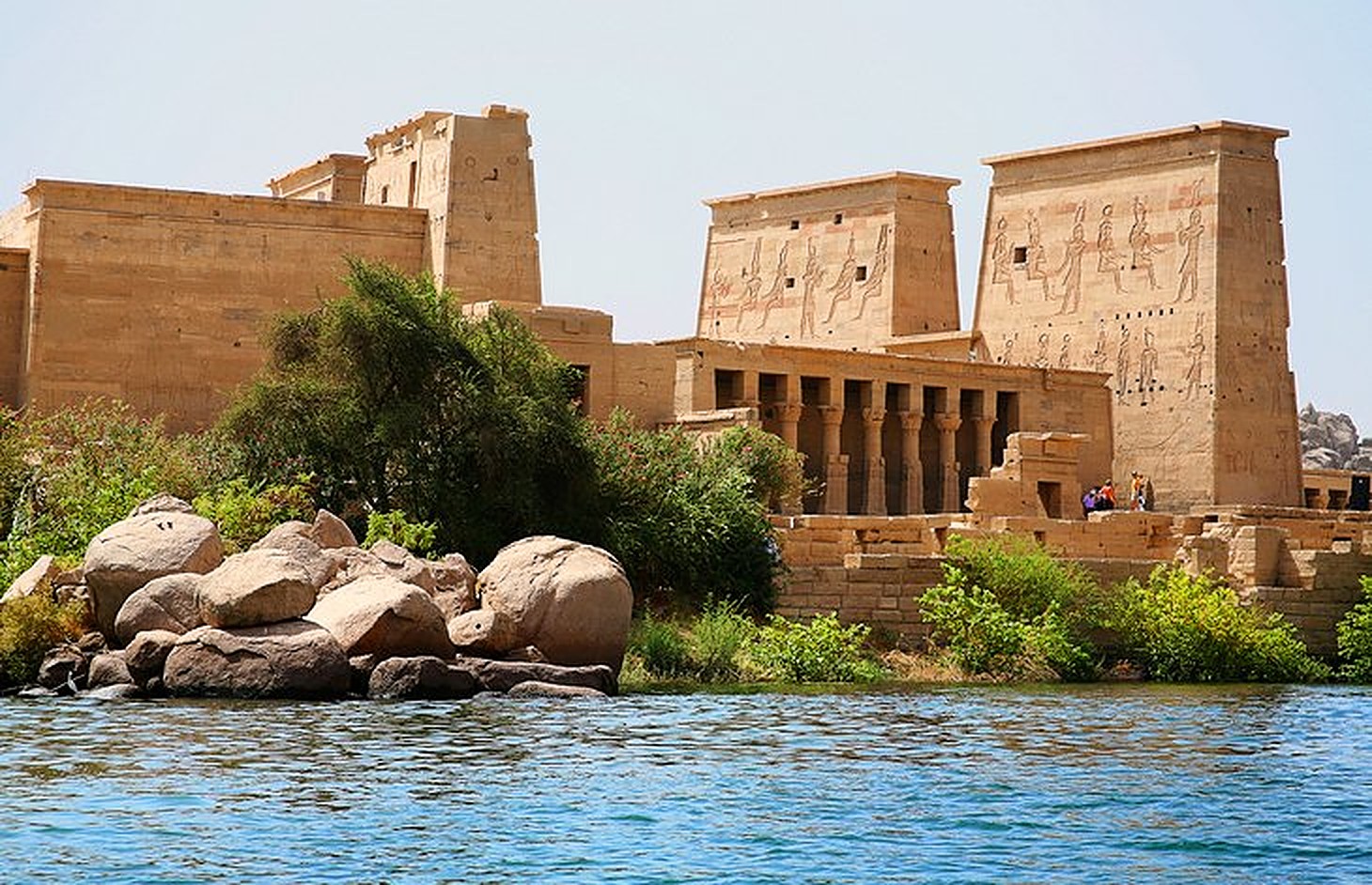
Philae Temple on Agilkia Island in Aswan
Philae Temple is reached by boat across the Nile near Aswan.

The complex is best known for the Temple of Isis, developed over
several centuries and especially important during the Ptolemaic and
Roman periods. Isis was associated with motherhood, protection, healing,
royal legitimacy, and the story of Osiris and Horus. As you pass through
the first pylon, the space opens into courtyards, colonnades, chambers,
relief-covered walls, and quieter areas where later religious
communities also left traces.

Philae has another extraordinary history. When rising water
threatened Nubian monuments in the twentieth century, an international
campaign dismantled and reconstructed the complex on higher ground at
Agilkia. The move preserved the major buildings while changing their
physical setting. Knowing this does not weaken the experience; it makes
the island a powerful place to think about archaeology, engineering,
cultural memory, and the cost of large development projects.

Allow around two to three hours for the complete experience,
including the boat journey. Early morning offers cooler temperatures and
softer light. A late-afternoon visit can be beautiful, but opening times
and the Sound and Light schedule change, so confirm current details
shortly before going.

If you prefer simple logistics, an Aswan
to Philae Temple private transfer
can combine an
air-conditioned car or van with the private return boat to Agilkia
Island. This is particularly useful for families, small groups, or
travelers who want to control their departure time.

2. Understand
Nubian History at the Nubian Museum

The Nubian Museum is not an optional rainy-day attraction. It is one
of the most important places to visit in Aswan because it gives context
to almost everything around you. Its displays trace Nubian life from
prehistory through ancient kingdoms, Pharaonic and Greco-Roman
connections, Christian and Islamic periods, and the modern
transformation of the region.

The museum’s architecture and landscaped grounds draw on the granite,
water, village forms, and desert landscape of Nubia. Inside, sculptures,
pottery, jewelry, tools, textiles, inscriptions, photographs, and
reconstructed scenes help visitors understand both archaeology and daily
life. One of the most moving parts of the story concerns the communities
relocated when the Aswan High Dam and Lake Nasser changed the valley.
The rescue of temples is famous; the human experience of displacement
deserves equal attention.

Plan at least 90 minutes, and closer to two hours if you enjoy
museums. It pairs well with the Unfinished Obelisk because both lie on
the eastern side of the city and reveal different aspects of Aswan’s
identity. Check the official Egyptian monuments platform for current
opening hours and tickets, as schedules can change.

3.
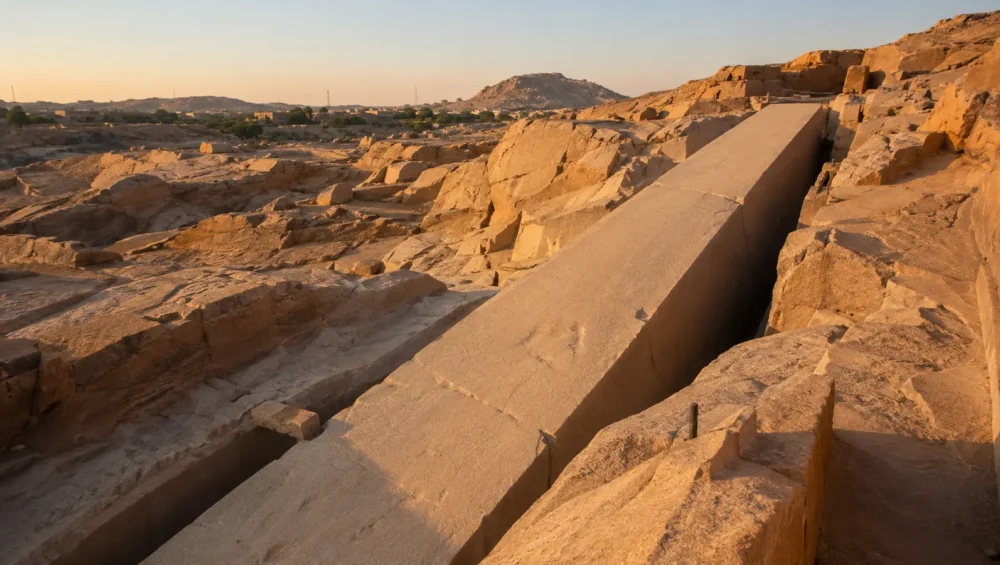
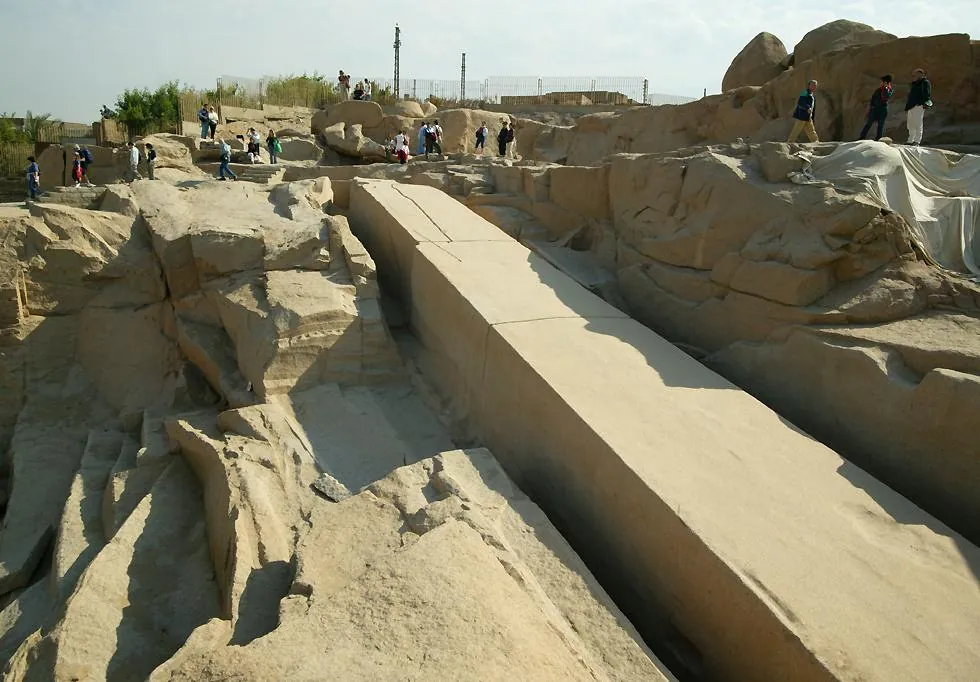
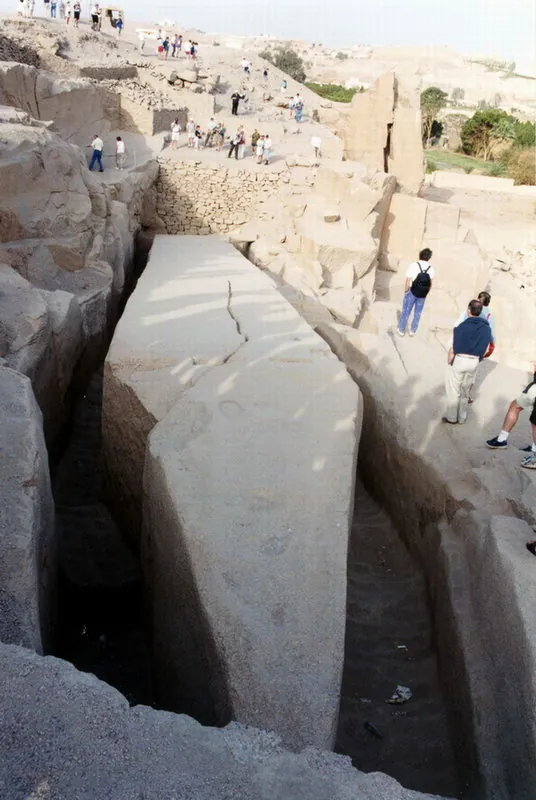
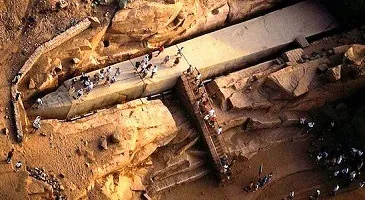
Walk Through an Ancient Quarry at the Unfinished Obelisk

At first glance, the Unfinished Obelisk may look like a single
abandoned block of stone. In reality, the quarry is one of the clearest
windows into ancient Egyptian engineering. The enormous obelisk remains
attached to the bedrock because cracks appeared during its creation. Its
unfinished state allows you to see the channels, working surfaces, and
sequence of extraction that a completed monument would hide.

Aswan’s pink and red granite traveled throughout Egypt. Statues,
sarcophagi, columns, shrines, and obelisks were cut here and transported
north. Standing above the unfinished stone encourages practical
questions: How did workers separate such a mass from the quarry? How was
it shaped? How would it have been moved to the river? Archaeologists
continue to study these processes, and simple explanations involving one
magical technique should be treated cautiously.

The site is exposed, with uneven granite underfoot and limited shade.
Visit in the morning, wear shoes with a good grip, and bring water.
Forty-five minutes to an hour is usually enough, but anyone interested
in stoneworking may want longer.

4. Cross to
Elephantine Island and Slow Down

Elephantine Island sits in the Nile opposite central Aswan, yet
crossing by local ferry can feel like entering another rhythm of life.
Narrow lanes pass Nubian homes and gardens. Children walk to school,
residents carry shopping from the ferry, and glimpses of water appear
between walls. The island is not a staged attraction; it is a living
community, so visitors should dress respectfully, ask before
photographing people, and keep voices low in residential areas.

Nile view from Elephantine Island in Aswan
Elephantine Island combines living Nubian neighborhoods with ancient archaeology.

The southern part of the island contains an important archaeological
zone. Ancient island, occupied a strategic
position near Egypt’s southern frontier. The site includes remains
connected with the temples of Khnum and Satet, settlement layers, a
Nilometer, and objects revealing long contact between Egypt, Nubia, Africa and
wider trade routes. The museum and open-air ruins reward travelers who
enjoy places where history is discovered in layers rather than through
one monumental façade.

Elephantine is also excellent for an unhurried walk. Sit at a small
riverside café, notice the granite outcrops beneath modern houses, and
watch boats move through the channels. Our detailed Elephantine
Island guide
explains the island’s history and the
practical route in greater depth.

Allow two to three hours, longer if you want lunch or a slow
afternoon. The public ferry is part of the experience, while a private
motorboat makes it easier to combine Elephantine with the Botanical
Garden or other islands.

5. Visit
Qubbet el-Hawa and the Tombs of the Nobles

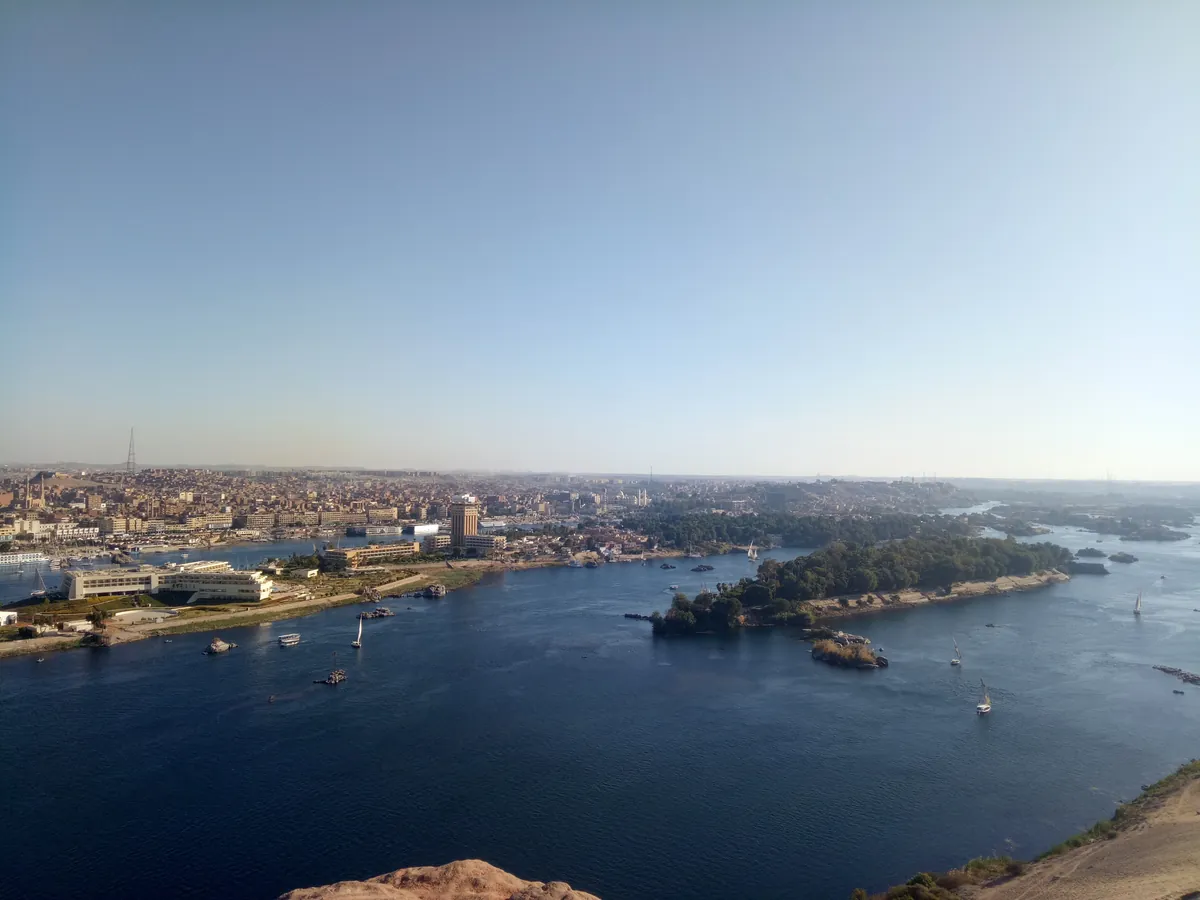
Across the Nile, high on the western bank, rows of tomb entrances cut
into the hillside at Qubbet el-Hawa. The name is often translated as the
Dome of the Winds, and the climb explains why: the view opens across
Elephantine, the modern city, and the river channels below.

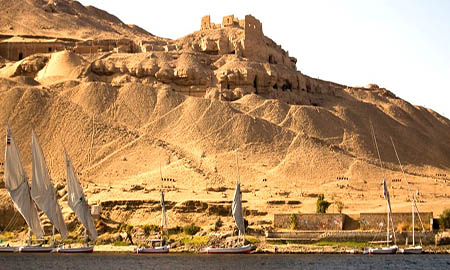
Qubbet el-Hawa Tombs of the Nobles in Aswan
The Tombs of the Nobles overlook the Nile from Aswan’s western bank.

The tombs belonged to governors and officials who controlled Egypt’s
southern frontier during different periods, particularly the Old and
Middle Kingdoms. Their inscriptions and scenes reveal expeditions,
family relationships, titles, religious beliefs, and contact with lands
to the south. These were people responsible for trade, diplomacy,
resource movement, and royal authority in a complex border region.

Qubbet el-Hawa feels more intimate than a major temple. You climb
through sand and rock, enter chambers cut for individual families, and
then step back into brilliant sunlight. Not every tomb is always open,
and access conditions can change, so check locally. The path involves
stairs and uneven surfaces. Wear secure shoes and avoid the hottest part
of the day.

Read our full Qubbet
el-Hawa guide
before visiting. Two hours is a useful
allowance, including the boat crossing and climb.

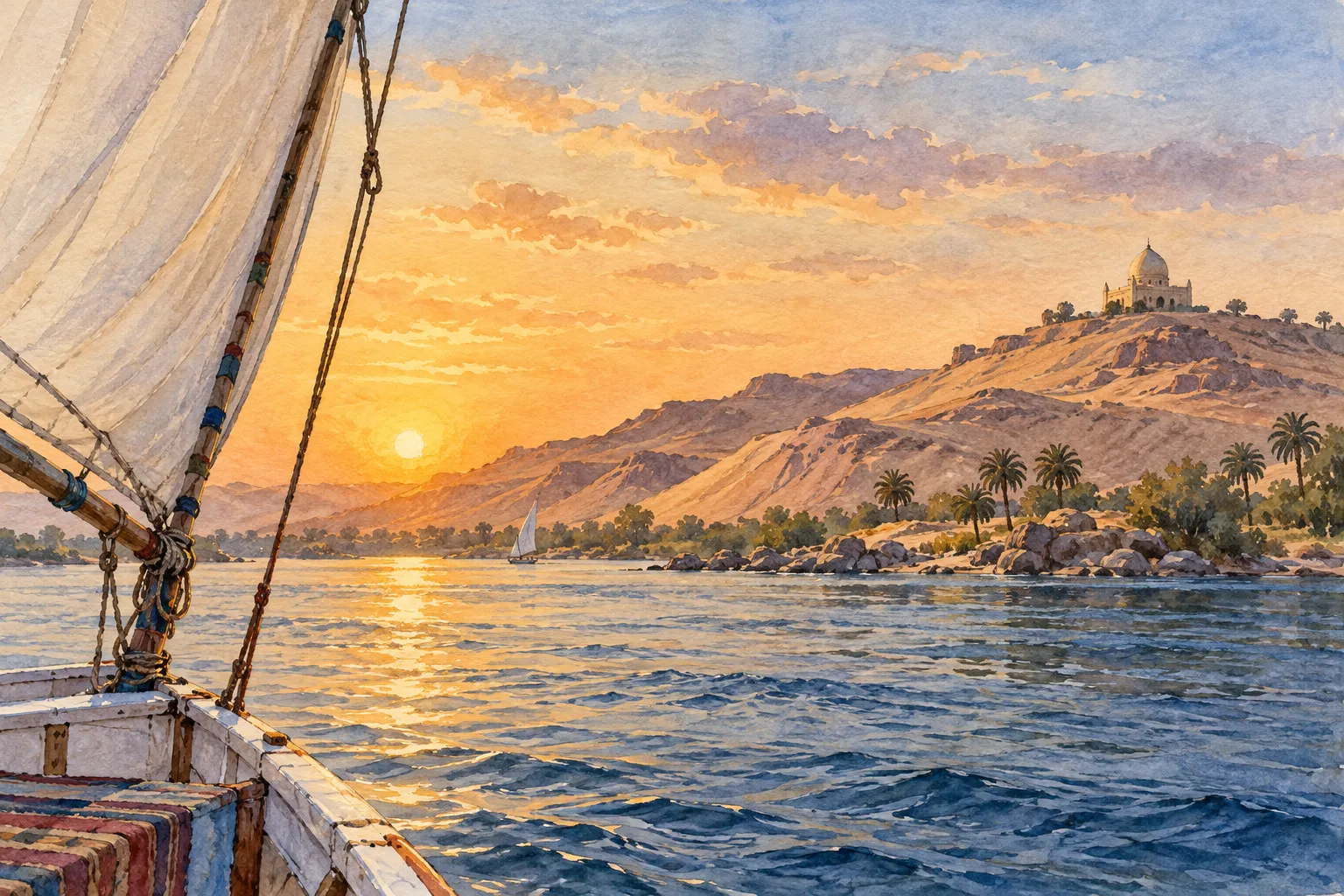
6. Sail a Felucca at Sunset

Few experiences capture Aswan more simply than a felucca ride. These
traditional sailboats use the wind rather than an engine, so the journey
follows the conditions of the river. When the breeze is steady, the boat
leans gently and glides between islands. When it falls, the pace becomes
very slow. That uncertainty is part of the experience.

A sunset sail can pass Elephantine, the Botanical Garden, the
western-bank dunes, and small granite islands. The city becomes quieter
on the water, and the last light warms the desert while the river turns
silver and blue. Bring a light layer in winter because the temperature
can drop quickly after sunset.

Agree on the duration, route, total price, and return point before
departure. A one-hour sail is relaxing; two or three hours allow you to
move beyond the busiest waterfront. Feluccas are not the best choice
when you must reach a ticketed site at an exact time. For fixed
schedules or places requiring a direct crossing, use a motorboat.

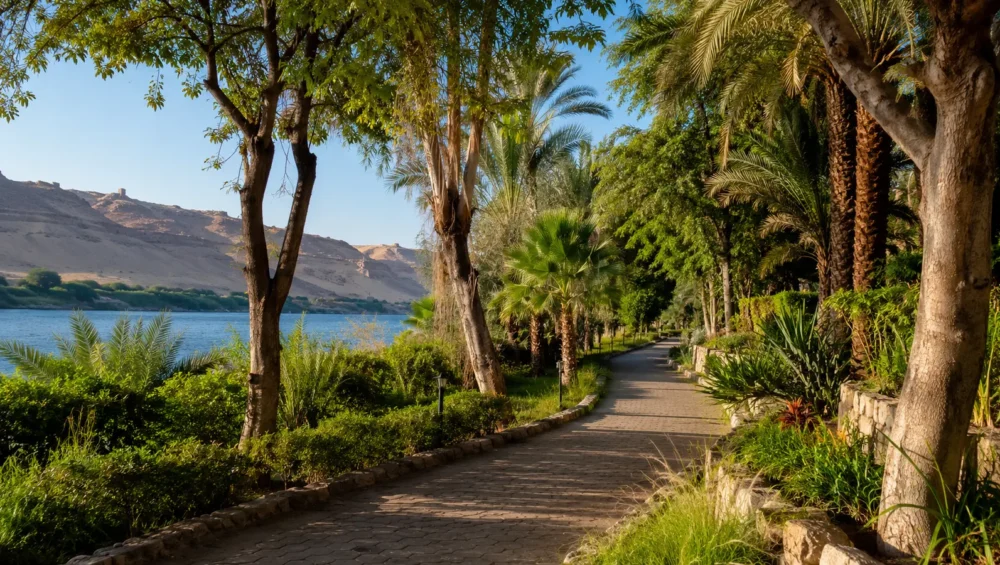
7. Explore the Aswan
Botanical Garden

Kitchener’s Island, officially known as the Aswan Botanical Garden,
forms a green strip in the Nile. Paths pass palms, flowering plants, and
trees introduced from different tropical and subtropical regions. After
several days of stone temples and desert roads, the shade and greenery
make a pleasant change.

The garden works well as part of an island-hopping afternoon. Arrive
by felucca or motorboat, walk from one end toward the other, and arrange
for your boat to meet you at the exit. The experience is less about rare
labels and formal botanical interpretation than about atmosphere: birds
in the branches, river views through the foliage, and a cooler path away
from traffic.

Allow about an hour. Conditions, maintenance, and ticket arrangements
can vary, so treat it as a gentle addition rather than the single
centerpiece of a tightly scheduled day.

8. Experience Nubian
Culture with Respect

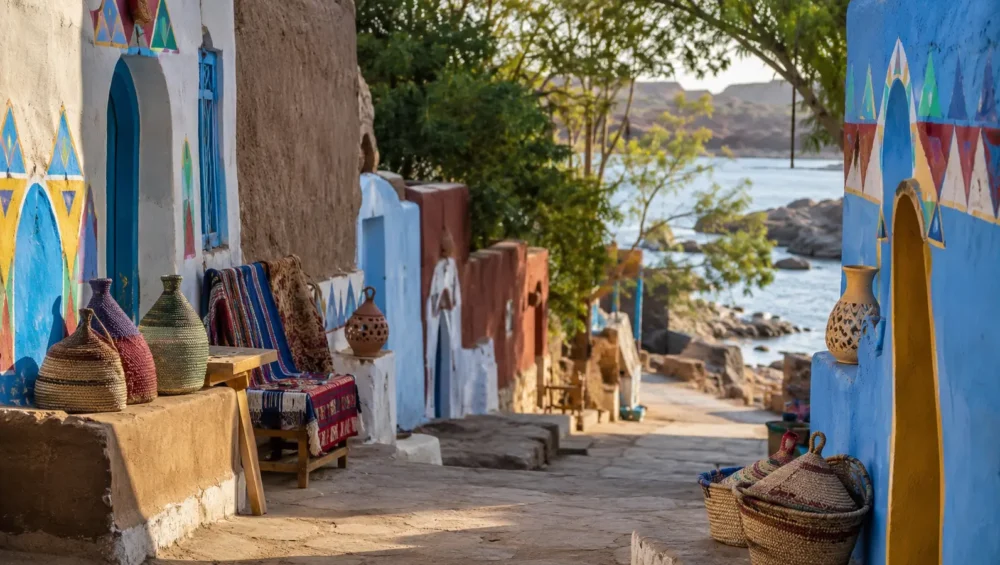
Colorful Nubian villages have become some of Aswan’s most
photographed destinations. Gharb Soheil is the best-known, with painted
houses, riverfront cafés, markets, music, and family-run guest spaces. A
visit can be joyful and memorable, but it should not reduce Nubian
identity to decorative walls and souvenir photographs.

Choose an experience that includes conversation, food, crafts, or
music led by local residents. Ask about language, family history,
architecture, and how communities adapted after relocation. Buy directly
from local makers when possible. Always request permission before
photographing people, especially children or private interiors.

Some venues display live crocodiles. Travelers concerned with animal
welfare may prefer cultural activities that do not rely on captive
animals. A respectful visit supports residents while giving you a more
meaningful understanding of Nubian life.

Combine the village with kayaking, a motorboat ride, or a west-bank
sunset rather than trying to rush it between monuments. Two to three
hours allows time for hospitality instead of treating the community as a
quick photo stop.

9. See the
Aswan High Dam and Think Beyond the View

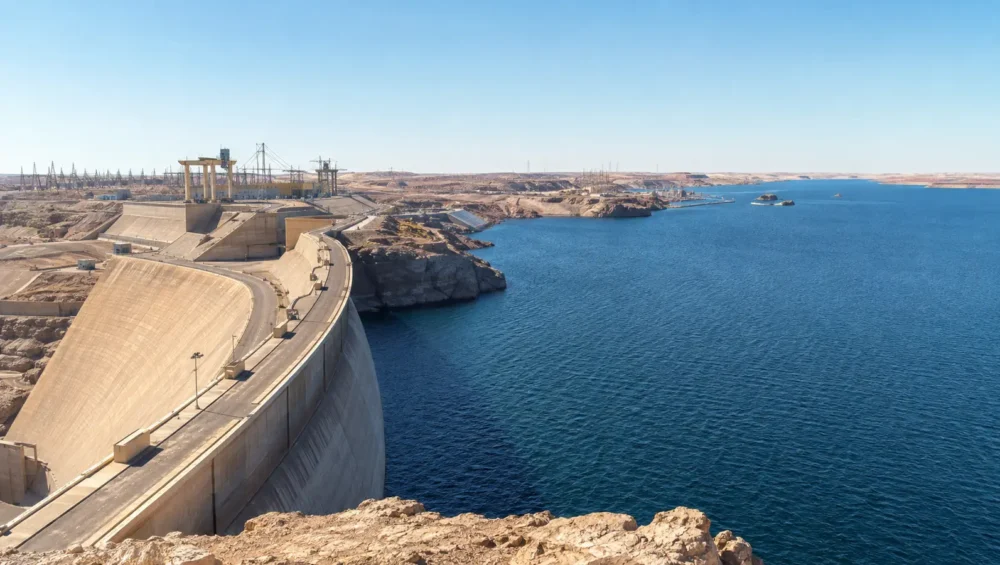
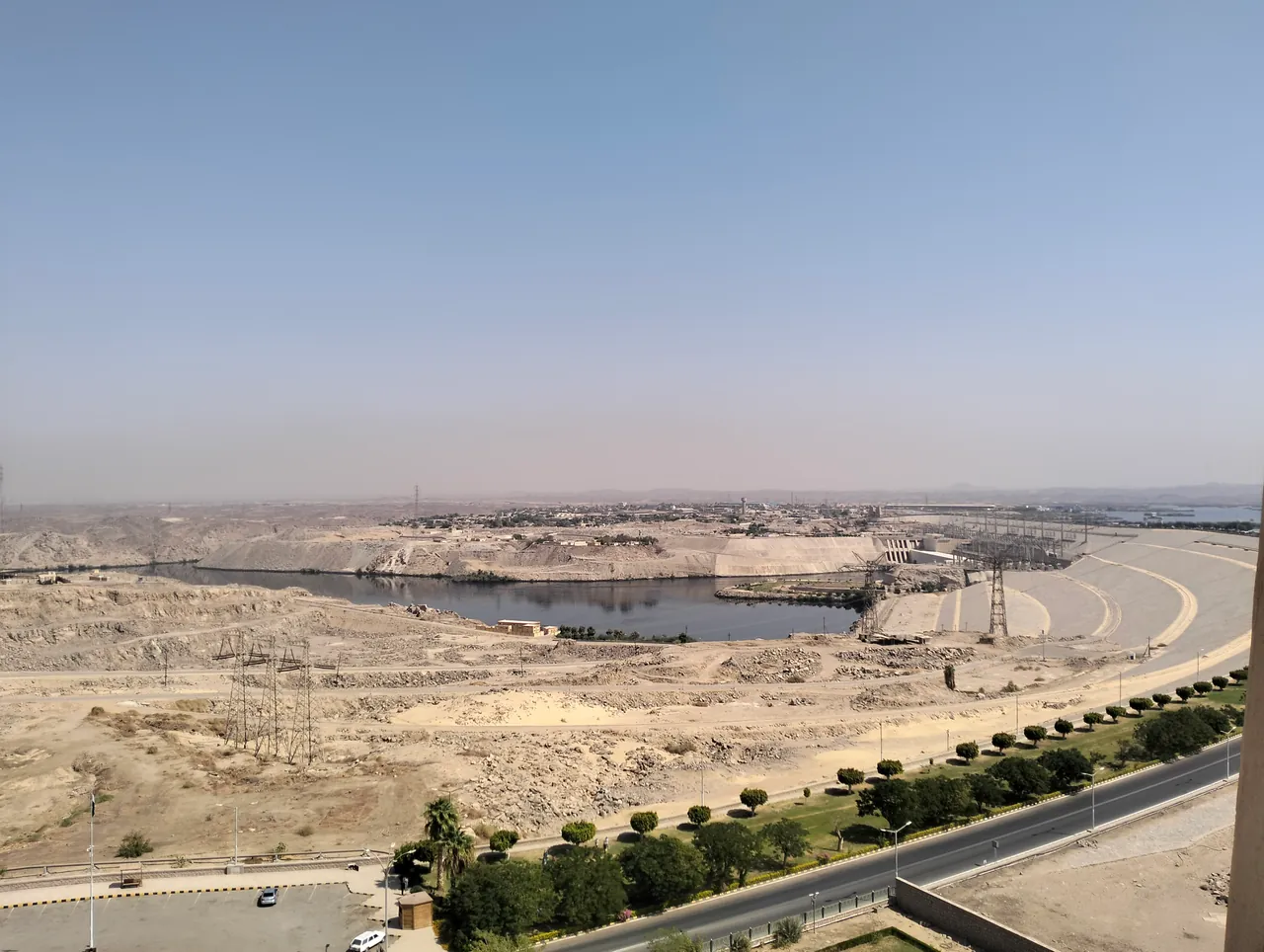
The Aswan High Dam represents one of the most consequential
engineering projects in modern Egypt. Completed in the twentieth
century, it helped regulate the Nile’s flow, generate electricity, and
expand control over irrigation. It also created Lake Nasser, transformed
ecosystems, contributed to the relocation of Nubian communities, and
triggered the international campaign to save threatened monuments.

The viewpoint gives a sense of the dam’s immense scale, but the visit
becomes more valuable when connected with the Nubian Museum and
relocated temples such as Philae and Kalabsha. Together, these places
reveal both the benefits and costs of reshaping a river.

Most travelers spend thirty to forty-five minutes here. Photography
rules can change because the dam is strategic infrastructure, so follow
current instructions. The dam is commonly combined with Philae and the
Unfinished Obelisk, although that creates a full and relatively fast
day.

10.
Discover Kalabsha Temple and Its Neighboring Monuments

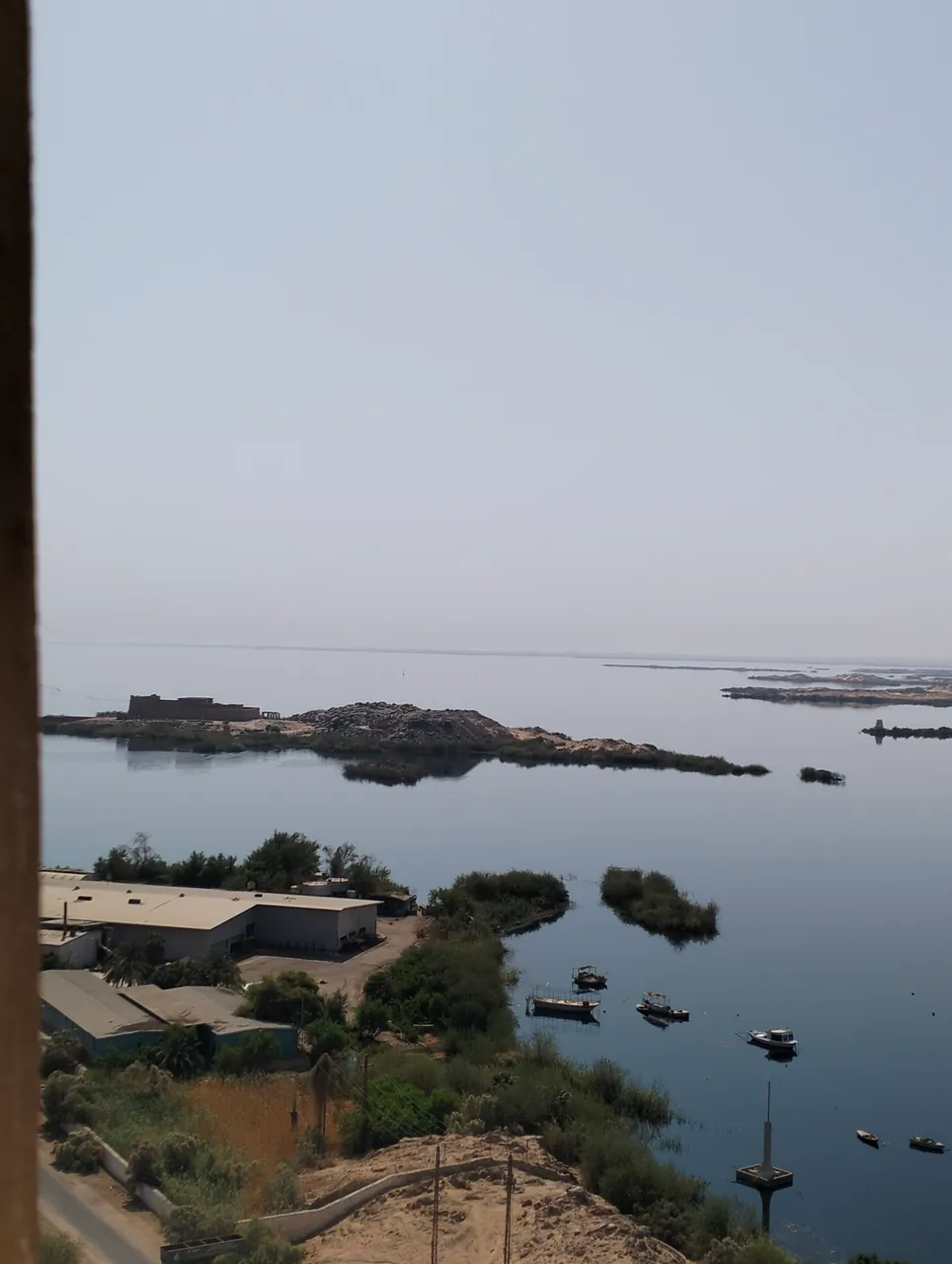
Kalabsha Temple stands near the High Dam in a location reached by
boat. Dedicated primarily to the Nubian deity Mandulis, the visible
temple was developed during the Roman period over an older sacred site.
Its broad courtyards, columns, reliefs, and view across Lake Nasser make
it one of the most impressive yet less crowded Aswan attractions.

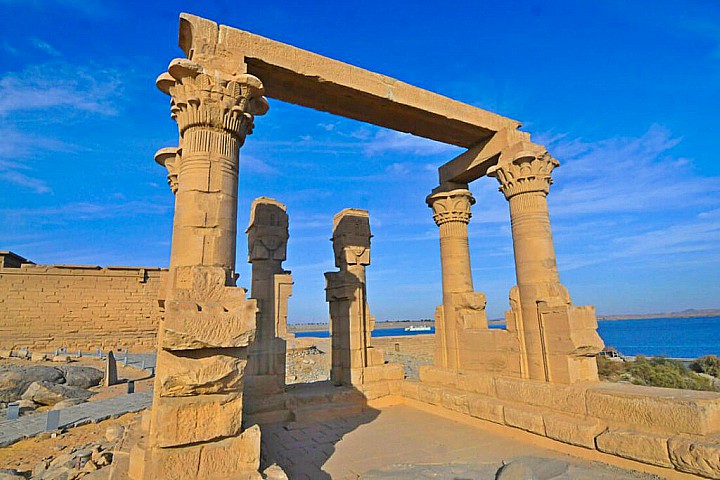
Kalabsha Temple near the Aswan High Dam
Kalabsha Temple was relocated during the international Nubian rescue campaign.

Nearby are the small kiosk of Qertassi and the rock-cut temple of
Beit el-Wali, associated with Ramesses II. Like Philae, these monuments
were moved during the Nubian rescue campaign. Their present arrangement
offers a concentrated lesson in ancient religion and modern
preservation.

Kalabsha is ideal for travelers who enjoy major sites without large
crowds. The boat logistics require planning, which is one reason many
short itineraries omit it. Read our Kalabsha Temple
guide
and allow roughly three hours including road and boat
time.

11. Spend Time in Aswan Souq

Aswan Souq stretches through the city with spices, baskets, textiles,
perfumes, dates, peanuts, hibiscus, clothing, household goods, and
souvenir stalls. Unlike a monument, it does not need a strict route.
Enter in the late afternoon, walk slowly, and notice which parts serve
local residents and which focus on visitors.

Hibiscus, known as karkadeh, is closely associated with southern
Egypt and makes a practical gift. Spices should smell fresh rather than
dusty, and packaged food is easier to carry. Bargaining is common for
many tourist goods, but keep the exchange friendly. A fair purchase is
more important than winning the smallest possible price.

The souq becomes lively in the evening when the heat softens. Keep
normal city awareness, protect valuables in crowded sections, and ask
before photographing vendors. One to two hours is enough for a first
visit, though food lovers may return more than once.

12. Have Tea Beside the Nile

Not every memorable Aswan activity needs an entrance ticket. A quiet
hour beside the river can reveal more of the city than another hurried
stop. Choose a terrace or café with a view of Elephantine and watch
ferries, fishing boats, feluccas, and motorboats cross in different
directions.

The historic Sofitel Legend Old Cataract Aswan is famous for its
architecture, gardens, river views, and associations with writers and
travelers. Non-resident access, dining reservations, dress expectations,
and minimum charges can change, so contact the hotel directly rather
than assuming you can walk in. There are also simpler local cafés where
tea, coffee, or fresh juice comes with an equally absorbing view.

13. Visit the Monastery of
St. Simeon

Beyond the western-bank dunes stand the remains of the Monastery of
St. Simeon, also called Anba Hadre. The fortified complex developed as
an important Christian monastic center and includes churches, cells,
service areas, and defensive walls. Its desert setting gives the visit a
powerful sense of distance from the river city.

Reaching the monastery usually involves a boat crossing followed by a
walk, vehicle arrangement, or camel ride depending on the route and
current access. Choose animal rides only when the animal appears healthy
and well treated. The site is exposed, so morning is best and sun
protection is essential.

Allow two to three hours including transport. Travelers interested in
Egypt’s Christian history will find it especially rewarding, and the
combination with Qubbet el-Hawa can make a strong west-bank day if
energy and temperatures permit.

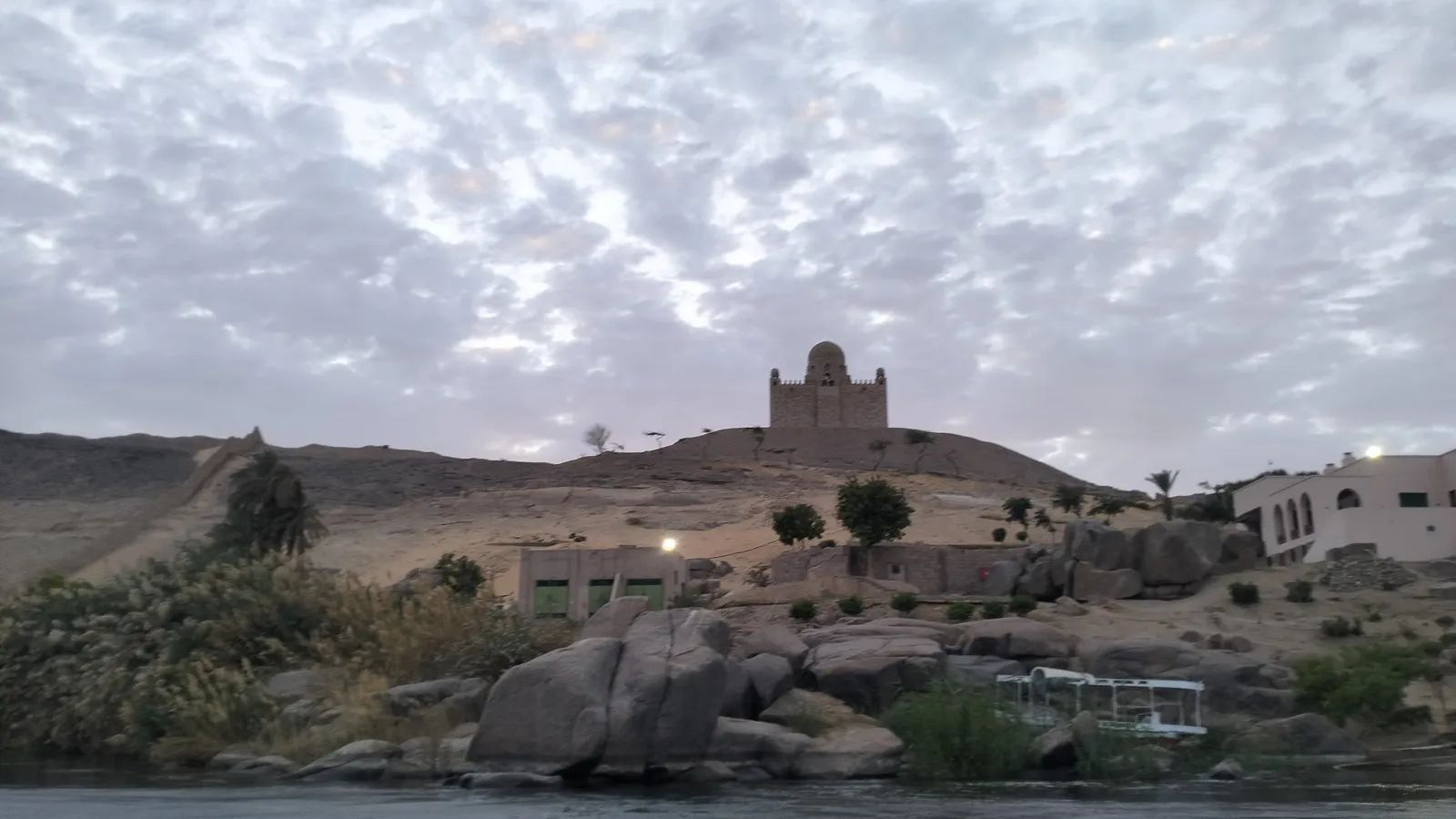
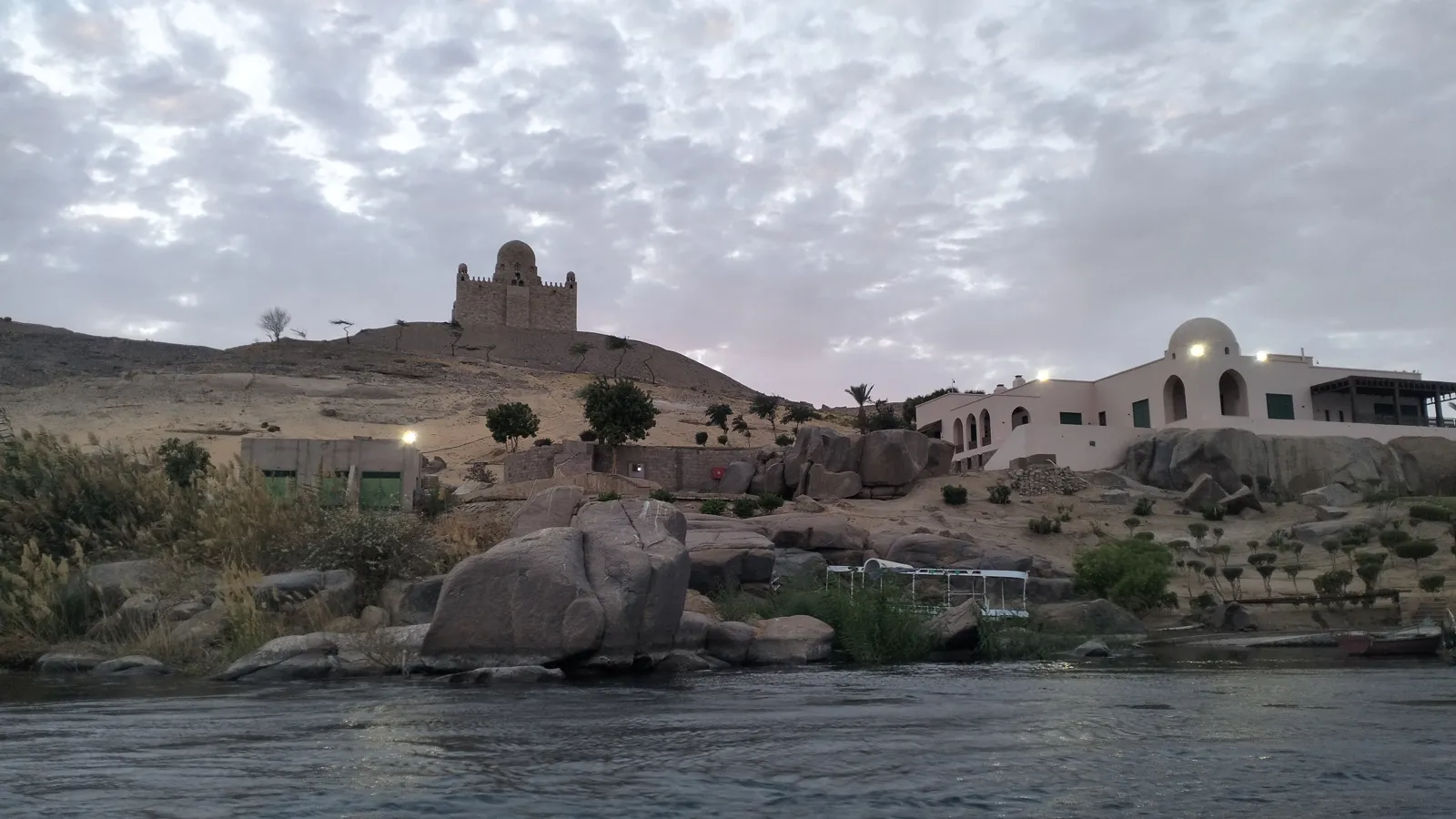
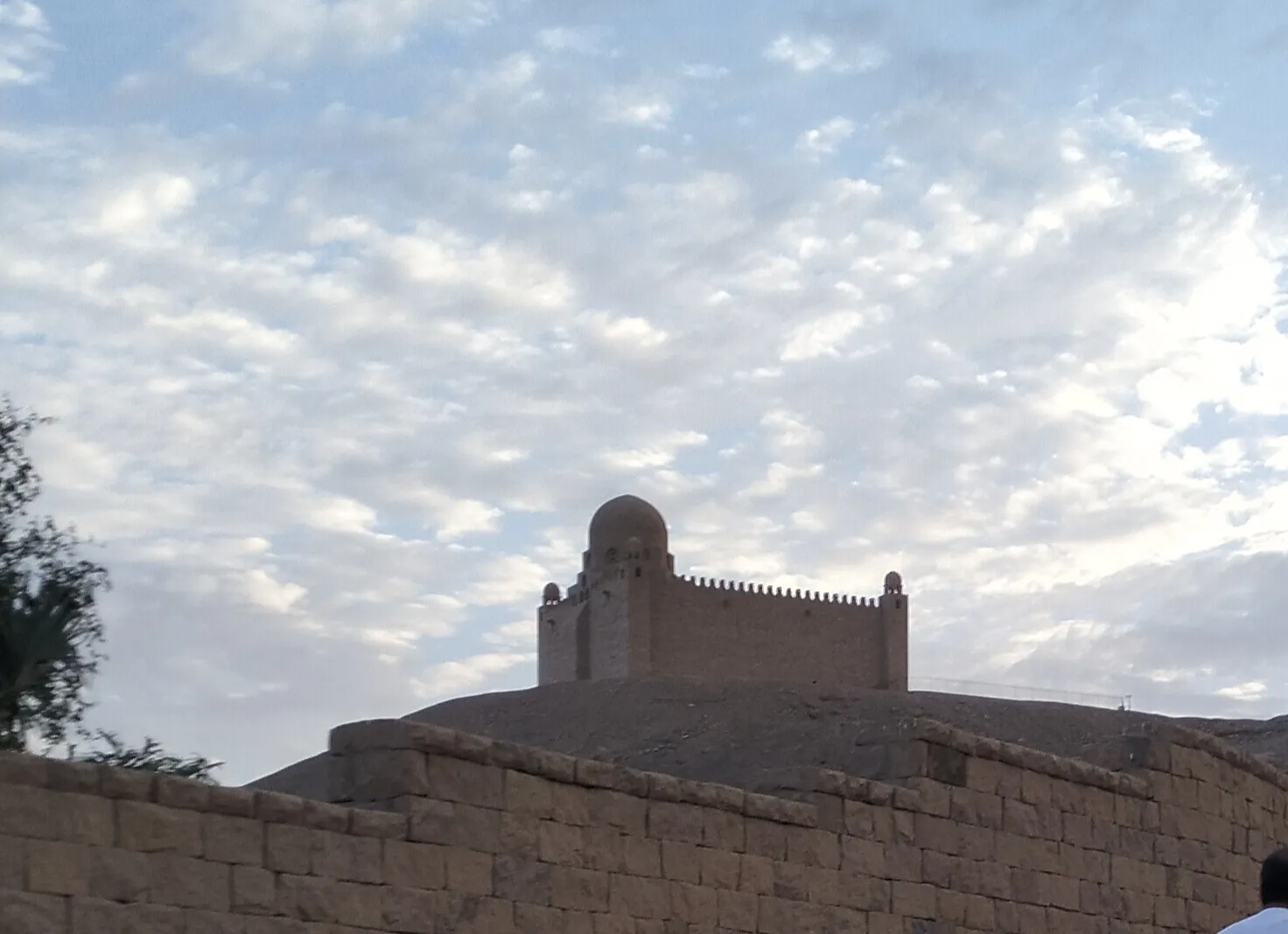
14. View the Aga
Khan Mausoleum from the Nile

The pale stone Aga Khan Mausoleum stands prominently on the western
bank above the river. It is associated with Aga Khan III, a major
twentieth-century leader of the Nizari Ismaili community. The building’s
position makes it one of Aswan’s most recognizable landmarks, especially
in late-afternoon light.

Public access has often been restricted, so do not plan an itinerary
that depends on entering. Instead, appreciate the mausoleum from a
felucca, motorboat, Elephantine Island, or the eastern waterfront. A
responsible guide should describe it as a landmark view unless current
access has been confirmed.

15. Go Kayaking on the Nile

Kayaking reveals a different Aswan. Sitting close to the water, you
can enter channels that larger boats pass too quickly. Granite boulders
rise beside the kayak, reeds move at the island edges, and the sound of
traffic fades. Depending on the route, paddlers may see Elephantine,
Nubian villages, west-bank dunes, small islands, and river birds.

Kayaking between Nile islands in Aswan
Kayaking offers a close-to-the-water view of Aswan’s granite islands.

Beginners should use an established operator that provides a properly
fitted life jacket, stable equipment, a safety briefing, and a local
guide familiar with currents and boat traffic. Wind can strengthen
during the day, and the Nile is a working river, not a closed lake.
Early morning or late afternoon often offers more comfortable
conditions, but the guide should make the final decision based on
weather and water.

Do not carry loose valuables. Use a waterproof phone pouch, sun
protection, quick-drying clothing, and secure footwear. If you cannot
swim confidently, tell the operator in advance. A one-hour session is
enough for a first experience; two to three hours suits active travelers
who want to explore farther.

Kayaking is one of the best things to do in Aswan for travelers who
want a physical activity without leaving the city. It also creates a
natural break between temple-heavy days.

16. Try Fishing with a Local
Expert

Fishing with a local expert on the Nile in Aswan
A quiet early-morning fishing experience reveals another side of the Nile in Aswan.

Fishing has long been part of life along the Nile. For visitors, the
value lies less in chasing a guaranteed catch than in spending quiet
time on the water with someone who understands local channels, seasons,
methods, and conditions. A morning with a local fisherman can become a
lesson in the river itself.

Arrange the experience through a reputable local contact who can
confirm where visitor fishing is appropriate and whether any current
permissions or restrictions apply. Avoid protected areas, respect catch
limits and local practices, and never leave line, hooks, or plastic
behind. Responsible operators should not promise a particular species or
quantity.

Early morning is usually the most comfortable time. Bring sun
protection and drinking water, and ask whether equipment is provided.
Fishing can also suit families with older children, provided the boat
has safety equipment and the activity is supervised carefully.

17. Watch Birds and
Seasonal Migration

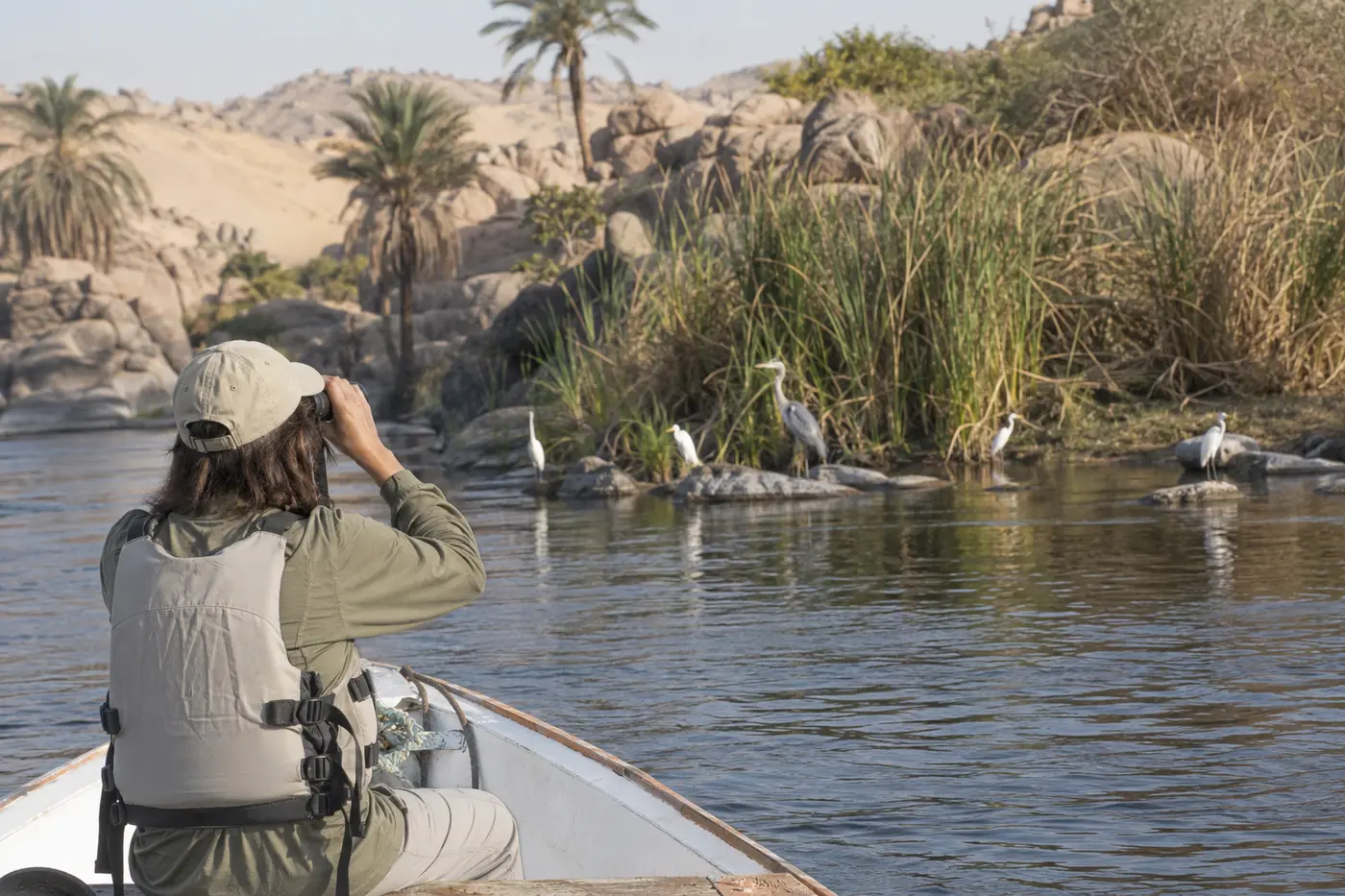
Birdwatching among the Nile islands of Aswan
Responsible birdwatching keeps a safe distance from herons, egrets, and other Nile wildlife.

Aswan’s islands, reeds, gardens, mud edges, and quieter river
channels create habitat for resident and migratory birds. The region
lies along routes connecting Africa, the Mediterranean, Europe, and
western Asia, so the cooler months and migration periods can bring
changing species to the Nile corridor.

You do not need to be an expert birdwatcher. A small pair of
binoculars and a slow boat ride can reveal herons, egrets, kingfishers,
waders, raptors, and other water-associated birds, though sightings vary
by season, water level, time, and luck. Saluga and Ghazal islands are
widely associated with protected natural habitat near Aswan; visits
should follow current environmental rules and avoid disturbing nesting
or feeding areas.

Early morning is best for activity, cooler weather, and softer light.
Ask the boat operator to reduce speed near birds and never request that
someone chase a flock for photographs. Use a telephoto lens rather than
approaching nests. Recorded bird calls should be avoided because they
can disrupt feeding and territorial behavior.

Birdwatching pairs naturally with kayaking, the Botanical Garden, or
a quiet motorboat route around the islands. It offers a refreshing
perspective on Aswan as an ecosystem rather than only an archaeological
destination.

18.
Photograph Sunrise, Sunset, and the Desert Light

Aswan rewards photographers because water, granite, palms, sails, and
desert occupy the same frame. At sunrise, the eastern light reaches the
western dunes and Qubbet el-Hawa. At sunset, feluccas become silhouettes
and the river reflects warm colors. After dark, the contrast between
illuminated boats and the quiet islands can be beautiful.

The best photograph often comes from waiting rather than visiting
another location. Choose one viewpoint, observe the movement of boats,
and allow the light to change. Ask permission before photographing
residents or working fishermen, and follow current rules at
archaeological and strategic sites. Drones are subject to strict
Egyptian regulations and should never be used without the required
official permissions.

19. Take a Desert Walk
on the West Bank

The western bank gives you quick access to a landscape that feels far
from the city. Sandy paths and dunes rise behind the river, offering
wide views over islands and Aswan’s skyline. A short walk near sunset
can be enough; longer routes should be arranged with someone who knows
the area.

Desert heat and dehydration are serious risks. Avoid midday, carry
more water than you think you need, use sun protection, and tell someone
your route. Sand can make distances deceptive. Travelers with mobility
limitations may prefer a boat-based sunset view.

Camel rides are available in some areas. If you choose one, agree on
the route and price in advance and assess the animal’s condition. Do not
ride an animal that appears injured, exhausted, or poorly handled.

20. Make a Day Trip to Abu
Simbel

Abu Simbel lies far south of Aswan near Lake Nasser, but it is one of
the region’s defining experiences. The Great Temple of Ramesses II
presents four colossal seated figures across its façade, while the
neighboring temple honors Queen Nefertari and the goddess Hathor. Their
scale expresses royal power, but the interior reliefs, sacred alignment,
and surrounding landscape deserve as much attention as the famous
exterior.

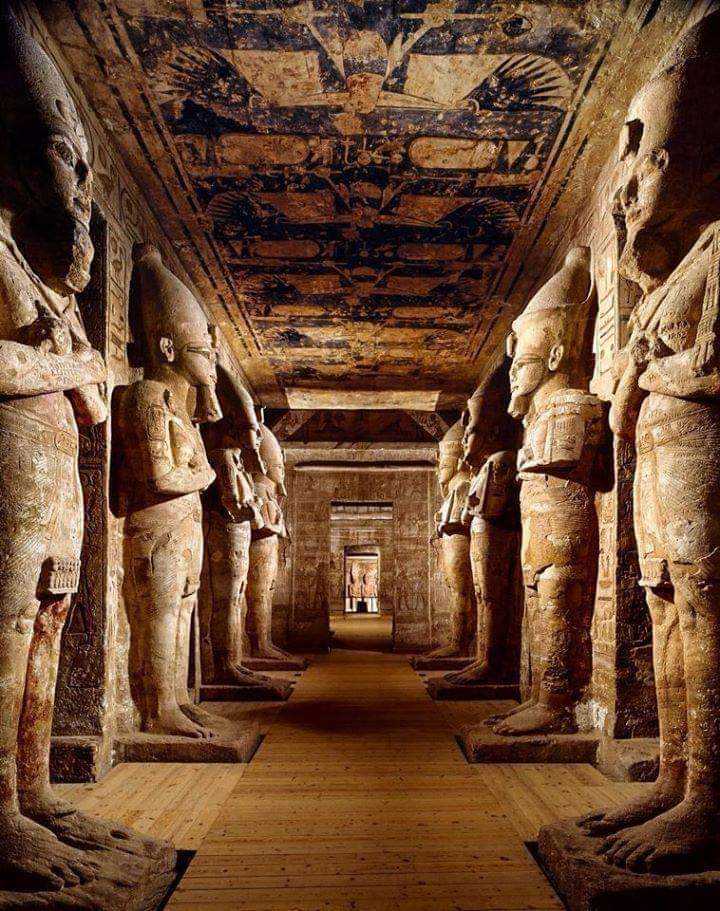
Great Temple of Ramesses II at Abu Simbel
Abu Simbel is a long but unforgettable day journey from Aswan.

The temples were cut into a new artificial hill during the
international rescue campaign, saving them from the rising waters of
Lake Nasser. The modern relocation is itself a remarkable chapter in
heritage preservation.

Road journeys commonly begin very early and take roughly three to
four hours each way depending on conditions and checkpoints. A private
Aswan
to Abu Simbel transfer
gives you control over pickup,
comfort stops, and the return rather than making the day feel like a
race. Read our complete Abu Simbel
guide
before departure and confirm current tickets and
opening hours officially.

21. Follow the Nile North
to Kom Ombo

Kom Ombo Temple stands beside the Nile north of Aswan and is unusual
for its paired arrangement associated principally with Sobek and Horus
the Elder. The reliefs include ritual scenes, calendars, and images
frequently discussed in connection with medicine, although popular
interpretations sometimes go beyond what the evidence securely
proves.

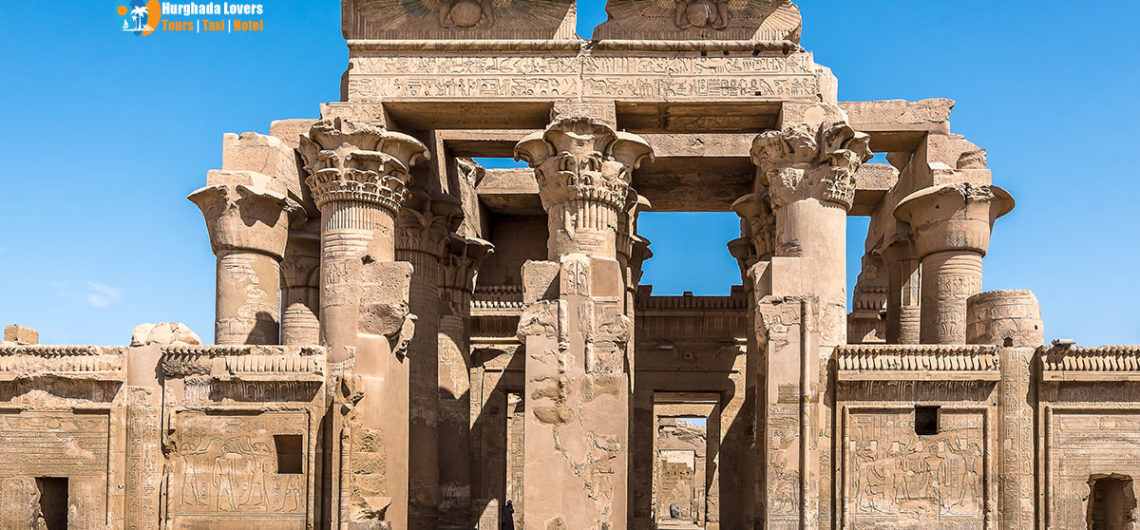
Kom Ombo Temple beside the Nile north of Aswan
Kom Ombo can be visited on the road or river journey toward Luxor.

The adjacent Crocodile Museum helps explain Sobek’s cult and displays
mummified crocodiles. Kom Ombo can be visited as a half-day outing, a
cruise stop, or part of an overland journey toward Luxor. Our Kom
Ombo Temple guide
provides historical context.

22. Continue to Edfu
on the Road to Luxor

Farther north, Edfu Temple preserves one of Egypt’s most complete
temple sequences. Its towering pylon, sunlit courtyard, hypostyle halls,
ritual chambers, granite naos, and reliefs connected with Horus make the
architecture easy to follow from public space toward the sanctuary.

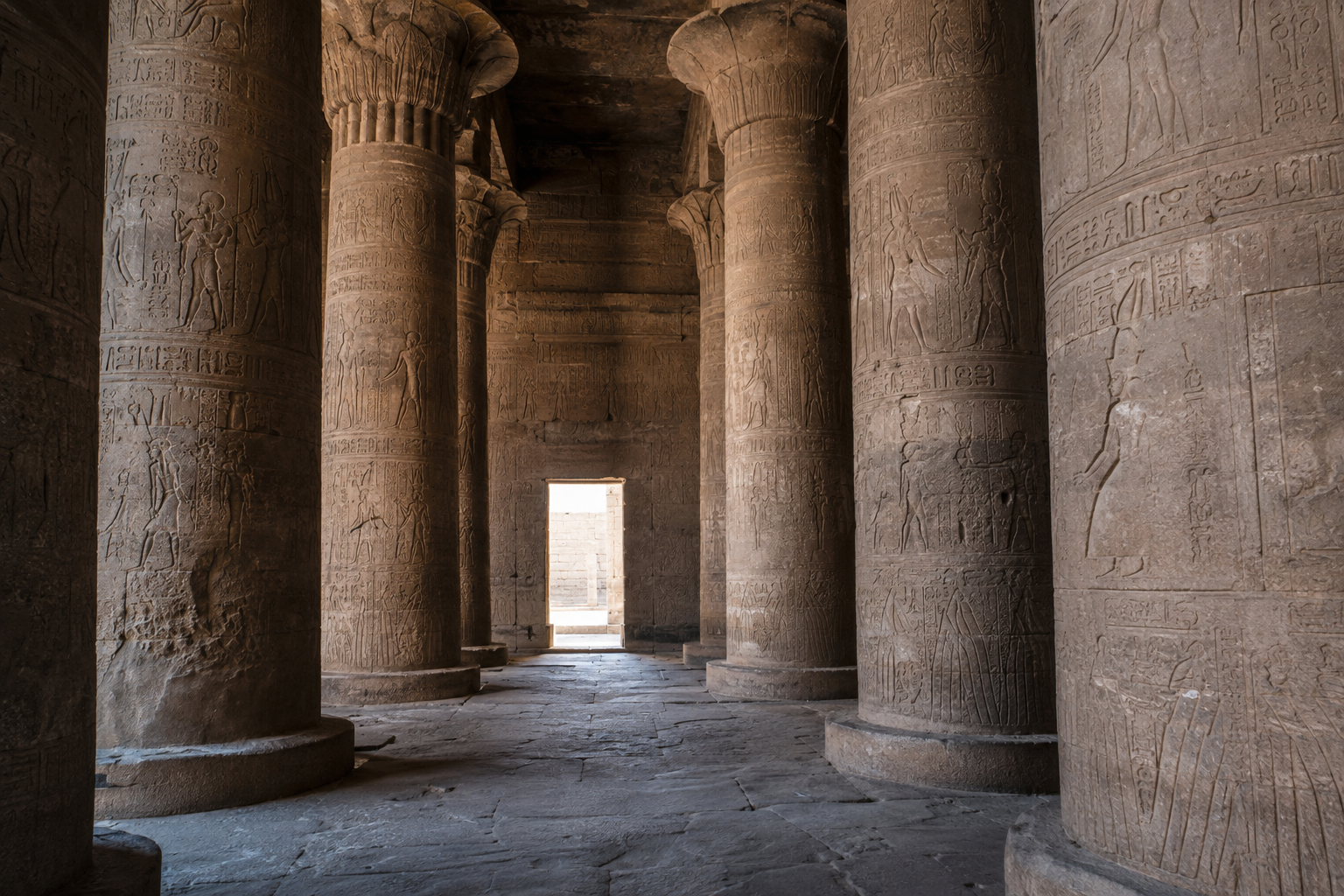
Columns inside the hypostyle hall of Edfu Temple
Edfu preserves one of Egypt’s most complete temple interiors.

Edfu is best treated as part of a full transfer day between Aswan and
Luxor rather than a quick return outing. Travelers using an Aswan
to Luxor private transfer
can request stops at Kom Ombo and
Edfu, subject to timing and opening hours. Our detailed Edfu Temple
guide
helps you recognize the major spaces before
arrival.

How Many Days Do You Need in
Aswan?

One Day in Aswan

With one full day, choose quality over quantity. Visit Philae early,
continue to the Unfinished Obelisk, and spend the late afternoon at the
Nubian Museum. End with the souq or a short felucca sail. The High Dam
can be included, but adding every classic stop creates a rushed
schedule.

Two Days in Aswan

Use the first day for Philae, the Unfinished Obelisk, and the Nubian
Museum. On the second, cross to Elephantine Island, explore its
archaeological zone and villages, then sail at sunset. This plan
balances monuments, living culture, and the Nile.

Three Days in Aswan

Add Qubbet el-Hawa, St. Simeon’s Monastery, Kalabsha, or a Nubian
village according to your interests. Active travelers can replace one
site with kayaking or birdwatching. Three days is the best first-time
balance for many visitors.

Four or Five Days in Aswan

Add Abu Simbel without sacrificing the city. You will also have room
for the Botanical Garden, fishing, a longer felucca sail, photography,
or an unplanned afternoon. This slower schedule is especially
comfortable for families and travelers visiting in warmer weather.

Best Time to Visit Aswan

Aswan is generally most comfortable from late autumn through early
spring, when daytime temperatures are milder and outdoor activities are
easier. Winter is popular, especially around Christmas and New Year, so
book key transport and accommodation early. Nights on the river can feel
cool even after a sunny day.

Spring and autumn can be excellent but temperatures vary. Summer is
extremely hot. If you visit then, begin archaeological sites at opening
time, rest during the middle of the day, drink water regularly, and plan
museums or shaded activities for the afternoon. Heat changes what is
realistic; a short, enjoyable itinerary is safer than trying to copy a
winter schedule.

Bird migration and wildlife sightings do not follow a guaranteed
tourist calendar. Seasonal patterns, water conditions, and weather all
matter. Contact a knowledgeable local guide shortly before the visit if
birdwatching is a priority.

Getting Around Aswan

Aswan uses several forms of transport, and choosing the right one
makes planning easier.

  • Local ferry: Affordable and atmospheric for
    Elephantine and parts of the west bank. Ferries follow local routes
    rather than custom itineraries.
  • Motorboat: Best for direct island crossings,
    Philae, Nubian villages, and combinations requiring fixed timing.
    Confirm whether the quoted price is one way or return.
  • Felucca: Ideal for relaxed sailing, not for a
    strict appointment when wind conditions matter.
  • Taxi or private car: Useful for the airport, Nubian
    Museum, Unfinished Obelisk, High Dam, Philae marina, and longer road
    journeys.
  • Walking: Practical in parts of central Aswan and
    the souq, but heat and uneven pavements can make distances harder than
    they appear.

If you are arriving by air, pre-arranging an Aswan
Airport transfer
removes the need to negotiate after a
flight and makes hotel or Nile-cruise pickup clearer. For day trips, ask
whether waiting time, parking, boat tickets, and return transport are
included. The cheapest initial quote is not always the simplest complete
journey.

Practical Tips for
Planning Aswan Activities

Check official opening hours close to your travel date. Monument
schedules, ticket categories, photography rules, boat access, and
evening performances can change. Carry some Egyptian cash for small
ferries, cafés, tips, and market purchases, even when larger businesses
accept cards.

Dress for strong sun and cultural respect. Lightweight long sleeves,
a hat, sunglasses, comfortable shoes, and refillable water are useful.
At islands and archaeological areas, paths may include steps, sand, boat
edges, or uneven stone. Ask detailed accessibility questions in advance
rather than relying on a general label.

For families, combine one major monument with one lighter activity
each day. Children often enjoy boats, the museum’s reconstructions, the
Botanical Garden, and short island walks more than a continuous sequence
of temples. Life jackets should be available in appropriate sizes.

Solo travelers will find central Aswan manageable, but normal
precautions apply. Share boat plans, avoid isolated desert routes alone,
and use a trusted driver for very early departures. Women may prefer
pre-arranged transport to reduce negotiation, especially at night.

Above all, leave space. A delayed felucca, a long conversation over
tea, or an unexpected bird sighting is not time lost. These are often
the moments travelers remember most.

Frequently
Asked Questions About Things to Do in Aswan

What
are the top things to do in Aswan for a first visit?

Start with Philae Temple, the Nubian Museum, the Unfinished Obelisk,
Elephantine Island, a felucca sail, and either Qubbet el-Hawa or a
respectful Nubian cultural experience. Add Abu Simbel if you have an
extra full day.

Is Aswan
worth visiting if I have already seen Luxor?

Yes. Luxor is famous for monumental temples and royal tombs, while
Aswan offers a different landscape and history shaped by Nile islands,
Nubian culture, frontier archaeology, granite quarries, relocated
monuments, and smaller-scale river experiences.

How many days should I
stay in Aswan?

Three days works well for most first-time visitors. Add a fourth day
for Abu Simbel or for a slower pace with kayaking, fishing,
birdwatching, and island exploration.

Can I visit Philae
Temple without a boat?

No. The temple complex is on Agilkia Island, so the final approach is
by boat. Confirm whether your arrangement includes a private return boat
and waiting time.

Are
kayaking and fishing in Aswan suitable for beginners?

They can be when arranged with experienced local providers using
suitable safety equipment. Conditions vary with wind, currents, boat
traffic, and season, so follow local guidance and do not treat the Nile
as a controlled swimming pool.

When is the
best time for birdwatching in Aswan?

Early morning is usually best, while cooler months and migration
periods may bring additional species. Sightings are never guaranteed.
Choose quiet island channels, keep your distance, and avoid disturbing
feeding or nesting birds.

Can Aswan, Kom Ombo,
and Edfu be combined?

Kom Ombo and Edfu fit naturally into an overland transfer from Aswan
to Luxor. Trying to visit both and return to Aswan makes a long day.
Check opening hours and agree on waiting time before departure.

Is Abu Simbel a day trip
from Aswan?

Yes. It requires a long road journey, commonly with an early start.
Private transport gives travelers more control over timing and comfort,
while flights may suit those who want to reduce road time.

Is Aswan good for families?

Yes. Boats, islands, the Nubian Museum, the souq, gardens, and short
temple visits create variety. Avoid midday heat, confirm child-sized
life jackets, and plan fewer stops than an adult-only itinerary.

What should I book before
arriving?

Book accommodation, airport pickup, Abu Simbel transport, and any
specialized kayaking, fishing, or birdwatching experience in advance
during busy periods. Routine local ferries and souq visits usually need
no reservation.

Final
Thoughts: Let Aswan Move at the Speed of the Nile

The best things to do in Aswan are connected by more
than geography. Philae and Kalabsha reveal ancient sacred landscapes
rescued from rising water. The Nubian Museum explains the human history
behind that transformation. Elephantine and Qubbet el-Hawa show why this
frontier mattered for thousands of years. Feluccas, ferries, fishing
boats, kayaks, and migrating birds remind you that the Nile is not a
backdrop; it is the city’s living center.

Plan the essential places, but do not remove every pause. Watch a
sail cross the sunset. Drink tea beside the river. Walk through a
village without treating each doorway as a photograph. Listen when a
museum or local resident complicates the simple version of a story.
Aswan rewards curiosity more than speed.

When your route is clear, private transport can connect the scattered
pieces comfortably: the airport, Philae marina, the High Dam, Abu
Simbel, Kom Ombo, Edfu, and Luxor. The purpose is not to rush between
them. It is to spend less energy negotiating logistics and more time
experiencing southern Egypt.


Massive columns inside the hypostyle hall of Edfu Temple

Edfu Temple: An Unforgettable Walk Through the House of Horus 2026

The streets of modern Edfu seem to close around you until, almost without warning, two immense stone towers rise above the town. Their surfaces catch the Upper Egyptian sun, and the figures carved across them appear larger with every step. This is your first view of Edfu Temple, the great sanctuary of Horus and one of the most complete ancient Egyptian temples still standing.

Approaching it is different from seeing an isolated ruin in the desert. The temple remains surrounded by a living city, just as sacred buildings in ancient Egypt were connected to busy communities, fields, workshops, river traffic, and festival routes. Yet the moment you pass between its pylons, the noise begins to fall away. Open sunlight gives way to columns and shadow. Doorways become smaller, rooms grow darker, and the building guides you toward the sanctuary at its heart.

This carefully controlled journey was part of the temple’s meaning. Edfu was not designed merely to impress. Its architecture moved worshippers and priests from the public world toward increasingly sacred space. Its walls recorded rituals, festivals, offerings, creation traditions, and the mythic victory of Horus over Seth. Walking through it today allows you to understand not only how an Egyptian temple looked, but how it worked.

What Is Edfu Temple and Why Is It Important?

Edfu Temple, also called the Temple of Horus at Edfu, stands on the west bank of the Nile between Aswan and Luxor. The surviving monument was built mainly during the Ptolemaic period, when Egypt was ruled by a dynasty of Macedonian Greek origin that adopted the public language and religious traditions of Egyptian kingship.

Its importance comes from more than its impressive preservation. Many Egyptian temples survive only in fragments: a gateway, scattered columns, foundations, or isolated reliefs. At Edfu, visitors can still follow a remarkably complete sequence from the monumental entrance through the courtyard and columned halls to the sanctuary and surrounding ritual chambers.

The inscriptions are equally valuable. They preserve extensive information about ceremonies, the temple calendar, priestly duties, sacred geography, and the rituals through which the Egyptians maintained order in the divine and human worlds. These texts must still be interpreted with care—they describe an ideal sacred system rather than an ordinary day witnessed by a modern observer—but they provide exceptional evidence for late Egyptian religion.

Who Built Edfu Temple?

The first stone of the Ptolemaic temple was laid in 237 BC under Ptolemy III Euergetes. Construction and decoration continued under successive rulers for generations. The inner portion was formally consecrated in 142 BC, while work on the pronaos, pylon, enclosure, and decoration continued afterward. The completed temple was consecrated in the first century BC, more than 170 years after construction began.

That long timeline matters. Edfu Temple was not the creation of one king or one architectural campaign. It was a multigenerational project in which rulers repeatedly presented themselves in the traditional role of pharaoh: offering to the gods, defeating disorder, and protecting Egypt. Although the Ptolemies came from outside Egypt, the imagery on these walls places them within a much older Egyptian ideology of sacred kingship.

The Ptolemaic building also did not appear on an empty site. Edfu had been an important settlement and cult center long before 237 BC. Inside the sanctuary stands a granite naos bearing the name of Nectanebo II, a ruler of Egypt’s Thirtieth Dynasty. It predates the visible Ptolemaic structure and connects the later temple with an earlier sacred building.

Horus of Edfu: The Falcon God at the Center of the Temple

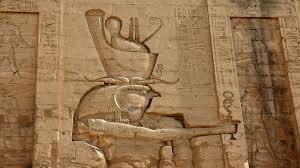
Falcon representation of Horus associated with Edfu Temple
Horus, the falcon god, was the divine protector at the heart of Edfu Temple.

As you enter the courtyard, a dark granite falcon watches from near the gateway. Its form is compact and powerful: folded wings, an upright body, and the calm gaze of a divine protector. It represents Horus of Edfu, often known as Horus Behdety.

Horus had several forms and traditions across Egypt, so it is best not to reduce him to a single simple identity. At Edfu he was a sky and solar deity, a defender of divine order, and a model of legitimate kingship. He was also understood within the story in which Horus, son of Isis and Osiris, contends with Seth and triumphs over forces threatening rightful rule.

Scenes of that conflict appear along the temple’s inner enclosure wall. Horus attacks Seth, who is represented in different forms, including a hippopotamus. These carvings are not a modern illustrated storybook. They belong to ritual performances and sacred texts through which the defeat of chaos was repeatedly renewed.

Horus was also linked to Hathor of Dendera. During the Festival of the Beautiful Reunion, Hathor’s divine image traveled from Dendera to meet Horus at Edfu. The festival united two cult centers and transformed theology into movement: boats on the Nile, processions, offerings, music, and communal celebration.

Walking Through Edfu Temple Step by Step

The Mammisi and the Approach

Before reaching the principal gateway, you encounter the remains of a mammisi, or birth house. Such buildings were associated with divine birth and the renewal of royal legitimacy. Its position outside the central temple reminds you that the sanctuary once belonged to a larger sacred complex rather than standing alone as it appears in many photographs.

Then your attention is pulled upward to the pylon. Roughly symmetrical towers frame the central entrance, their broad surfaces covered with reliefs of the king before the gods. The scale deliberately reduces the human visitor. You stand below a world in which rulers and deities are monumental, while the gateway offers the only path forward.

The Great Pylon

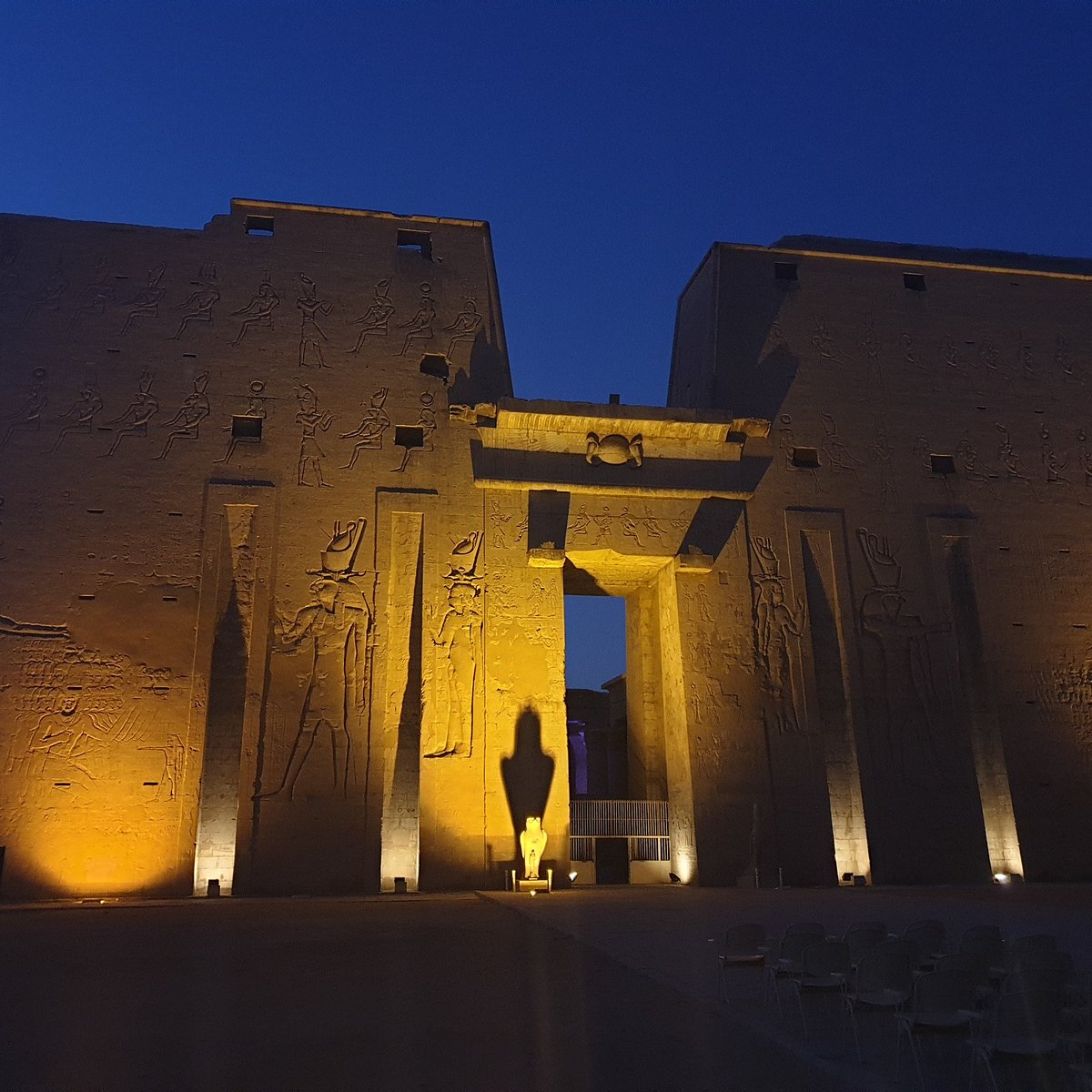
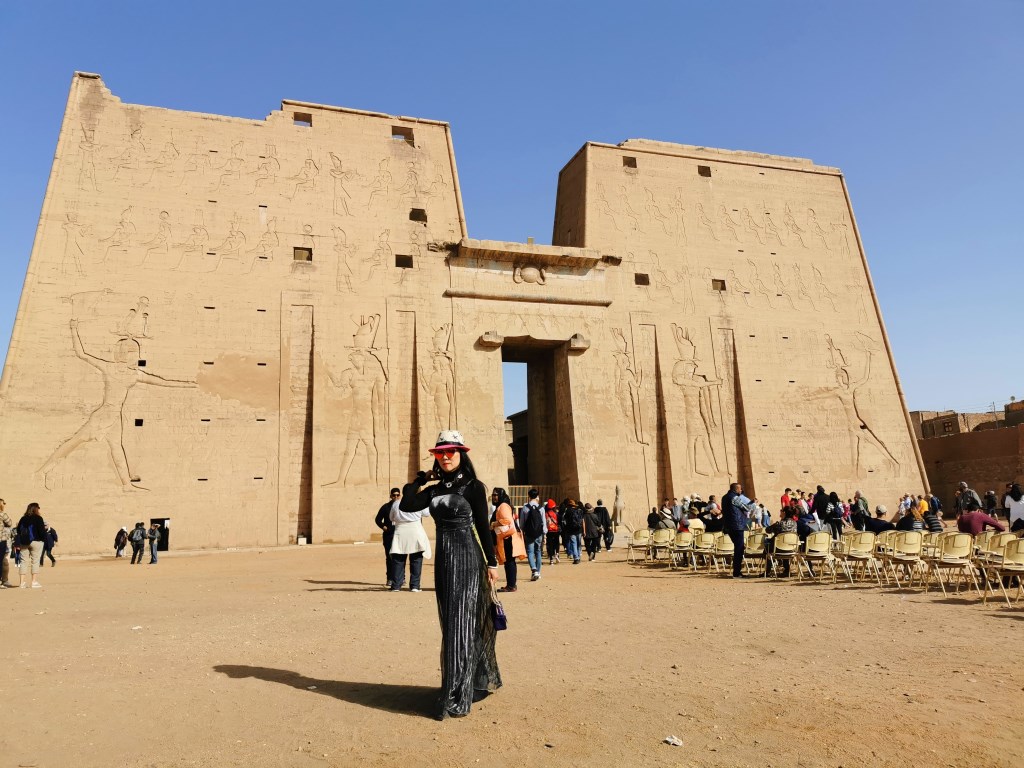
Monumental pylon at the entrance of Edfu Temple
The monumental pylon forms the imposing public entrance to Edfu Temple.

The pylon is the public face of Edfu Temple. Among its dominant scenes is the familiar Egyptian image of the king raising a weapon over defeated enemies before Horus and Hathor. The representation should not automatically be read as a record of one literal battle. It is also a symbolic statement: the pharaoh restrains disorder and preserves maat, the proper balance of the world.

Look for the vertical grooves that once held flagstaffs. Banners would have added color and movement to the stone façade. Imagine them lifting in the wind as a procession approached—not as a claim that we know the exact appearance of every festival day, but as a reminder that ancient temples included textiles, incense, music, polished metal, painted surfaces, and human activity now largely missing.

The Open Courtyard

Sunlit courtyard and columns inside Edfu Temple
The open courtyard creates a transition from bright sunlight to the darker inner halls.

Through the gateway, sunlight spreads across a wide courtyard surrounded on three sides by columns. This was a transitional space. It remained more accessible than the inner rooms, yet its surrounding reliefs placed every visitor within a sacred program of offerings and divine presence.

Walk slowly beneath the colonnades. Each capital differs in its plant-inspired design, evoking the fertile world created from the primeval waters. The courtyard also gives you one of the best opportunities to appreciate the temple’s changing rhythm: dazzling open sky behind you, deepening shade ahead.

Two granite falcon statues are associated with this entrance area, although they are not identical in condition. They have become recognizable symbols of Edfu, but they were never simply decoration. They made the god’s presence visible and guarded the passage into his house.

The First Hypostyle Hall

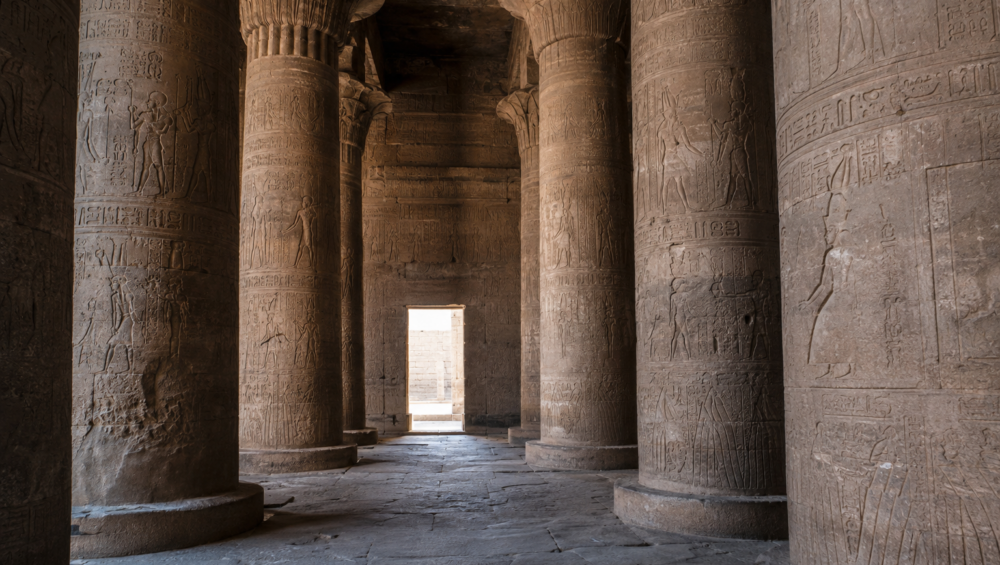
Massive columns inside the hypostyle hall of Edfu Temple
Columns and carved reliefs lead visitors deeper into Edfu Temple.

Cross the threshold and the atmosphere changes immediately. The first hypostyle hall rises around you, supported by massive columns. Light enters more selectively, sharpening carved figures while leaving corners in shadow. The ceiling feels lower than the open sky of the court, even though the hall itself is monumental.

Small chambers connected with temple functions open from this area. One was associated with consecration, another with a library. The latter does not mean a modern reading room lined with surviving books. Wall inscriptions record categories of sacred texts, offering a rare glimpse into the knowledge temple specialists considered essential.

The Inner Halls and Offering Rooms

As you continue, the architectural axis becomes more intimate. A second hypostyle hall and a sequence of vestibules lead toward the sanctuary. Rooms were associated with offerings, preparation, ritual purity, and the storage of objects required for cult practice.

Here it becomes easier to understand that an Egyptian temple was not primarily a congregational building. Daily service centered on the divine image and was carried out by authorized priests. Food, drink, linen, incense, oils, and symbolic objects moved through a carefully ordered system. The building functioned as the god’s earthly residence and as an institution supported by land, labor, and administration.

The Sanctuary and Granite Naos

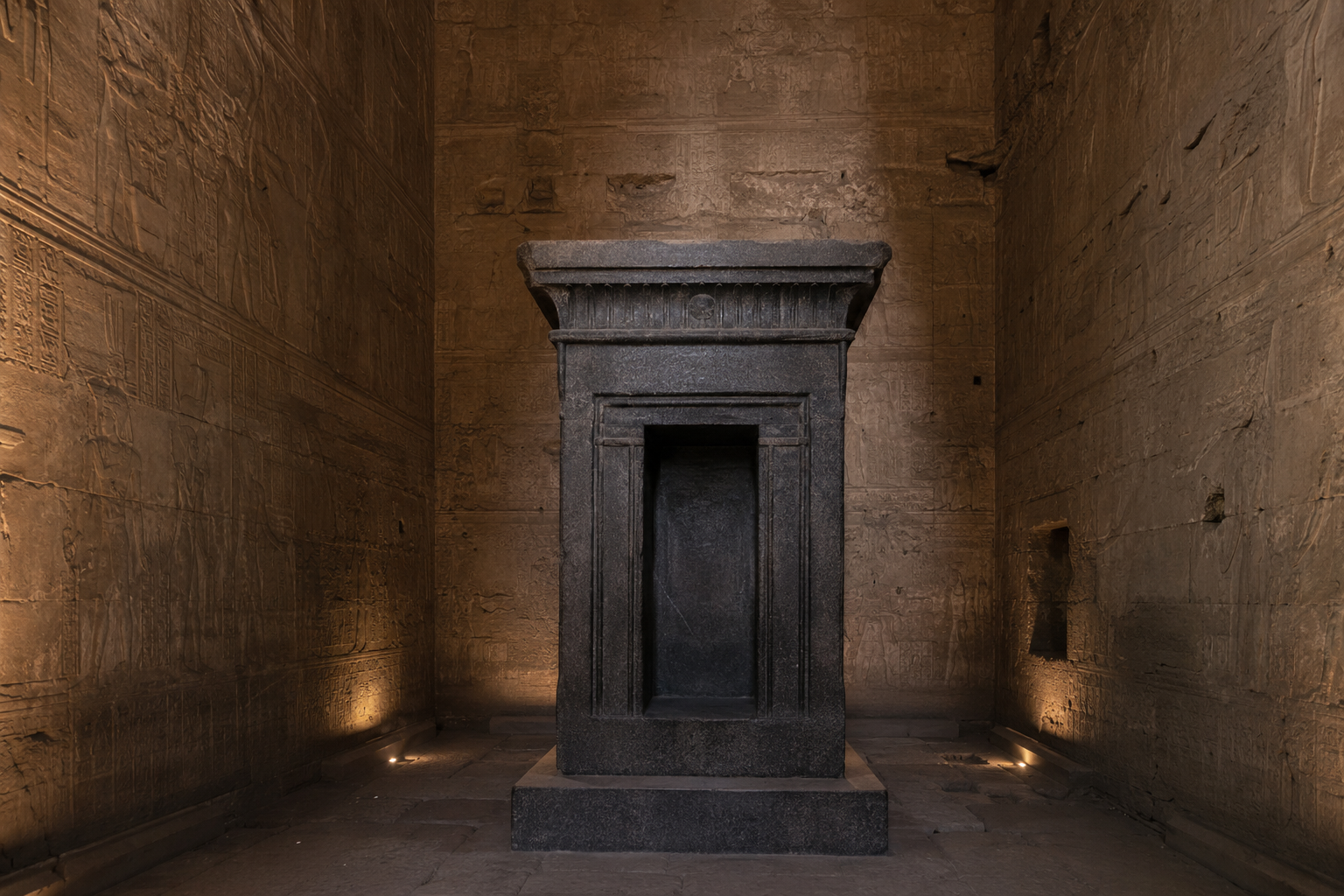
Granite naos inside the sanctuary of Edfu Temple
The dark granite naos stands at the sacred heart of Edfu Temple.

At last you reach the most sacred zone. The sanctuary is darker and quieter, enclosed by chapels and corridors. At its center stands the granite naos of Nectanebo II. The divine cult image would once have been protected within such a shrine, although the original statue is no longer present.

A modern sacred-bark reconstruction helps visitors imagine how a portable shrine could have carried the god during processions. It is useful as interpretation, but it should not be confused with an intact Ptolemaic ritual object. The distinction is small but important: responsible history separates what survives from what has been reconstructed to explain it.

Around the sanctuary are chapels associated with particular gods and ritual purposes. Their density creates the feeling of being inside a sacred machine, with every surface, doorway, and room contributing to ceremonies larger than any single visitor could see.

The Horus and Seth Reliefs

One of the most memorable areas lies along the inner enclosure, where reliefs present the ritual drama of Horus overcoming Seth. Horus and accompanying figures spear a hippopotamus, a form connected here with the defeated adversary. Repeated action emphasizes that disorder was not conquered once and forgotten; it had to be ritually controlled again and again.

These scenes are sometimes described loosely as the world’s first comic strip or as a straightforward historical battle. Both labels are misleading. The sequence certainly tells a story visually, but it belongs to a complex union of myth, performance, temple ritual, and kingship. Its power comes from this combination, not from forcing it into a modern category.

How Was Edfu Temple Preserved?

The temple’s survival was partly the result of burial. Over centuries, accumulating debris and settlement covered much of the structure. Houses were built above and around the buried monument, while sand and material helped shield lower walls from prolonged exposure.

During the nineteenth century, Auguste Mariette directed clearance work at Edfu. Calling this simply a “discovery” would erase the fact that local people already lived around and above the visible remains. Archaeological clearance revealed the monument on an extraordinary scale, but it also belonged to an era whose methods and effects on communities differed from modern practice.

Some reliefs show damage to divine faces and figures, often associated with changing religious use in late antiquity. Soot-darkened ceilings and other traces also reveal that the temple continued to exist within later human lives. Preservation does not mean the building was frozen after the Ptolemies; its stones carry several histories.

Practical Guide to Visiting Edfu Temple

Where Is Edfu Temple?

The temple is in the city of Edfu on the west bank of the Nile, approximately between Luxor and Aswan. Nile cruises commonly include it, and it can also be visited during an overland journey.

Travelers using an Aswan to Luxor private transfer can arrange Edfu as an optional stop, often together with Kom Ombo Temple. Allowing enough time matters: Edfu rewards a slower walk far more than a hurried photograph at the pylon.

Opening Hours and Tickets

Egypt’s official monument-ticket platform currently lists seasonal working hours for the Temple of Horus at Edfu, with opening from 7:00 AM and earlier last entry in winter than in summer. Hours, ticket categories, and prices can change, so check the official Egyptian monuments booking page shortly before your visit rather than relying on an old price copied into a blog post.

Best Time to Visit

Early morning is generally the most comfortable choice, particularly during hot months. Temperatures are lower, the stone receives softer light, and you may have more space before large groups arrive. Visitor patterns change with cruise schedules, however, so there is no guaranteed empty hour.

What to Bring

  • Comfortable shoes for stone and uneven surfaces
  • Water, especially during warmer months
  • Sun protection for the exposed courtyard and approach
  • A camera or phone, while respecting current photography rules
  • Enough time to look beyond the main entrance

Dress for the weather and for a major cultural site. Edfu is not an active mosque or church, but considerate clothing and behavior remain appropriate.

What Most Visitors Should Not Miss

If time is limited, focus on the spatial journey rather than racing between isolated highlights:

  1. Step back far enough to understand the full scale of the pylon.
  2. Examine how the courtyard changes from sun to shade.
  3. Compare the varied column capitals.
  4. Notice the shift in light through the hypostyle halls.
  5. Spend time with the granite naos in the sanctuary.
  6. Find the ritual reliefs showing Horus defeating Seth.
  7. Look for smaller rooms and inscriptions that reveal the temple’s practical functions.

This sequence helps the architecture tell its story. The most meaningful feature of Edfu Temple is not one statue or carving; it is the way the entire building draws you from the human world toward the presence of the god.

Why Edfu Temple Still Matters

Edfu gives modern visitors an unusually coherent view of an Egyptian temple, but its completeness should not tempt us to treat it as a perfect model for every period. It is a late temple shaped by Ptolemaic politics, older Egyptian traditions, local theology, and centuries of ritual development. Earlier temples could differ in plan, material, scale, and religious emphasis.

That qualification makes Edfu more interesting, not less. Its rulers were Greek-speaking monarchs presenting themselves through Egyptian sacred forms. Its priesthood preserved and developed complex traditions. Its festivals joined towns through river journeys. Its inscriptions looked backward to creation while its builders worked across generations in a changing Mediterranean world.

When you finally walk back toward the courtyard, the movement reverses. Darkness loosens its hold, columns separate, and the blue sky returns above the pylon. The town waits outside, full of engines, voices, and ordinary life. Yet the temple has changed the way you see the stone behind you.

You have not merely entered an old building. You have followed a path designed to transform space into meaning—from public power to sacred mystery, from the king’s monumental image to the quiet naos of Horus. That is why Edfu Temple remains unforgettable: it allows the architecture of ancient Egyptian belief to be felt one threshold at a time.

Frequently Asked Questions About Edfu Temple

Who was Edfu Temple built for?

Edfu Temple was principally dedicated to Horus of Edfu, a falcon-form deity associated with the sky, solar power, protection, divine order, and legitimate kingship.

When was Edfu Temple built?

Construction of the surviving Ptolemaic temple began in 237 BC and continued in stages for more than 170 years, with completion and final consecration in the first century BC.

Is Edfu Temple worth visiting?

Yes. Its unusually complete sequence of pylons, courtyard, hypostyle halls, inner rooms, sanctuary, and ritual inscriptions makes it one of Egypt’s clearest places for understanding how a temple was organized.

How long should I spend at Edfu Temple?

Around 90 minutes allows a useful first visit, while two hours or more is better for travelers who want to study the reliefs and smaller chambers without rushing.

Can I visit Edfu while traveling between Aswan and Luxor?

Yes. Edfu is a practical cultural stop on the overland route between Aswan and Luxor and is also included in many Nile-cruise itineraries.

Also Read Our Other Blog Posts

Official Opening Hours and Ticket Prices

The Ministry of Tourism and Antiquities currently lists Edfu Temple as closing at 5:00 pm every day. The official weekly schedule shows opening at 6:00 am on Sunday and Wednesday and at 7:00 am on the other listed days. Tickets are listed at EGP 550 for foreign adults and EGP 275 for foreign students. Egyptian admission is listed at EGP 40 for adults and EGP 20 for students.

Schedules and admission prices can change, and the ticket window may close before the monument itself. Check the official Edfu Temple page and the official Egypt monuments ticket portal shortly before visiting.

What are the current Edfu Temple opening hours and ticket prices?

Edfu currently closes at 5:00 pm daily, opening at 6:00 am on Sunday and Wednesday and 7:00 am on the other days shown by the Ministry. Foreign adult/student tickets are listed at EGP 550/275. Verify current details through the official links above.

Ancient Egyptian medicine – physician treating an injured patient

The greatness of Ancient Egyptian Medicine: Its Remarkable Development, Surgery, and Medical Papyri

Ancient Egyptian medicine was one of the most sophisticated healing traditions of the ancient world. Across more than three millennia, Egyptian physicians learned to observe symptoms, examine wounds, set fractures, prepare medicines, and record their methods on papyrus. Their practice was never identical to modern medicine: practical treatment existed beside religious ritual and magic. Yet surviving texts reveal an impressive movement toward systematic examination, diagnosis, prognosis, and treatment.

This article follows the development of medicine from the Early Dynastic Period and Old Kingdom to the Greek and Roman eras. It also explains the most important medical papyri, the operations and procedures ancient Egyptian healers performed, and the evidence left by mummies, tomb scenes, and temple reliefs.

The Edwin Smith Papyrus records the examination and treatment of traumatic injuries. Image source: Codex99 reproduction; manuscript held by the New York Academy of Medicine.

When Did Medicine Become Advanced in Ancient Egypt?

There was no single moment when Egyptian medicine suddenly became advanced. Knowledge accumulated gradually. Evidence for specialist physicians appears in the Old Kingdom, while important surviving manuscripts were copied during the Middle Kingdom and New Kingdom. Many of these papyri probably preserve ideas that were already centuries old.

The Old Kingdom, especially the Third to Sixth Dynasties (about 2686–2181 BC), produced some of the earliest named physicians and medical titles. The Middle Kingdom (about 2055–1650 BC) is represented by specialist texts such as the Kahun Gynaecological Papyrus. The early New Kingdom, particularly the Eighteenth Dynasty, gave us copies of the Ebers Papyrus and the Edwin Smith Papyrus. Later, during the Ptolemaic and Roman periods, Egyptian traditions interacted with Greek medical learning in centres such as Alexandria.

The Earliest Physicians: Medicine in the Old Kingdom

One of the best-known early medical figures is Hesy-Ra, who lived during the reign of King Djoser of the Third Dynasty, around the twenty-seventh century BC. His wooden tomb panels identify him with high-ranking titles commonly translated as “chief of dentists and physicians.” The exact interpretation of ancient professional titles is debated, but the inscription clearly shows that medical occupations had status and organisation at the royal court.

Another famous figure is Imhotep, Djoser’s official and the architect traditionally associated with the Step Pyramid at Saqqara. Modern popular accounts often call Imhotep the first doctor, but no contemporary inscription securely identifies him as a physician. Centuries after his death, however, he was worshipped as a divine healer and was later associated by the Greeks with Asclepius. His reputation illustrates how medicine, wisdom, religion, and royal authority could merge in Egyptian memory.

Old Kingdom evidence also indicates specialisation. Egyptian titles refer to physicians connected with the palace, the army, labour forces, and particular parts of the body. Some practitioners may have focused on eyes, teeth, the abdomen, or other complaints. This does not mean specialisation functioned exactly like a modern hospital department, but it proves that Egyptian healing was more organised than a single undifferentiated craft.

How Ancient Egyptian Medicine Worked

Egyptian healers did not divide science and religion as sharply as we do. Illness might be attributed to injury, diet, parasites, environmental conditions, divine displeasure, malevolent forces, or the action of a deceased person. A treatment could therefore combine a physical remedy with a spoken spell.

Three broad roles appear in the evidence. The swnw is usually translated as physician and was associated with practical treatment. Priests of Sekhmet were linked with healing and ritual knowledge. Specialists connected with the goddess Serqet dealt particularly with dangerous bites and stings. One person could possibly possess more than one kind of expertise.

Despite the magical dimension, many Egyptian medical instructions are strikingly methodical. A healer might question the patient, smell or inspect a discharge, feel the pulse, examine movement, compare both sides of the body, and monitor changes over several days. Some texts divide cases into three outcomes: “an ailment I will treat,” “an ailment with which I will contend,” and “an ailment not to be treated.” This is an early form of prognosis and triage.

Ancient Egyptian physician treating an injured patient
Ancient Egyptian physicians developed systematic methods for examining wounds and treating injuries

The Edwin Smith Papyrus: A Landmark in Trauma and Surgery

The Edwin Smith Papyrus is the strongest evidence for rational trauma medicine in ancient Egypt. The surviving manuscript was copied around 1600 BC, during the Second Intermediate Period, but its language suggests that it derives from a considerably older work, perhaps composed around 1900 BC or earlier.

Edwin Smith Papyrus and the development of ancient Egyptian medicine Title: Edwin Smith Papyrus – Ancient Egyptian Medicine
The Edwin Smith Papyrus is one of the most important surviving sources for trauma medicine and surgical treatment in ancient Egypt

The papyrus presents 48 cases arranged anatomically from injuries of the head downward to the shoulders and chest, where the surviving text ends. Each case generally follows a recognisable sequence: title, examination, diagnosis, prognosis, and treatment. The injuries are consistent with accidents on building sites or wounds sustained in combat.

Its authors observed anatomy with remarkable care. They described skull fractures, wounds exposing bone, injuries to the spine, dislocations of the jaw, broken collarbones, chest injuries, and neurological symptoms. The text connects damage to the brain with effects elsewhere in the body, such as impaired movement or speech. It also contains an early written reference to the brain and describes the membranes and fluid surrounding it.

Treatments include bandaging, suturing, applying fresh meat to control bleeding during the first day, using honey and grease in later dressings, immobilising fractures, and repositioning certain dislocations. Not every remedy would meet modern medical standards, but the clinical organisation is extraordinary for its age.

Edwin Smith Papyrus describing trauma and surgery in ancient Egypt
The Edwin Smith Papyrus presents 48 trauma cases using a systematic approach to examination, diagnosis, prognosis, and treatment

What Surgical Procedures Were Performed?

Ancient Egyptian surgical instruments used for medical treatment
Ancient Egyptian healers used instruments and practical techniques to treat wounds, fractures, swellings, and other injuries


The Egyptian evidence supports several forms of minor surgery and trauma care:

  • Suturing wounds: The Edwin Smith Papyrus recommends drawing together the edges of some wounds with stitches.
  • Bandaging: Linen was used to protect wounds, maintain dressings, and provide support.
  • Setting fractures: Injured bones could be aligned and immobilised with splints made from wood, bark, linen, and other materials.
  • Reducing dislocations: The papyrus gives practical instructions for treating a dislocated jaw and some shoulder or collarbone injuries.
  • Draining swellings or abscesses: Other medical texts mention cutting certain swellings and treating the opening afterward.
  • Cauterisation: Heat could be used in selected cases to destroy tissue or control a lesion.
  • Circumcision: Old Kingdom tomb scenes, especially the relief traditionally identified as a circumcision scene in the tomb of Ankhmahor at Saqqara, are often cited as evidence of the procedure.
  • Dental intervention: Egyptian remains show heavy tooth wear and dental disease. Treatments probably focused more on pain relief and stabilisation than complex restorative dentistry.

Claims that Egyptians routinely performed major abdominal operations or brain surgery should be treated cautiously. Trepanation has been reported in a small number of skulls, but evidence that it was common or performed successfully during life is limited. Mummification gave embalmers knowledge of the body, yet embalmers and physicians were not necessarily the same profession.

The Ebers Papyrus: Medicine, Drugs, and Internal Disease

A section of the Ebers Papyrus written in ancient Egyptian hieratic script
The Ebers Papyrus is one of the longest surviving Egyptian medical manuscripts. Image reproduced for educational reference; manuscript preserved at Leipzig University Library.

The Ebers Papyrus, copied around 1550 BC in the early Eighteenth Dynasty, is the largest and most wide-ranging surviving Egyptian medical manuscript. Its 110 columns contain hundreds of passages, including prescriptions and discussions of diagnosis. It covers digestive complaints, skin disease, eye conditions, burns, wounds, parasites, dental pain, pregnancy, contraception, and disorders associated with the heart.

Its remedies draw on plants, minerals, and animal products. Ingredients include honey, resins, oils, dates, figs, onions, garlic, natron, ochre, and many herbs. Preparations could be swallowed, inhaled, applied as an ointment, placed in a bandage, used as a wash, or administered by other routes.

Honey was particularly valuable. Modern research confirms that some kinds of honey can inhibit bacterial growth, although ancient Egyptians did not understand microbes. They used honey in wound dressings because experience showed that it helped protect and soothe injured tissue. Resins and oils could also form barriers, while linen kept a dressing in place.

The Ebers Papyrus includes a famous “treatise on the heart.” Egyptian writers believed that vessels connected the heart to the body. Their model was not modern circulation, and they sometimes imagined that air, blood, tears, urine, and other substances travelled through a common network. Nevertheless, feeling the pulse and relating it to the heart demonstrates careful physiological observation.

The Kahun Gynaecological Papyrus

The Kahun Gynaecological Papyrus comes from the Middle Kingdom town of Lahun and dates to around 1850–1700 BC. It is among the earliest surviving texts devoted to women’s health. Its cases discuss fertility, pregnancy, contraception, and gynaecological symptoms.

The manuscript usually presents a complaint, a diagnosis, and a remedy. Treatments include fumigation, drinks, oils, and plant-based preparations. Some explanations reflect now-obsolete ideas about the womb, but the specialised focus is historically important. It shows that women’s health was recognised as a distinct field of medical practice almost four thousand years ago.

Other Important Medical Papyri

The Hearst Papyrus

Usually dated to the early New Kingdom, the Hearst Papyrus contains prescriptions for urinary problems, digestive complaints, bites, wounds, and pain. Several passages resemble material in the Ebers Papyrus, showing that scribes copied, adapted, and circulated bodies of medical knowledge.

The Berlin Medical Papyrus

The Berlin Papyrus 3038 includes diagnostic and therapeutic material, fertility tests, and remedies. Although the surviving copy is later, portions may preserve Middle Kingdom traditions.

The Chester Beatty Medical Papyrus

This Ramesside manuscript includes treatments associated with headaches and disorders of the anus. Its existence alongside literary texts at Deir el-Medina suggests that medical writings circulated among the highly skilled community that built and decorated royal tombs.

The London and Leiden Papyri

These manuscripts contain a stronger concentration of magical spells and ritual treatments. They remind us that practical observation and supernatural explanation remained intertwined rather than replacing one another in a simple progression.

Medicines and Pharmacy in Ancient Egypt

Ancient Egyptian medicine prepared with herbs and natural remedies
Egyptian healers prepared medicines from plants, honey, oils, minerals, resins, and other natural ingredients


Egyptian healers developed a sophisticated tradition of compounding medicines. A prescription could specify ingredients, quantities, preparation, timing, and duration. The same substance might be ground, boiled, strained, mixed with beer or wine, combined with fat, or formed into a suppository or poultice.

Some ingredients had plausible therapeutic effects. Honey could support wound care; willow contains compounds related to salicylates; castor oil has a laxative action; and aromatic resins may have helped preserve preparations. Beer and wine could act as solvents or carriers. Other ingredients were ineffective, symbolic, or potentially harmful. Historical importance should not be confused with a recommendation to use ancient recipes today.

Diet was also part of treatment. Bread and beer were staples, while onions, garlic, dates, figs, fish, and meat supplied different nutrients. Physicians linked some discomforts to food and waste inside the body, although their explanations were framed through Egyptian concepts rather than modern pathology.

Dentistry and Eye Medicine

Dental disease was widespread. Stone particles introduced during grain grinding wore down enamel, exposing sensitive tissue and increasing the risk of infection. Mummies display severe abrasion, abscesses, missing teeth, and periodontal disease. Medical papyri contain remedies for toothache and loose teeth, often using pastes or mouth treatments.

There are intriguing examples of teeth joined with wire, but scholars debate whether these were therapeutic procedures performed during life or funerary repairs made after death. Evidence for fillings and advanced dental prostheses remains limited.

Eye complaints also received considerable attention. Dust, glare, insects, and infection made eye disease common. Egyptian texts prescribe washes and ointments containing minerals, plant products, and honey. Some treatments might have soothed irritation, while others carried risks. Specialist titles connected with eye care reinforce the idea of organised medical expertise.

Pregnancy, Childbirth, and Family Health

Women usually gave birth in a squatting or kneeling position, supported by birth bricks and assisted by female attendants. Deities such as Taweret and Bes were invoked to protect mother and child. Medical texts propose fertility and pregnancy tests using grains and other materials. Their reliability varies, but they demonstrate an effort to predict pregnancy through observable changes.

Contraceptive recipes are also recorded. Some ingredients may have formed a physical barrier, while others were symbolic or unsafe. Childbirth was dangerous, and religion provided reassurance where practical medicine had limited power. Archaeological evidence from settlements helps historians understand maternal and infant health, but the surviving written record was produced mainly by literate elites.

Public Health, Cleanliness, and the Environment

Egyptians valued washing, shaving, clean linen, and scented oils. Priests followed especially strict purification routines. Natron was useful for cleaning and drying, while cosmetics could protect the skin and eyes to some degree. However, ancient communities still faced parasites, contaminated water, respiratory irritation, occupational injuries, and infectious disease.

The Nile made agriculture possible but also exposed people to waterborne parasites. Evidence from mummies has contributed to the study of schistosomiasis and other diseases. Workers suffered fractures, arthritis, and spinal stress, while desert sand and smoke affected lungs and eyes. Egyptian medicine developed in direct response to these everyday conditions.

Medicine Under the Ptolemies and Romans

After Alexander the Great conquered Egypt in 332 BC, Alexandria became an international centre of scholarship. Egyptian, Greek, and later Roman traditions interacted. Greek physicians gained opportunities to study anatomy, and writers associated with Alexandria, such as Herophilus and Erasistratus, made influential anatomical observations.

Egyptian temple healing continued, and Imhotep’s cult flourished. Visitors sought cures through prayer, ritual, dreams, and practical remedies. Knowledge did not flow in only one direction: Greek authors admired aspects of Egyptian specialisation, while Egyptian practitioners absorbed and adapted ideas from the wider Mediterranean world.

Relief of medical and surgical instruments at Kom Ombo Temple in Egypt
Relief commonly described as medical or surgical instruments at Kom Ombo Temple. Photo: Ad Meskens, Wikimedia Commons, CC BY-SA.

A famous relief at Kom Ombo Temple shows a group of instruments that are often described as surgical tools. The relief belongs to the Graeco-Roman temple context, much later than the Edwin Smith Papyrus. Some objects resemble forceps, probes, knives, cups, and scales, although interpretations differ and they may also represent ritual equipment. The scene is valuable, but it should not be used by itself to prove that every modern-looking operation was performed in pharaonic Egypt.

What Mummies Reveal

Modern imaging has transformed the study of Egyptian health. X-rays and CT scans can identify fractures, arterial calcification, dental disease, arthritis, and evidence of trauma without unwrapping a mummy. Laboratory analysis has also investigated parasites and pathogens.

Mummies must still be interpreted carefully. Many belonged to elites, preservation can alter tissues, and a condition observed in one mummy cannot represent the whole population. Yet when physical evidence is compared with papyri, tomb scenes, and archaeological context, it provides an unusually rich picture of ancient disease and treatment.

How Scientific Was Ancient Egyptian Medicine?

Calling Egyptian medicine either “fully scientific” or “merely magical” creates a false choice. The Edwin Smith Papyrus demonstrates disciplined observation, case classification, and practical treatment. The Ebers Papyrus combines useful remedies with spells and theories that modern medicine rejects. Both belong to the same culture.

The most important achievement was not a single operation. It was the habit of recording cases and organising knowledge. Egyptian healers recognised patterns: a particular injury produced particular symptoms; some wounds could be treated; some required caution; and some were beyond help. This approach placed experience beside tradition and helped preserve medical knowledge over generations.

Frequently Asked Questions

Which period was the golden age of medicine in ancient Egypt?

Medical knowledge developed throughout Egyptian history. The Old Kingdom provides early evidence of professional physicians, the Middle Kingdom produced specialist traditions such as the Kahun Papyrus, and the early New Kingdom preserved the major Ebers and Edwin Smith manuscripts. Therefore, the Middle and early New Kingdoms are especially important for surviving texts, but they built on older practice.

Did ancient Egyptians perform brain surgery?

The Edwin Smith Papyrus accurately describes skull and brain injuries, but this does not prove routine brain surgery. Evidence for trepanation is rare and debated. Egyptian trauma care was advanced in observation and treatment, yet claims of frequent neurosurgery should be approached cautiously.

Did they use anaesthesia?

There is no secure evidence for anaesthesia comparable to modern surgical practice. Alcoholic drinks and sedating or pain-relieving plants may have reduced discomfort, but dosage and effects would have been unpredictable.

Who was the first Egyptian doctor?

Hesy-Ra is one of the earliest named people associated with physicians and dentistry. Imhotep later became a divine patron of healing, but contemporary evidence does not securely identify him as a practising doctor.

What is the most important ancient Egyptian medical text?

The Edwin Smith Papyrus is crucial for trauma and surgical practice, while the Ebers Papyrus is the broadest source for medicines and internal disease. Neither replaces the other; together they show the range of Egyptian healing.

Conclusion

The development of medicine in ancient Egypt was a long process shaped by royal institutions, temples, trained practitioners, scribal learning, warfare, construction, and everyday illness. From the specialist titles of the Old Kingdom to the clinical cases of the Edwin Smith Papyrus and the vast pharmacological collection of the Ebers Papyrus, Egyptian healers created one of antiquity’s most enduring medical traditions.

Their achievements should be described accurately, without exaggeration. They sutured wounds, bandaged injuries, reduced some dislocations, immobilised fractures, drained selected swellings, prepared complex medicines, and developed methods of examination and prognosis. At the same time, they relied on ritual and theories that do not match modern anatomy or disease. That combination is precisely what makes the subject so fascinating: ancient Egyptian medicine stands at the meeting point of close observation, accumulated experience, religion, and humanity’s timeless search for healing.

Also Read Our Other Blog Posts

Selected Sources and Further Reading

Atum Trip

Your gateway to discovering Egypt

Kalabsha Temple

Kalabsha Temple: The Hidden Nubian Treasure of Aswan You Must Discover 2026

Kalabsha Temple

Temple of Mandulis

Where Silence Speaks and Stones Remember

There are places in Egypt where history does not simply exist—it breathes. Where every carved line in stone carries echoes of forgotten prayers, distant battles, and shifting empires. Kalabsha Temple is one of those places.

Standing quietly near the High Dam in Aswan, overlooking the shimmering waters of Lake Nasser, Kalabsha Temple is often overshadowed by more famous monuments. Yet those who step into its vast, sunlit courtyard quickly realize something extraordinary: this is not just a temple—it is a survivor.

A survivor of time.
A survivor of empires.
A survivor of water itself.

From its origins in the age of pharaohs to its rebirth under Roman rule, and finally to its dramatic relocation in the 20th century, Kalabsha Temple carries within its walls one of the most fascinating stories in all of Egypt.

Where Is Kalabsha Temple Located Today?

Today, Kalabsha Temple rests in a place known as New Kalabsha, just west of the Aswan High Dam.

It overlooks Lake Nasser, one of the largest man-made lakes in the world, where the deep blue water stretches endlessly into the horizon. The temple often appears as if it is floating between desert and water—a powerful visual reminder of its dramatic past.

But this is not where Kalabsha Temple originally stood.

Its first home was in Lower Nubia, at a site called Talmis (Bab al-Kalabsha), around 50 kilometers south of Aswan. There, it stood for nearly two thousand years, watching the Nile flow beside it—until the river itself changed forever.

Kalabsha Temple
Kalabsha Temple

The Birth of Kalabsha Temple: A Story Older Than It Seems

When people ask, “When was Kalabsha Temple built?” the answer is layered.

The structure we see today dates to around 30 BC, during the reign of the Roman emperor Augustus. But the story of Kalabsha Temple begins long before that.

Beneath the Roman stones lies the memory of an older sacred place—one that dates back to the New Kingdom of ancient Egypt, particularly the reign of the great pharaoh Ramesses II.

This earlier temple was part of Egypt’s effort to establish control over Nubia, a land rich in gold, trade, and cultural exchange.

So while Kalabsha Temple is technically Roman, its soul is unmistakably Egyptian.

Which God Was the Temple Dedicated To?

The Temple of Kalabsha was dedicated primarily to the Nubian sun god:

  • Mandulis (also known as Merul)

Mandulis was associated with:

  • The sun
  • fertility
  • renewal

He was often linked with Egyptian gods such as:

  • Isis
  • Osiris
  • Horus

This fusion of Nubian and Egyptian deities highlights the cultural blending in southern Egypt during ancient times.

Kalabsha Temple 2
Kalabsha Temple 2

The Forgotten Sanctuary of Ramesses II

Before Kalabsha Temple rose in its current form, the site was home to an earlier sanctuary connected to Ramesses II.

Nearby, this legacy survives most clearly in the remarkable Beit el-Wali Temple, a rock-cut temple that offers a vivid window into that earlier era.

A Temple of Power and Propaganda

Beit el-Wali was dedicated to:

It later became known as “The House of the Holy Man,” a name given during its later use as a hermit’s dwelling.

But its original purpose was far more political.

Inside its walls, Ramesses II is immortalized as a warrior king:

  • Charging into battle against Nubian tribes
  • Leading his sons in military campaigns
  • Receiving tribute from conquered lands

The tribute scenes are especially striking:

  • Giraffes and exotic animals
  • Ivory tusks
  • Gold and precious goods

These were not just artistic depictions—they were messages of dominance, carefully crafted to reinforce Egypt’s authority over Nubia.

Religious Grandeur

Alongside scenes of conquest, the temple also presents moments of devotion:

  • Ramesses II offering gifts to the gods
  • Rituals performed before Amun
  • Sacred ceremonies carved with exquisite precision

Even today, many of these reliefs retain their colors, giving visitors a rare glimpse into the vibrancy of ancient Egyptian art.

The Roman Vision: Rebuilding Kalabsha Temple

Centuries later, under Roman rule, the site was transformed.

The Romans, rather than imposing their own religious systems, chose a different approach: they embraced Egyptian traditions.

Thus, Kalabsha Temple was built in classical Egyptian style, despite being commissioned by Emperor Augustus.

The God of Kalabsha Temple

The temple was dedicated to Mandulis, a Nubian solar deity associated with:

  • The sun
  • fertility
  • divine protection

Mandulis represents a fascinating blend of cultures—a Nubian god worshipped in an Egyptian-style temple under Roman authority.

This fusion defines Kalabsha Temple.

Several historical records were inscribed on the temple walls of Kalabsha such as “a long inscription carved by the Roman Governor Aurelius Besarion in AD 250, forbidding pigs in the temple” as well as an inscription of “the Nubian king Silko, carved during the 5th century and recording his victory over the Blemmyes and a picture of him dressed as a Roman soldier on horseback.” Silko was the Christian king of the Nubian kingdom of Nobatia . When Christianity was introduced to Egypt, the temple was used as a church

Architecture of Kalabsha Temple: Monumental Elegance

Walking through Kalabsha Temple reveals a layout that feels both familiar and grand:

The Pylon

A massive gateway that once marked the boundary between the human and divine worlds.

The Courtyard

An open space filled with sunlight, where rituals and gatherings took place.

The Hypostyle Hall

A forest of columns, their capitals carved with intricate designs, supporting the sacred roof above.

Inner Chambers

Dark, cool rooms where priests once moved in silence.

The Sanctuary

The most sacred space, where the statue of Mandulis once stood.

The temple stretches approximately 76 meters in length, making it the largest free-standing temple in Nubia.


The Granite Stela and Its Journey to Berlin

One of the most intriguing aspects of Kalabsha is the story of a granite stela (inscribed slab) that was removed from the site and is now housed in the Neues Museum in Berlin.

This stela contains:

  • Important inscriptions
  • Historical records related to the temple and its administration

Why Was It Taken?

During the 19th century, many European expeditions removed artifacts from Egyptian sites. The Kalabsha stela was among these pieces.

In 1971, Egypt gave one of the temple’s gates to the Federal Republic of Germany out of gratitude for Germany’s participation in the rescue of the Nubian temples.

Where Is It Now?

Today, it is preserved in the Neues Museum, one of the most important museums for Egyptian antiquities in Europe.

Since 1977 the gate has been located in the annex of Berlin’s Egyptian Museum in Berlin-Charlottenburg.
The gate will be moved to become the monumental entrance to the fourth wing of the Pergamon Museum in Berlin, which is currently being constructed.

Why It Matters

The stela provides:

  • Historical context about Kalabsha
  • Evidence of religious practices
  • Insight into Nubian-Egyptian relations

The Kiosk of Qertassi: A Jewel Beside Kalabsha Temple

Near Kalabsha Temple stands a smaller but elegant structure: the Kiosk of Qertassi.

Though modest in size, it is rich in beauty.

Architectural Charm

  • Four Hathor-headed columns
  • Delicate carvings
  • A harmonious blend of Egyptian and Roman styles

Purpose

The kiosk likely served as:

  • A ceremonial gateway
  • A resting place for religious processions

Its simplicity contrasts beautifully with the grandeur of Kalabsha Temple, creating a balanced architectural landscape.

The Great Rescue: Saving Kalabsha Temple from the Waters

In the 1960s, everything changed.

The construction of the Aswan High Dam led to the creation of Lake Nasser, threatening to submerge vast areas of Nubia—including Kalabsha Temple.

Kalabsha Temple 3

A Global Effort

UNESCO launched an international campaign to save these monuments.

The Relocation Process

Kalabsha Temple was:

  • Cut into over 13,000 blocks
  • Carefully numbered
  • Transported to higher ground
  • Reassembled stone by stone

This operation took place between 1961 and 1963.

It was not just engineering—it was preservation on a monumental scale.

Kalabsha Temple Through the Ages

Kalabsha Temple has lived many lives:

  • New Kingdom – Early sanctuary under Ramesses II
  • Roman Period – Reconstruction and dedication to Mandulis
  • Christian Era – Conversion into a church
  • Modern Era – Relocation and preservation

Each layer added new meaning, new markings, new stories.

What Makes Kalabsha Temple Unique?

Kalabsha Temple is unique because it is:

  • The largest free-standing Nubian temple
  • A fusion of Egyptian, Nubian, and Roman cultures
  • A monument that survived relocation
  • A site rich with inscriptions from multiple eras
  • A peaceful alternative to crowded attractions

Why Kalabsha Temple Matters

Kalabsha Temple is more than a historical site.

It is:

  • A bridge between cultures
  • A testament to resilience
  • A symbol of global cooperation

It reminds us that history is not fixed—it can be saved, moved, and reborn.

Visiting Kalabsha Temple Today

Arriving at Kalabsha Temple is part of the experience.

Visitors drive to the temple’s private dock near the High Dam, then take a boat for a short trip across Lake Nasser.

Sometimes, a special permit from the Egyptian authorities is required to visit the temple, as it is located in a border area.

Tickets for Kalabsha Temple.

 Where to Buy Tickets
Tickets are purchased at the entrance gate of the archaeological site on the island

Or through the official government website to purchase tickets for museums and temples: https://egymonuments.com/

Ticket Prices (Approximate)
Egyptians: low-cost entry
Foreign visitors: 200 Egyptian pounds
Students (with ID): discounted tickets

📌 Note: Prices may change, so it’s always good to check locally.

 Opening Hours
Typically from 7:00 AM to 5:00 PM
Last entry is usually before closing time by about an hour
 Visitor Tips
Wear comfortable shoes (the site involves walking on sand and stones)
Bring water, especially in summer

Contact us to arrange a private tour of Kalabsha Temple and experience a journey to another world, far removed from the hustle and bustle of modern life.

A Journey Through Kalabsha Temple: An Immersive Ending

Imagine this:

The sun is beginning to soften as you step off a small boat onto the quiet shore of New Kalabsha.

The air is still.

Ahead of you, Kalabsha Temple rises in warm sandstone, glowing under the golden light of late afternoon.

You walk slowly toward the massive pylon. Each step echoes faintly against the stone.

Crossing the entrance, you leave the modern world behind.

The courtyard opens before you—vast, silent, filled with sunlight. The wind moves gently through the columns, carrying whispers of a time long past.

You step into the hypostyle hall.

The temperature drops. Shadows stretch across the floor. The columns rise around you like ancient guardians.

Your fingers brush against the carved walls.

Here is Ramesses II—frozen in victory.
There, Mandulis—eternal and watchful.
Every surface tells a story.

You move deeper.

The sanctuary awaits—quiet, sacred.

For a moment, everything stands still.

No crowds. No noise. Just you… and thousands of years of history.

Outside, the light begins to fade. Lake Nasser reflects the sky like a mirror, and Kalabsha Temple stands between water and desert, exactly where it was meant to be—again.

And as you leave, one thought lingers:

Some places are visited.
Others are experienced.

Kalabsha Temple is remembered.

Unveil the treasures of Ancient Egypt’s kingdoms throuh time with

Atum Trip


Read more in the Atum Trip blogs:


Abu Simbel Temple,  Philae Temple,  Kom Ombo Temple,  Edfu Temple,  Tombs of the Nobles, Elephantine Island


Official Opening Hours and Ticket Prices

The Ministry of Tourism and Antiquities currently lists Kalabsha Temple as open daily from 7:00 am to 4:00 pm. Tickets are listed at EGP 200 for foreign adults and EGP 100 for foreign students. Egyptian admission is listed at EGP 10 for adults and EGP 5 for students. Because New Kalabsha is reached by water, boat transport is arranged separately and is not included in the archaeological-site ticket.

Opening hours, admission prices, and boat arrangements can change. Check the official Kalabsha Temple page and the official Egypt monuments ticket portal close to your visit.

What are the current Kalabsha Temple opening hours and ticket prices?

Kalabsha Temple is currently listed as open from 7:00 am to 4:00 pm daily. Foreign adult/student admission is listed at EGP 200/100; boat transport is separate. Verify the latest information through the official links above.

Elephantine island

Elephantine Island: A Mesmerizing Journey Through Living History in Aswan 2026

Elephantine Island

Elephantine Island in Aswan:

Where the Nile Whispers the Secrets of Ancient Egypt

There are places in Egypt where history is not just remembered—it is felt beneath your feet. Elephantine Island is one of those rare places. Rising gently from the waters of the Nile River opposite Aswan, this island is far more than a scenic stop—it is a living archive of civilization, a gateway to Africa, and a sacred landscape that has witnessed over five millennia of human history.

Walk here at sunrise, and you will feel it: the quiet echo of priests, traders, soldiers, and kings who once stood exactly where you stand now.

Step Onto Elephantine Island… and Into Another Time

The boat slows as it approaches Elephantine Island. The waters of the Nile River ripple gently, reflecting golden sunlight. As you step onto the shore, something shifts—time feels different here.


This is not just another island in Aswan. This is Elephantine Island, where every stone, every path, and every breeze carries stories that began more than 5,000 years ago.

Elephantine Island
Elephantine Island

Where Is Elephantine Island Located?

Elephantine Island sits gracefully in the middle of the Nile, directly opposite the city of Aswan in southern Egypt.

Despite its relatively small size—about 1.5 km long and 500 meters wide—its importance is immense. Its strategic position made it:

  • Egypt’s southern gateway
  • A border control point with Nubia
  • A hub for trade and military operations

As you stand on its rocks, you are literally standing at what was once the edge of ancient Egypt.


The island is located just downstream of the First Cataract, at the southern border of Upper Egypt with Lower Nubia.

This region above is referred to as Upper Egypt because it is further up the Nile.

Why Is It Called Elephantine Island?

The name Elephantine Island is deeply rooted in its economic past.

In ancient Egyptian times, the island was called “Abu”, meaning elephant. This wasn’t symbolic—it was practical. The island was a major center for the ivory trade, where elephant tusks from Africa passed into Egypt.

Later, during the Greek period, the name evolved into Elephantine, derived from the Greek word for elephant or ivory.

So the name Elephantine Island is more than a label—it is a reflection of its role as a gateway of wealth and trade.


The island may have received its name after its shape, which in aerial views is similar to that of an elephant tusk, or from the rounded rocks along the banks resembling elephants.

Known to the ancient Egyptians as “Elephant” , the island of Elephantine stood at the border between Egypt and Nubia.

Elephantine Island Through the Ages

Early Dynastic Period (c. 3000 BCE)

As you walk further inland, imagine soldiers guarding Egypt’s southern frontier. Elephantine Island was:

  • A military fortress
  • An administrative center
  • A checkpoint for expeditions

It was known as the Guardian of the South.

Old and Middle Kingdoms

The island grew into a powerful center of both religion and economy:

  • Granite from nearby quarries was transported through here
  • The Nile’s flood was closely monitored
  • Worship of Khnum flourished

Khnum, the ram-headed god, was believed to control the Nile and create humans from clay.

New Kingdom

Now picture the island alive with rituals and movement. Temples expanded, priests performed ceremonies, and Elephantine Island became a vibrant religious hub.

Ptolemaic and Roman Periods

Foreign rulers didn’t diminish its importance—they enhanced it.

Temples were restored and redesigned, blending Egyptian traditions with Greek and Roman styles, preserving the sacred identity of Elephantine Island.

Islamic and Modern Periods

Even after the fall of ancient civilizations, life continued.

The island transformed into:

  • A residential and الزراعي area
  • A cultural center for Nubian communities
  • A bridge between ancient heritage and modern life

And what is mentioned in some other narrations

The island may have received its name after its shape, which in aerial views is similar to that of an elephant tusk, or from the rounded rocks along the banks resembling elephants.

Known to the ancient Egyptians as “Elephant” , the island of Elephantine stood at the border between Egypt and Nubia

What Can You See on Elephantine Island?

Walking across Elephantine Island feels like exploring layers of history.

Temple of Khnum

At the heart of the island lies the temple of Khnum.

This temple dates from the Old Kingdom and continued through the Roman era. Khnum was believed to:

  • Control the Nile’s flow
  • Shape humans on a potter’s wheel

Standing here, you can almost hear ancient prayers carried by the wind.

Khnom (2)
Khnom (2)

Temple of Satet

One of the oldest temples in Egypt, dedicated to Satet.

Satet was the goddess of:

  • The Nile’s flood
  • Protection of Egypt’s southern borders

Her temple was rebuilt across multiple dynasties, reflecting the island’s continuous importance.

Khnom 1

Temple of Anuket

The third part of the sacred triad honors Anuket.

She symbolized:

  • Fertility
  • The life-giving energy of the Nile

According to the ancient Egyptian religion, Elephantine was the dwelling place of Khnum, the ram-headed god of the cataracts, who guarded and controlled the waters of the Nile from caves beneath the island.

He was worshipped here as part of a late triad of Egyptian deities. This “Elephantine Triad” included Satis and Anuket. Satis was worshipped from very early times as a war goddess and protector of this strategic region of Egypt.


Historical texts from the Middle Kingdom of Egypt mention the mother of Amenemhat I, founder of the Twelfth Dynasty, being from the Elephantine Egyptian name Ta-Seti

(Many scholars have argued that Amenemhat I’s mother was of Nubian origin).

The Altar on Elephantine Island

The altar in the area of Elephantine Island is one of the lesser-known yet deeply significant archaeological elements compared to temples and tombs. Despite its simplicity, it carries profound religious meaning and offers insight into the ritual life of ancient Egypt.

What is the Altar?

An altar is a stone platform or simple structure used for presenting offerings to the gods. On Elephantine Island, these altars were often associated with local temples, especially those dedicated to Khnum, the creator god believed to shape humans from the clay of the Nile.

Location

The remains of these altars are typically found within or near religious complexes on the island, particularly around the Temple of Khnum. This area served as the spiritual and administrative heart of Elephantine.

Function in Rituals

Altars were used for:

  • Offering food and drink to the gods
  • Burning incense and aromatic substances
  • Performing purification and sacred rituals

These offerings were not merely symbolic—they were believed to sustain the gods and maintain cosmic order, known as Ma’at.

What Makes Elephantine Altars Unique?

  • Their relative simplicity compared to grand altars in major temples like Karnak
  • Their connection to the daily life of the island’s inhabitants
  • Evidence of influences from multiple periods (Pharaonic, Persian, and Greek)

Archaeological Significance

These altars reveal:

  • The nature of local religious practices, not just official state rituals
  • The island’s importance as a religious center in southern Egypt
  • The continuity of worship despite changing rulers over time

Historical Context

Elephantine Island flourished from pre-dynastic times through the Greco-Roman period and served as Egypt’s southern gateway. Its altars reflect a blend of traditional Egyptian beliefs and external cultural influences.

The Nilometer

One of the most fascinating structures on Elephantine Island is the Nilometer.

This ancient device measured the Nile’s water levels and determined:

  • Agricultural success
  • Economic stability
  • Tax levels

It represents the brilliance of ancient Egyptian science.

oplus_0

Aswan Museum

Located on the island, Aswan Museum offers a deeper look into discoveries made here.

Inside, you’ll find:

  • Statues and inscriptions
  • Tools and artifacts
  • Objects from daily life across centuries

Annex of the Aswan Museum (Modern Section)

A newer extension has been added to the museum, enhancing its role as a center for archaeological discovery and interpretation.

 What does this section include?

  • Artifacts uncovered from ongoing excavations on Elephantine Island
  • Discoveries made by the German Archaeological Mission working on the island
  • Relatively recent finds that shed light on daily life, administration, and religion in ancient Aswan


 One of the Oldest Marriage Contracts

Among the most fascinating objects displayed in the museum is one of the oldest known marriage contracts ever discovered in Egypt.

  • This document dates back to the ancient Egyptian period (likely Middle or New Kingdom origins, with later parallels in Demotic texts)
  • It outlines agreements between الزوج والزوجة، including:
    • Financial rights
    • Property arrangements
    • Obligations of both partners

 What makes it remarkable is that it shows how marriage in ancient Egypt was not only a social or religious bond, but also a legal and economic agreement—highlighting the advanced administrative and legal systems of the time.


 Why This Section Matters

This modern annex is important because it:

  • Connects past discoveries with ongoing archaeological work
  • Provides a deeper understanding of Elephantine as a living, evolving settlement
  • Showcases how new findings continue to reshape our knowledge of ancient Egyptian society

Ancient Settlements

As you wander, you’ll see remains of:

  • Priests’ homes
  • Administrative buildings
  • Ancient streets

These ruins transform Elephantine Island from a historical site into a living story of everyday life.

Nubian Villages

Elephantine Island is not frozen in time—it is alive.

Villages like Siou and Koti are home to Nubian communities who preserve:

  • Brightly colored houses
  • Traditional crafts
  • Unique cultural identity

Population of Elephantine Island Today

Today, Elephantine Island is home to around 5,000–6,000 people, mostly Nubians.

Their lives blend tradition and modernity through:

  • Tourism
  • Agriculture (especially palm trees)
  • Handicrafts

Archaeological Zones on Elephantine Island

The island is divided into several key archaeological areas:

  • Temple of Khnum complex
  • Temple of Satet zone
  • Ptolemaic and Roman ruins
  • Nilometer area
  • Aswan Museum sector
  • German excavation sites

Each zone represents a different historical layer of Elephantine Island.

Historical Periods of the Temples

Temple Period
Temple of Satet Early Dynastic → Ptolemaic
Temple of Khnum Old Kingdom → Roman
Temple of Anuket New Kingdom → Later
Additions Ptolemaic & Roman

This diversity makes Elephantine Island a timeline carved into stone.

Strategic and Economic Importance

Elephantine Island was a center of power:

  • Ivory trade hub
  • Military defense point
  • Trade checkpoint
  • Administrative capital of the south

It was Egypt’s gateway to Africa.


How to Get to Elephantine Island

Getting to the island is simple and part of the adventure:

By Local Boat (Felucca or Motorboat)
Small boats depart regularly from the Aswan Corniche
You can negotiate directly with local boatmen
The ride takes about 5–10 minutes

Or By public ferry
There are two public ferries to the island. The northern ferry is next to KFC and the southern ferry is near Ferial Park.

Tip:
The best time to visit is early morning or around sunset for cooler weather and beautiful views.

 Tickets for Aswan Museum and the Temples.

 Where to Buy Tickets
Tickets are purchased at the entrance gate of the archaeological site on the island

Or through the official government website to purchase tickets for museums and temples: https://egymonuments.com/

There is usually a single ticket that grants access to:
Aswan Museum
The open-air archaeological site
Temples such as:
Temple of Khnum
Temple of Satet
Nilometer
Ticket Prices (Approximate)
Egyptians: low-cost entry
Foreign visitors: 200 Egyptian pounds
Students (with ID): discounted tickets

📌 Note: Prices may change, so it’s always good to check locally.

 Opening Hours
Typically from 8:00 AM to 5:00 PM
Last entry is usually before closing time by about an hour
 Visitor Tips
Wear comfortable shoes (the site involves walking on الرمال والحجارة)
Bring water, especially in summer
Combine your visit with nearby attractions like the Nubian villages

A visit to Elephantine Island is not just about seeing ruins—it’s about walking through layers of history, from Pharaonic temples to living Nubian culture, all in one .

Why Elephantine Island Is Unique

What makes Elephantine Island truly special?

  • It spans all major Egyptian historical eras
  • It contains some of the oldest temples in Egypt
  • It is still inhabited today
  • It blends archaeology with living culture

Few places in the world offer such continuity.

The Soul of Elephantine Island

As the sun sets over the Nile, Elephantine Island glows in warm golden light. The past and present merge into one seamless moment.

This is not just a destination.
This is Elephantine Island—a place where history breathes, culture lives, and the Nile tells its eternal story.

Unveil the treasures of Ancient Egypt’s kingdoms throuh time with

Atum Trip


Read more in the Atum blogs:


Abu Simbel Temple, Philae Temple, Kom Ombo Temple, Edfu Temple, Tombs of the Nobles,

Explore Qubbet el-Hawa / Dome of the Winds: A Rare Ancient Site Off the Beaten 2026

Qubbet el-Hawa / Dome of the Winds

The Hidden Tombs of Aswan You Shouldn’t Miss

High above the golden west bank of the Nile in Aswan lies one of Egypt’s most underrated archaeological treasures—Qubbet el-Hawa / Dome of the Winds. While most travelers rush toward temples and monumental landmarks, this hillside necropolis quietly preserves thousands of years of human stories carved into stone.

If you’re searching for a destination that blends history, breathtaking views, and authentic discovery, then Qubbet el-Hawa / Dome of the Winds should be at the top of your list.

Where is Qubbet el-Hawa / Dome of the Winds Located?

Qubbet el-Hawa is located on the west bank of the Nile, directly opposite Aswan city and near Elephantine Island.

It sits atop a high sandstone hill, rising roughly 130 meters above the river, offering panoramic views of:

  • The Nile River
  • Lush islands
  • Desert landscapes
  • The skyline of Aswan

This strategic location was not random—it reflects ancient Egyptian beliefs about the afterlife, where the west symbolized the land of the dead.

Qubbet el-Hawa  Dome of the Winds
Qubbet el-Hawa Dome of the Winds

Visual Experience of the Site

As you approach Qubbet el-Hawa / Dome of the Winds, the experience begins with a peaceful boat ride across the Nile. Once you reach the west bank, a long stone staircase leads you upward.

With every step:

  • The breeze becomes stronger (true to its name, Dome of the Winds)
  • The view becomes more dramatic
  • The silence deepens

At the top, small openings carved into the mountain reveal a hidden world—ancient tombs waiting to be explored.

Why is it Called Qubbet el-Hawa / Dome of the Winds?

The name has two origins:

  • “Qubbet” (Dome) refers to a small Islamic shrine at the summit dedicated to a local saint.
  • “El-Hawa” (The Winds) reflects the strong, constant breeze at the hilltop.

Thus, the English translation “Dome of the Winds” perfectly captures both its physical and cultural identity.

Interestingly, this name is relatively modern—the tombs themselves date back over 4,000 years.

What Does Qubbet el-Hawa Contain?

The site is a vast necropolis featuring more than 80 tombs carved directly into the rock, dating from:

  • The Old Kingdom
  • The Middle Kingdom
  • Later periods including the Roman era


Inside the Tombs

Each tomb typically includes:

  • A carved entrance
  • Pillared halls
  • Burial chambers
  • Walls covered with hieroglyphs and artwork

Unlike royal tombs, these belong to governors, officials, and nobles—giving us rare insight into everyday elite life in ancient Egypt.

Famous Tomb Owners

Harkhuf

Harkhuf
A governor and explorer known for expeditions deep into Africa. His tomb inscriptions describe trade missions and even mention bringing a “dancing dwarf” for the king.

Sabni

Sabni
Famous for avenging his father’s death in Nubia and retrieving his body—one of the most emotional and human stories ever recorded in Egyptian tombs.

Sarenput I & II

Sarenput I
Sarenput II
Their tombs are among the most artistically refined, featuring detailed carvings and elegant architectural layouts.

Stories Carved in Stone

What makes Qubbet el-Hawa / Dome of the Winds extraordinary is not just its age—but its stories.

A Story of Loyalty and Revenge

Sabni’s inscriptions tell how he:

  • Traveled south after his father was killed
  • Retrieved his body
  • Led a campaign of justice

This is not mythology—it is a real, personal narrative preserved for over 4,000 years.

Journeys to Africa

Harkhuf’s tomb reveals:

  • Trade expeditions into Nubia and middle of Africa
  • Diplomatic missions
  • Cultural exchange

These inscriptions prove that Aswan was once Egypt’s gateway to Africa.

 Daily Life Scenes

Inside the tombs, you’ll see depictions of:

  • Farming
  • Hunting
  • Religious rituals
  • Family life

These scenes provide a vivid picture of ancient Egyptian society beyond kings and pyramids.

What Makes Qubbet el-Hawa Special?

  1. Breathtaking Views

Few places in Egypt offer such a stunning panoramic view of the Nile.

  1. Authentic Experience

It’s less crowded than major tourist sites, allowing a peaceful and immersive visit.

  1. Human Stories

Unlike temples, these tombs focus on real people and their lives.

  1. Ongoing Discoveries

Archaeologists continue to uncover new tombs and artifacts here, making it a living historical site.

How to Visit Qubbet el-Hawa / Dome of the Winds

 (Access)

  • Take a felucca or motorboat from Aswan
  • Or reach it by car via the west bank

Climbing

  • Expect a 15–25 minute climb
  • Wear comfortable shoes
  • Bring water, especially in summer

 Opening Hours

  • 7:00 Am up to 5:00 Pm.

 Tickets

  • Affordable entry fees
  • Separate tickets may apply for specific tombs

 Archaeological Importance

Qubbet el-Hawa / Dome of the Winds is invaluable for historians because it offers:

  • Firsthand autobiographical inscriptions
  • Evidence of Egypt’s southern relations
  • Insight into non-royal elite society
  • Evolution of tomb architecture

It bridges the gap between royal history and everyday life.

 Why is Qubbet el-Hawa Not Well Known?

Despite its significance, it remains under the radar.

Reasons include:

  • Limited global promotion
  • Focus on famous sites like Luxor and Giza
  • Physically demanding access (the climb)
  • Lack of monumental structures visible from afar

Yet, this is exactly what makes it a hidden gem.

 A Journey Worth Taking

Visiting Qubbet el-Hawa / Dome of the Winds is not just about seeing tombs—it’s about experiencing history in its rawest form.

Standing at the top, with the wind around you and the Nile stretching below, you begin to understand why ancient Egyptians chose this place as their eternal resting ground.


Deeper Archaeological Insights into

Qubbet el-Hawa / Dome of the Winds

To fully understand the significance of Qubbet el-Hawa / Dome of the Winds, we need to go beyond its surface beauty and explore the deeper archaeological layers that make this site one of the richest yet most overlooked necropolises in Egypt.

️ The Origin of the Name Revisited

While the modern name Qubbet el-Hawa / Dome of the Winds comes from the Islamic dome of Sheikh Ali Abu el-Hawa at the summit, archaeologists interpret the name in a broader sense.

It refers not only to the visible dome but to the entire funerary landscape beneath it—a vast arrangement of tombs built on artificial terraces carved into the hillside overlooking the Nile.

This layered structure reflects centuries of continuous burial activity, making the site a multi-period historical archive rather than a single-era cemetery.

 Geological and Geographical Setting

The necropolis of Qubbet el-Hawa is located in West Aswan, just south of the Nubian village of Gharb Aswan.

At first glance, the site appears like a massive sand dune rising from the desert. However, beneath this sandy surface lies a huge formation of Nubian Sandstone, which provided the perfect material for carving tombs.

This natural formation became home to one of the most densely occupied cemeteries in ancient Egypt, with burials spanning from around 2500 BC through the Roman period.

 A Multi-Layered Necropolis

The central part of Qubbet el-Hawa / Dome of the Winds is composed of four distinct levels of rock-cut tombs, each reflecting different social classes and historical periods.

️ The Upper Level

Located just below the Islamic dome, this level contains a small number of relatively simple tombs.

 The Middle Terraces

Further down, the quality of the rock improves, allowing for large, elaborate tombs built by high-ranking officials and governors—particularly those connected to Elephantine Island.

These individuals gained wealth and power through:

  • Trade with Nubia
  • Military expeditions
  • Administrative control of Egypt’s southern frontier

 The Lower Necropolis

Below the main terraces lies a vast, long-overlooked burial zone extending toward the ancient floodplain of the Nile.

Social Stratification in Ancient Aswan

During the Old and Middle Kingdoms, burial locations clearly reflected social hierarchy:

  • Lower classes were buried on Elephantine Island
  • Administrative elites occupied the lower necropolis of Qubbet el-Hawa
  • The highest-ranking officials were buried on the upper terraces

This spatial organization offers rare physical evidence of social stratification in ancient Egyptian society, especially in the strategically important First Cataract region.

History of Exploration and Excavation

Although parts of the site were known earlier, modern archaeological interest began in the late 19th century.

  • During the French campaign in Egypt and Syria, early explorers documented features like the causeway leading to Tomb QH 34h.
  • In 1885, British General Francis Grenfell conducted one of the first formal explorations.
  • Around 15 years later, Lady Cecil began systematic excavations.

Throughout the 20th century:

  • Labib Habachi focused on key tombs (1946–1952)
  • Elmar Edel expanded research (1959–1984)

By 2008, archaeologists had identified 209 tombs, though large parts of the site remained unexplored.

 Modern Discoveries and Research

A major breakthrough came in 2016 with the Qubbet el-Hawa Research Project (QHRP), led by international teams including:

  • University of Birmingham
  • Egypt Exploration Society
  • Later joined by Macquarie University

Key Discoveries:

  • Identification of a second terrace of tombs
  • Discovery of monumental structures supported by retaining walls
  • Excavation of a lower cemetery (Site C)

By 2019, researchers uncovered:

  • Nine mastaba tomb superstructures
  • A grid-like road system connecting burial complexes
  • Evidence of continuous use from the Old Kingdom to the Middle Kingdom

Recent Archaeological Finds

In January 2020, the QHRP team led by Martin Bommas discovered:

  • Six mastaba tombs
  • Two shaft graves
  • One rock-cut tomb with multiple burials

Some tombs were remarkably well preserved, with dimensions reaching up to 352 × 635 cm.

Interestingly, one tomb had:

  • A sealed mudbrick entrance
  • Evidence of ancient looting through a rear wall

This highlights a timeless reality: even in antiquity, tomb robbers were active.

Number and Types of Tombs

As of July 2022, around 100 tombs have been fully documented and studied in detail, though the total number is higher.

Most date back to the Old Kingdom, providing valuable insights into burial traditions in Upper Egypt’s First Nome.

 Notable Figures Buried at Qubbet el-Hawa

Beyond the well-known figures already mentioned, the site includes tombs of:

  • Mekhu and Sabni – known for their dramatic father-son story
  • Sobekhotep – a royal seal-bearer
  • Heqaib – later venerated as a local god
  • Ishemai

Later burials include:

  • Setka (a chanting priest from the First Intermediate Period)
  • Kakm (a New Kingdom high priest)
  • User Wadjat (a ruler of Elephantine)
  • Amenhotep (a high priest and royal official)

Even kings such as Senusret I and Senusret II are associated with the site.

What the Inscriptions Reveal

According to Egyptian Ministry of Tourism and Antiquities, the inscriptions inside the tombs highlight:

  • Trade expeditions to foreign lands
  • Military campaigns
  • Administrative responsibilities
  • Religious practices

One of the most important roles documented is that of expedition leaders, such as Harkhuf, who were sent to distant regions to acquire rare goods for the royal court.

 Religious Importance

During the Middle Kingdom, a sanctuary dedicated to figures like Heqaib emerged near Elephantine Island.

These individuals were not just officials—they became locally revered figures, blurring the line between history and religious worship.

 Ongoing Development and Future Access

In July 2022, officials from the Aswan and Nubian Antiquities Sector announced plans to:

  • Restore and prepare more tombs for public access
  • Improve roads leading to the site
  • Install signage and visitor guidance systems
  • Introduce modern lighting

These efforts aim to transform Qubbet el-Hawa / Dome of the Winds into a more accessible and engaging destination without compromising its authenticity.

 Final Insight

What makes Qubbet el-Hawa / Dome of the Winds truly exceptional is its depth—both physically and historically.

It is not just a collection of tombs, but a layered narrative of:

  • Power and politics
  • Trade and exploration
  • Family, loyalty, and memory

Every terrace you descend…
Every inscription you read…
Reveals another chapter of a story that has been unfolding for over 4,000 years.

Contact us to discover more secrets that many people overlook in Aswan.

Philae TempleAbu Simbel Temple – The Unfinished Obelisk – Kalabsha Temple – Elephantine Island – Nubian Village – Edfu TempleKom Ombo Temple – Khnum Temple

Kom Ombo Temple

The unique Kom Ombo Temple – Horus and Sobek

Kom Ombo Temple

A Journey Through the Twin Sanctuary of Horus the Elder and Sobek

2026

Introduction: Stepping Into Kom Ombo Temple

The sun is slowly sinking behind the golden hills of Upper Egypt, and the Nile reflects its final glow like molten glass. You step off your boat, the soft earth beneath your feet carrying echoes of footsteps from thousands of years ago. Ahead of you rises the Kom Ombo Temple, silent yet alive, ancient yet eternal.

As you walk closer, the symmetry of the structure begins to reveal itself—two entrances, two axes, two worlds intertwined into one sacred space. This is not just any temple. Kom Ombo Temple is a place where duality reigns, where two gods share one sanctuary, and where history whispers from every carved stone.

This is your journey into Kom Ombo Temple—an immersive exploration of its location, history, architecture, deities, secrets, and the unseen stories that most visitors never truly notice.

Kom ombo 2

Where You Stand:

The Sacred Geography of Kom Ombo Temple

You are standing on the east bank of the Nile, about 50 kilometers north of Aswan, in a place once known as Nubt—the City of Gold. The river flows quietly beside the temple, but in ancient times, these waters held something far more powerful—crocodiles, sacred and feared, embodiments of the god Sobek.


The location of Kom Ombo Temple was not chosen by chance. It was strategic, spiritual, and symbolic. The Nile here was both a giver of life and a force of destruction. And so, the temple was built to honor both protection and power—two sides of existence.

As you look around, imagine ancient priests watching the river, measuring its rise and fall, predicting the fate of crops, kingdoms, and people.

Walking Into History:

Who Built Kom Ombo Temple?

As your hand brushes against the stone, you are touching history carved during the reign of Ptolemy VI Philometor, one of the rulers of the Greek Ptolemaic dynasty. Construction of Kom Ombo Temple began during his rule in the 2nd century BC.

But the story does not end there.

Generations of rulers followed, adding their marks—kings, priests, and even Roman emperors. The temple became a living monument, evolving across centuries. Each carving you see is a voice from a different time, layered upon the last.

And yet, beneath it all, there are whispers of an even older temple—one from Egypt’s New Kingdom—long gone, but not forgotten.

kom ombo 3

The Era of Fusion: A Temple Between Worlds

You are not just in ancient Egypt—you are in a time of transformation.

The Kom Ombo Temple belongs to the Graeco-Roman period, where Greek rulers adopted Egyptian traditions, and Egyptian gods were worshipped with new artistic styles.

Look closely at the carvings:

  • The poses are Egyptian
  • The proportions carry Greek influence
  • The inscriptions merge two worlds

This is where cultures met—not in conflict, but in coexistence.

A Temple Between Worlds: The Graeco-Roman Era

As you move deeper into Kom Ombo Temple, you begin to notice something subtle but powerful.

This is Egyptian—but not entirely.

This is Greek—but not fully.

This temple was built during the Graeco-Roman period, a time when Egypt was under foreign rule—but its traditions refused to fade.

Instead, they adapted.

  • Egyptian gods were still worshipped
  • Hieroglyphs still covered the walls
  • Rituals remained sacred

But artistic styles shifted.

Bodies became more natural. Proportions more fluid. Details more refined.

Kom Ombo Temple is not just a temple.

It is a conversation between civilizations.

The Two Gods of Kom Ombo Temple

Now, you reach the heart of the mystery.

Why is everything doubled?

Because Kom Ombo Temple is dedicated to two gods.

Not one.

Two.

As you pass through the entrance, you realize something unusual.

Everything is doubled.

Because this temple belongs to two gods:

Horus the Elder (Haroeris): The Falcon of the Sky

Horus the Elder

Horus the Elder is not the child Horus you may know from the story of Isis and Osiris. This is an older, more ancient form—Haroeris, meaning “Horus the Great.”

He is:

  • A sky god
  • A symbol of kingship
  • The protector of order (Ma’at)

As you stand before his side of Kom Ombo Temple, imagine the power he represented. Kings ruled in his name. Justice was believed to flow from his divine authority.

His falcon eyes were said to watch everything—nothing escaped him.

Horus

This is not the Horus of childhood myths.

This is Haroeris—Horus the Great.

An ancient form of the falcon god, older and more powerful in symbolism.

He represents:

  • The sky itself
  • Divine kingship
  • Protection and justice

Imagine standing in his presence.

Above you, the vast sky. Below you, the land he protects.

His eyes—sharp, unblinking—symbolize awareness. Nothing escapes Horus.

Pharaohs ruled as his earthly embodiment. Justice was believed to flow from his divine will.

In Kom Ombo Temple, Horus represents order.

The structure.

The known.

Sobek: The Crocodile Lord of the Nile

Sobek

Now turn to the other side.

Sobek is raw power.

He is:

  • The god of the Nile
  • A symbol of fertility and creation
  • A force of both chaos and protection

In ancient times, real crocodiles swam in the Nile beside this temple. They were not hunted—they were worshipped.

Priests fed them, adorned them, and even mummified them after death.

Sobek represents the unpredictable nature of life—the same river that gives can also take away.

Sobek

Then you turn—and everything changes.

Sobek is not calm.

Sobek is force.

He represents:

  • The Nile’s fertility
  • Raw strength
  • Creation and chaos

But Sobek is not evil.

He is necessary.

The Nile could not be tamed—but it could be respected.

Ancient Egyptians believed Sobek controlled its waters. Appeasing him meant survival.

Live crocodiles once swam near this temple. They were adorned with jewels. Fed by priests. Worshipped as living gods.

And when they died?

They were mummified.

Preserved.

Eternal.

Sobek represents the unknown.

The unpredictable.

The power that cannot be controlled—only understood.

At the heart of the Kom Ombo Temple, Sobek stands as one of the most powerful and mysterious deities in ancient Egyptian religion. Worshipped as the god of the Nile, fertility, and raw natural القوة، Sobek was deeply connected to the environment surrounding the temple—especially the crocodile-filled waters of the Nile.

What makes Sobek even more fascinating at Kom Ombo Temple is his role within a divine family structure, often referred to as the Kom Ombo Triad.


Sobek (The Father)

Sobek is the central figure of this divine family.

He is depicted as:

  • A man with the head of a crocodile
  • Wearing a crown with horns and a solar disk

Sobek

His Role:

  • God of the Nile and its life-giving floods
  • Symbol of strength, protection, and fertility
  • Guardian of the land and controller of water forces

At Kom Ombo Temple, Sobek represents the power of nature—unpredictable, dangerous, yet essential for life.

Ancient Egyptians both feared and revered him. Crocodiles were seen as living manifestations of Sobek, and many were raised, worshipped, and mummified in this very location.


The Father of Sobek (In Some Traditions)

  • Ra

In certain ancient Egyptian beliefs, Sobek is considered a manifestation or son of Ra, the sun god. This connection gave Sobek a cosmic dimension, linking him not only to the Nile but also to the power of the sun and creation itself.

Sometimes, Sobek was even merged with Ra as:
Sobek-Ra, symbolizing the unity of solar and earthly القوة.


 The Mother of Sobek (In Other Traditions)

  • Neith

In other traditions, Sobek is described as the son of Neith, one of the oldest and most powerful goddesses in Egypt.

Neith’s Role:

  • Goddess of war and wisdom
  • A primordial creator deity
  • Protector of the universe

This relationship emphasizes Sobek’s role as a primordial force, born from one of the earliest divine powers in Egyptian mythology.


Hathor (The Wife of Sobek)

  • Hathor

At Kom Ombo Temple, Sobek is often paired with Hathor as his consort.

Hathor represents:

  • Love and joy
  • Motherhood and femininity
  • Music, beauty, and harmony

Symbolic Meaning:

The union between Sobek and Hathor reflects a powerful balance:

  • Sobek = strength and raw force
  • Hathor = gentleness and nurturing

Together, they represent the harmony between power and compassion, a central concept in ancient Egyptian belief.


 Khonsu (The Son)

  • Khonsu

Khonsu, the moon god, is sometimes considered the son of Sobek and Hathor in the Kom Ombo tradition.

He represents:

  • The moon and time cycles
  • Healing and protection
  • Renewal and rebirth

His Role in the Triad:

Khonsu completes the divine family:

  • Father (Sobek) → Power and creation
  • Mother (Hathor) → Love and life
  • Son (Khonsu) → Time and renewal

The Kom Ombo Triad Explained

At Kom Ombo Temple, this divine family forms a sacred triad:

  • Sobek (Father – Power, Nile, Creation)
  • Hathor (Mother – Love, Fertility, Harmony)
  • Khonsu (Son – Moon, Time, Healing)

This structure reflects a common pattern in ancient Egyptian religion:
 A father, mother, and child representing the cycle of life.


 Important Note on Egyptian Mythology

Unlike modern religions, ancient Egyptian beliefs were not fixed or unified.

This means:

  • Sobek’s parents could change depending on the region
  • His family structure could vary across temples
  • Different priests promoted different traditions

So while the Kom Ombo version presents this triad, other regions might describe Sobek differently.


In Kom Ombo Temple, Sobek is not just a crocodile god—he is part of a divine family that represents the balance of the universe.

  • Born from powerful cosmic forces
  • United with a goddess of love
  • Father to a god of time

Sobek embodies the ancient Egyptian understanding of life itself:
Strength must be balanced with compassion
Creation must be guided by harmony
Power must exist alongside renewal

And as you stand within the walls of Kom Ombo Temple, surrounded by carvings of crocodiles, gods, and sacred symbols—you begin to realize:

Sobek is not just a myth.

He is the Nile.

He is life.

He is power.

The Symmetry of Kom Ombo Temple: Walking Through Two Worlds

As you walk deeper into Kom Ombo Temple, you begin to feel it.

Everything is mirrored.

  • Two entrances
  • Two hypostyle halls
  • Two sanctuaries

It is as if you are walking through two temples at once.

One for Horus. One for Sobek.

And yet, they exist in perfect balance.

This symmetry is not just architectural—it is philosophical. It represents duality:

  • Order and chaos
  • Sky and water
  • Protection and power

Ancient Egyptians understood something profound: balance is the foundation of existence.

Inside Kom Ombo Temple:

What You Discover

Now you begin to explore the inner chambers of Kom Ombo Temple.

kom ombo 4

The Hypostyle Halls

Massive columns rise around you, covered in carvings of gods, kings, and rituals. The ceiling once painted in vivid colors now whispers in faded tones.

The Sanctuaries

Deep inside lie the sacred rooms where offerings were made. Only priests could enter here. You are standing where ancient rituals once connected humans with gods.

The Medical Carvings

On one wall, something unusual appears—carvings of surgical tools.

Knives. Forceps. Instruments.

This is not myth. This is science.

Kom Ombo Temple holds one of the earliest known depictions of medical knowledge in human history.

The Nilometer

Nilometer Kom ombo

Nearby, a deep well descends into darkness. This is the Nilometer, used to measure the Nile’s water level.

The fate of entire harvests—and entire civilizations—depended on these measurements.

The Crocodile Museum

Just outside, you find mummified crocodiles.

Once living gods. Now silent witnesses.

Secrets Few People Know About Kom Ombo Temple

Even as you walk through Kom Ombo Temple, there are secrets hidden in plain sight.

Hidden Passageways

Priests used secret corridors to create divine illusions—voices of gods echoing from unseen places.

Dual Priesthood

Two separate priesthoods likely served each god, operating independently within the same temple.

Lost Sections

Parts of the temple have been lost to Nile floods and earthquakes. What you see today is only a fragment of its original grandeur.

Astronomical Alignments

Some carvings suggest connections to stars and celestial events—linking the temple to the cosmos.

Visiting Kom Ombo Temple Today

As your journey continues, you realize that Kom Ombo Temple is not just ancient—it is alive with visitors from around the world.

How do I visit Kom Ombo Temple?

You can visit Kom Ombo Temple by stopping there while traveling from Aswan to Luxor by private car.

Or you can visit it via Nile cruise, which also stops there.

Aswan to Luxor

Opening Hours

  • Daily: 7:00 AM – 9:00 PM

Ticket Prices

last update

  • Foreign visitors: 450 EGP
  • Students: 225 EGP

You can book tickets online through the Egyptian government website.

Prices may change slightly depending on tourism regulations.

Why Kom Ombo Temple Still Matters

You step back and look at the temple one last time.

Why does Kom Ombo Temple still captivate us?

Because it is more than stone.

It is:

  • A story of balance
  • A meeting of cultures
  • A fusion of religion and science
  • A reminder that humanity has always searched for meaning

Conclusion:

Leaving Kom Ombo Temple

The unique Kom Ombo Temple - Horus and SobekThe sun has set.

The temple is now illuminated, glowing in the night like a memory that refuses to fade.

As you walk away from Kom Ombo Temple, you realize something—

You did not just visit a place.

You experienced a world.

A world where gods walked beside humans.

Where crocodiles were sacred.

Where balance was everything.

And where, even now, the past is never truly gone.

For reservations and more information, contact us via WhatsApp or email.

Atum Trip


Official Opening Hours and Ticket Prices

Kom Ombo Temple is currently listed by the Ministry of Tourism and Antiquities as open daily from 7:00 am to 9:00 pm. The combined area ticket, which includes Kom Ombo Temple and the Crocodile Museum, is listed at EGP 450 for foreign adults and EGP 225 for foreign students. Egyptian admission is listed at EGP 40 for adults and EGP 20 for students. The museum’s official visitor information states that its ticket window closes at 8:00 pm.

Hours and prices may be revised. Check the official Kom Ombo Temple page and the official Egypt monuments ticket portal before traveling.

What are the current Kom Ombo Temple opening hours and ticket prices?

The site is currently listed as open from 7:00 am to 9:00 pm daily. The combined foreign adult/student ticket for the temple and Crocodile Museum is listed at EGP 450/225. Confirm current information through the official links above.

philae temple

Philae Temple

Philae Temple

ISIS & OSIRIS


A Complete Guide

1.  Why is it Called the “Philae Temple”?

The name “philae temple ” (Greek: Φιλαί, Arabic: فيلا) comes from the ancient Egyptian term “P-aaleq” (𓊪𓄿𓃭𓅱𓊖), meaning “the end” or “remote place.” This refers to its location near the southern frontier of Egypt. The Greeks later adapted it to “philae temple.”

Some scholars also link the name to the Coptic word “Pilak”, meaning “corner,” as the temple was situated on an island at the edge of Egypt’s dominion.

  1. Location of the Philae Temple

Originally, the temple stood on Philae Island in the Nile near Aswan. However, due to the construction of the Aswan Low Dam (1902) and High Dam (1960s), the temple was submerged underwater for most of the year.

To save it, UNESCO led a massive relocation project (1972–1980), moving the temple block-by-block to Agilkia Island, about 500 meters away. Today, visitors access it by boat from Aswan.

  1. When Was the Philae Temple Built?

  • Earliest construction: Begun by Pharaoh Nectanebo I (380–362 BCE)of the 30th Dynasty (Late Period).
  • Major expansions: Carried out by the Ptolemies (Greek rulers, 332–30 BCE)and Roman Emperors (Augustus & Tiberius, 1st century CE).
  • Latest additions: Some inscriptions date to Emperor Diocletian (3rd–4th century CE).

Unlike most Egyptian temples built by pharaohs, philae temple was largely developed under foreign rulers who revered Egyptian gods.


  1. What Does the Temple Contain Inside?

The philae temple Temple Complex includes several structures:

The Temple of Isis (Main Temple)

  • First Pylon: Massive gateway with reliefs of Ptolemy XII smiting enemies.
  • Birth House (Mammisi): Depicts the divine birth of Horus, son of Isis and Osiris.
  • Inner Sanctuary: Once held the sacred golden statue of Isis(now lost).
  • Nilometer: Used to measure the Nile’s water levels for flood predictions.

The Kiosk of Trajan (Pharaoh’s Bed)

  • A beautiful, unfinished Roman pavilion with 14 columns, built by Emperor Trajan.

Temple of Hathor

  • Features musical reliefsof Bes (dwarf god of dance) and musicians.

Temple of Horus (Harendotes)

  • Dedicated to Isis’ son, Horus, in his form as “Horus the Avenger.”

Christian Influence

  • After Christianity spread, parts were converted into a church (6th century CE). Crosses and Coptic graffiti can still be seen.
  1. Why Was the Philae Temple Destroyed?

  • Natural Causes: Flooding from the Aswan Low Dam (1902)submerged Philae for months each year, eroding its reliefs.
  • Religious Conflict: Early Christians defaced some pagan carvings.
  • Salvage Operation: The High Dam (1960s)threatened to drown it permanently, prompting UNESCO to relocate it.


  1. Why Do Tourists Visit Philae Temple?

  • Last Active Pagan Temple: One of the final places where ancient Egyptian religion was practiced(until 537 CE).
  • Sound & Light Show: A famous nighttime spectacle narrating Isis’ legends.
  • Architectural Beauty: Blends Egyptian, Greek, and Roman styles.
  • Mythological Significance: Linked to Isis, Osiris, and Horus—central to Egyptian mythology.


  1. Philae Temple Opening Hours & Tickets

  • Opening Hours: 7:00 AM – 4:00 PM (Winter), 7:00 AM – 5:00 PM (Summer).
  • Sound & Light Show: Evening sessions (multiple languages).
  • Ticket Cost: ~500 EGP(foreign tourists), discounts for students.


10 Lesser-Known Facts About Philae Temple

  • The last hieroglyphic inscription(394 CE) and demotic text (452 CE) in history were found here.
  • Napoleon’s troopsdrew the first modern sketches of Philae in 1799.
  • Isis worshipcontinued here 200 years after Rome became Christian.
  • The temple was a pilgrimage sitefor Nubians, Greeks, and Romans.
  • Cleopatra VIImay have visited Philae.
  • The sacred Isis statuewas smuggled to Rome before Christianity banned her cult.
  • Agilkia Island, where it now stands, was reshaped to mimic original Philae.
  • The temple’s axisaligns with the Nile’s flow, unlike most Egyptian temples.
  • A hidden chamberbeneath the sanctuary may have held Osiris’ relics.

Philae was considered a burial place of Osiris (Abaton Island nearby was believed to hold his body).

The Goddess Isis: Myths & Facts in Egyptology

Who Is Isis?

  • Goddess of Magic, Motherhood, and Healing
  • Wife of Osiris, mother of Horus
  • Symbols: Throne headdress, ankh, tyet (knot of Isis)

Key Myths

  1. Resurrection of Osiris: Isis reassembled Osiris after his murder by Set, creating the first mummy.
  2. Protector of Horus: Hid Horus in the Delta marshes to save him from Set.
  3. The Secret Name of Ra: Tricked Ra into revealing his true name to gain divine power.

Cult & Worship

  • Spread to Rome: Temples built as far as London (Londinium).
  • Linked to Virgin Mary: Early Christians merged her imagery with Mary.
  • Last Pagan Stronghold: Philae was her most sacred site.

Isis: The Divine Mother of Egypt.

Her Relationships with Osiris, Horus, and Anubis

Isis (Egyptian: Aset or Auset, 𓊨𓏏𓆇𓁐) was one of the most important goddesses in ancient Egyptian religion. She was worshipped as the ideal mother, wife, and magician, embodying love, healing, and resurrection.

Her relationships with Osiris, Horus, and Anubis form the core of one of Egypt’s most enduring myths—the Osiris Cycle—which explains life, death, and kingship.

1.      Isis and Osiris: The Sacred Marriage

Roles:

    • Isis: Goddess of magic, fertility, and protection.
    • Osiris: God of the afterlife, resurrection, and agriculture.

The Myth:

    • Osiris was the first divine king of Egypt, ruling wisely with Isis as his queen.
    • His jealous brother Set (Seth)murdered him by tricking him into a coffin, which was thrown into the Nile.
    • Isis searched tirelesslyfor Osiris’ body, finding it in Byblos (Lebanon).
    • Using her magical powers, she briefly revived Osiris and conceived their son, Horus.
    • After Osiris’ second death, she helped Anubismummify him, making Osiris the first mummy and ruler of the Duat (underworld).

Symbolism:

    • Their love symbolized eternal devotion and resurrection.
    • Osiris’ resurrection was linked to the Nile’s flooding and crop cycles.

2.      Isis and Horus: The Protective Mother

Roles:

    • Horus: Sky god, divine avenger, and rightful heir to Osiris’ throne.

The Myth:

    • After Osiris’ death, Isis hid Horus in the Delta marshes(Chemmis) to protect him from Set.
    • She used magic spellsto heal him when he was stung by scorpions (a story told in the Metternich Stela).
    • When Horus grew up, she supported his battle against Setto reclaim his father’s throne.

Symbolism:

    • Isis’ protection of Horus made her the archetype of motherhood(similar to the Virgin Mary in Christianity).
    • The Horus-Set conflictrepresented the struggle between order (Ma’at) and chaos (Isfet).

3.      Isis and Anubis: The Secret Son?

Roles:

    • Anubis: God of mummification and guardian of the dead.

The Myth (Lesser-Known Version):

    • In some late traditions, Anubis was secretly the son of Osiris and Nephthys(Isis’ sister).
    • Nephthys, disguised as Isis, seduced Osiris, and when Set discovered this, she abandoned the baby.
    • Isis found and raised Anubis, making him her adopted son and ally in mummifying Osiris.

Symbolism:

    • Anubis’ role in Osiris’ resurrection reinforced Isis’ power over death and rebirth.
    • Their bond showed her compassion, as she accepted Anubis despite his origins.

Conclusion: The Divine Family’s Legacy

  • Isis & Osiris→ Represent love, death, and resurrection.
  • Isis & Horus→ Symbolize motherly protection and royal succession.
  • Isis & Anubis→ Highlight her mercy and mastery over funerary rites.

This myth cycle was so influential that Isis worship spread to Greece and Rome, where she was called “Isis Myrionymos” (Goddess of a Thousand Names).


contact us to explore the beauty of ancient Egyptian civilization. 

Atum Trip will provide you with more plans and options for your visits.


Official Opening Hours and Ticket Prices

The Ministry of Tourism and Antiquities currently lists Philae as open daily from 7:00 am to 4:00 pm. Tickets are listed at EGP 550 for foreign adults and EGP 275 for foreign students. Egyptian tickets are EGP 40 for adults and EGP 20 for students. A separate temple-panorama ticket is listed at EGP 200/100 for foreign adults/students and EGP 40/20 for Egyptian adults/students. Boat transport to Agilkia Island is arranged separately and is not included in the archaeological-site ticket.

Schedules and prices may change. Review the official Philae page and the official Egypt monuments ticket portal before visiting.

What are the current Philae Temple opening hours and ticket prices?

Philae is currently listed as open from 7:00 am to 4:00 pm daily. Foreign adult/student admission is listed at EGP 550/275, excluding the separately arranged boat journey. Confirm the latest details through the official links above.

Abu Simbel temple

Abu Simbel Temples: Complete Guide, History (2026)

Abu Simbel Temples: A Monument of Eternal Majesty (2026 Guide)

As you step through the vast sands of southern Egypt and the shimmering edge of Lake Nasser comes into view, the monument begins to rise from the ground like a revelation. From afar, you first notice four colossal statues seated solemnly at the façade—each one an image of Ramses II, measuring over 20 meters (66 feet) high. Their sheer size is overwhelming.

Each statue wears the double crown of Upper and Lower Egypt, symbolizing his dominion over the entire land. Even time itself has bowed to these statues—despite the damage to one of them (destroyed by an ancient earthquake), its head lies reverently at its base, still guarding the temple.

Beneath these statues runs a row of baboon carvings, arms raised in praise to the rising sun—a nod to the solar deity Ra-Horakhty. Above the entrance is a bas-relief of Ra-Horakhty himself, seated in a shrine with a falcon head, crowned with the sun disk, holding the ankh (life) and scepter of power.

Now you walk toward the entrance, under the shadow of these giants. You are about to step inside a mountain carved with divine intention.

Stepping into the Hypostyle Hall

As you cross the threshold, the outside world fades. You’re now standing in the Great Hypostyle Hall, a vast chamber about 18 meters deep and 16 meters wide. It’s dim, cool, and hushed. The air is thick with history.

You immediately face eight colossal Osirid pillars, each carved as a mummified figure of Ramses II, arms crossed over his chest, holding the crook and flail—the emblems of kingship. These statues line both sides of the hall in two rows, four on each side, and rise about 10 meters tall.

Their presence is not merely structural but deeply symbolic. Ramses appears as Osiris, the god of the afterlife, declaring his divine connection and eternal life.

As you walk deeper between these massive pillars, you see that the walls of the hall are alive with scenes.

Reliefs on the Right Wall: The Battle of Kadesh

On the right side, the temple becomes a war chronicle.

Here, in intricate detail, the famous Battle of Kadesh unfolds before your eyes. Chariots race. Horses rear. Ramses II stands at the center, larger than life, pulling back his bow with precision, his muscles tensed.

This battle, fought against the Hittites around 1274 BCE, was one of the largest chariot battles in history. Though it ended in a stalemate, Ramses declared it a triumph. Here, it is presented not as history but as divine conquest.

You see the enemies fleeing in disarray, while Ramses charges into their midst with the confidence of a god-king. His inscriptions boast:
“I alone defeated millions of enemies!”

Left Wall: Religious Rituals and Offerings

Turning to the left wall, you are immersed in a quieter, more spiritual world.

Here Ramses is shown making offerings to various gods:

  • Pouring wine before Ra-Horakhty
  • Burning incense for Amun-Ra
  • Kneeling in prayer before Ptah, the god of craftsmen

These scenes reflect the temple’s dual function—as both a monument of power and a place of worship. Ramses is not only a warrior but also a pious intermediary between his people and the divine.

Look closely and you’ll notice the symbols:

  • The ankh, the sign of life
  • The was scepter, power
  • The djed pillar, stability

Everything is intentional—every relief a prayer in stone.


The Small Vestibule (Second Hall)

You proceed deeper into the temple. The Hypostyle Hall gives way to a second, smaller hall, supported by four square pillars. This space is quieter, more intimate. The decoration here emphasizes Ramses’s role in the divine order.

One scene shows him standing beside the sacred barques—portable shrines for the gods—used in religious processions. Another shows him performing the ritual of the Sed Festival, a ceremonial renewal of kingship celebrated after 30 years of rule.

Ramses, here, is no longer just a mortal leader—he is transforming into a god among gods.

Entering the Sanctuary

At last, you arrive at the Holy of Holies—the sanctuary, the most sacred room of the temple.

The room is small and dark, about 3 meters wide and 7 meters deep. At the far end are four enthroned statues, carved directly into the back wall:

  1. Ra-Horakhty – the rising sun, falcon-headed, god of light and justice
  2. Ramses II – seated as a god beside the gods
  3. Amun-Ra – the hidden one, king of the gods
  4. Ptah – the god of creation, shrouded in darkness

Twice a year—on February 22 and October 22—the first rays of the morning sun enter this sanctuary and strike the faces of the first three statues. Only Ptah remains in shadow, eternally associated with the underworld.

Standing in this room feels like standing inside an ancient calendar, a cosmic observatory aligned with celestial perfection. You realize this is more than a temple—it is a sun temple, a solar machine engineered for eternity.

The Ceiling and Hidden Details

Look up—the ceilings of the halls are covered in vibrant, though faded, star patterns and representations of the vulture goddess Nekhbet, spreading her protective wings.

In corners and along side chambers, you may find niches, likely used for ritual storage or offerings. There are also graffiti left by early explorers, including Greek and Roman visitors, who stood where you now stand and left their names behind.

Side Rooms and Storage Chambers

Flanking the halls are smaller side rooms—six in total. Scholars believe these were used to house:

  • Ritual tools
  • Statues of gods
  • Sacred texts or scrolls
  • Offerings made by priests or pilgrims

Each room has its own carvings, though less elaborate, and echoes with mystery.

The Small Temple of Nefertari: A Brief Step Aside

A short distance away stands the Temple of Hathor and Nefertari. Its façade features six standing statues—four of Ramses and two of his queen, Nefertari. What makes this unique is that Nefertari is carved the same height as Ramses, a rare honor in ancient Egypt.

Inside:

  • Columns adorned with images of Hathor-cows and musical instruments
  • Reliefs of Nefertari playing the sistrum, an instrument sacred to Hathor
  • Intimate, artistic scenes emphasizing fertility, beauty, and love

It is not just a royal monument—it is a celebration of divine femininity.

Abu Simbel 3

The Abu Simbel Temples are among the most breathtaking monuments of ancient Egypt, standing proudly in the golden sands of southern Egypt near Lake Nasser. These iconic temples are not just architectural masterpieces—they are a timeless story carved in stone, reflecting power, faith, and scientific brilliance.

In this complete guide, we explore everything about the Abu Simbel Temples—from their location and history to their incredible solar phenomenon and why they are a must-visit destination.


Where Are the Abu Simbel Temples Located?

The Abu Simbel Temples are located in southern Egypt, about 230 km southwest of Aswan, near the Sudanese border.

Originally carved into a sandstone cliff on the west bank of the Nile, the temples were relocated in the 1960s to higher ground near Lake Nasser after the construction of the Aswan High Dam.

Today, their dramatic setting—surrounded by desert and water—adds to their legendary beauty.


Why Are They Called Abu Simbel Temples?

Interestingly, the name Abu Simbel is not ancient Egyptian.

It dates back to the 19th century when Swiss explorer Johann Ludwig Burckhardt discovered the site with the help of a local Nubian boy named Abu Simbel. Later, Italian explorer Giovanni Belzoni officially explored the temples in 1817 and kept the name in honor of the boy.


Who Built the Abu Simbel Temples?

The Abu Simbel Temples were built by Pharaoh Ramses II, one of the most powerful rulers in ancient Egypt.

The temples are dedicated to:

  • Ramses II himself (as a divine ruler)

  • Gods:

    • Ra-Horakhty

    • Amun-Ra

    • Ptah

Next to the Great Temple is the Small Temple, dedicated to:

  • Queen Nefertari

  • Goddess Hathor

This makes Abu Simbel unique, as it honors both divine kingship and royal love.


What Is Inside the Abu Simbel Temples?

The Great Temple

  • Four colossal statues of Ramses II (20 meters tall)

  • A massive hypostyle hall with Osirid pillars

  • Detailed wall carvings of battles like the Battle of Kadesh

  • Religious scenes and offerings

At the sanctuary:

  • Statues of Ramses II, Amun-Ra, Ra-Horakhty, and Ptah


The Small Temple

  • Six statues on the façade (including Queen Nefertari)

  • Unique equality in statue size between king and queen

  • Interior scenes of music, worship, and devotion to Hathor


Why Are the Abu Simbel Temples So Famous?

The Abu Simbel Temples are famous for several reasons:

  • Massive scale reflecting ancient Egyptian power

  • Precise solar alignment (astronomical genius)

  • Artistic perfection in carvings and design

  • Unique dedication to both a king and his queen

  • UNESCO relocation project, one of the greatest rescue operations in history


The Sun Festival: A Unique Astronomical Phenomenon

One of the most incredible features of the Abu Simbel Temples is the solar alignment phenomenon.

Twice a year:

  • February 22

  • October 22

The sun penetrates the temple and illuminates:

  • Ramses II

  • Amun-Ra

  • Ra-Horakhty

While Ptah remains in darkness, symbolizing the underworld.

This phenomenon highlights the advanced astronomical knowledge of ancient Egyptians.


The Relocation of the Abu Simbel Temples

In the 1960s, the construction of the Aswan High Dam threatened to submerge the temples.

Between 1964 and 1968:

  • The temples were cut into over 1,000 blocks

  • Each block weighed up to 30 tons

  • They were moved 65 meters higher and 200 meters back

This massive project, led by UNESCO, is considered one of the greatest engineering achievements in history.


Who Was Ramses II?

Ramses II, also known as Ramses the Great, ruled Egypt from 1279 to 1213 BCE.

He was known for:

  • Military leadership (Battle of Kadesh)

  • Massive construction projects

  • Diplomatic achievements (first peace treaty in history)

He ruled for 66 years and had over 100 children, leaving behind a powerful legacy.


Is Visiting Abu Simbel Temples Worth It?

Absolutely. The Abu Simbel Temples are one of the top tourist attractions in Egypt.

Highlights:

  • Giant statues up close

  • Ancient hieroglyphics

  • The Sun Festival experience

  • Unique desert landscape

Visiting Abu Simbel is not just a trip—it’s a journey through history.


Conclusion

The Abu Simbel Temples are more than just monuments—they are a symbol of human brilliance, artistic mastery, and eternal legacy.

From their colossal statues and sacred alignment with the sun to their dramatic rescue from flooding, they continue to inspire millions of visitors every year.

If you are passionate about history, culture, or architecture, the Abu Simbel Temples should be at the top of your travel list.

For more information, please contact us.

Who is Atum according to the ancient Egyptians?

Official Opening Hours and Ticket Prices

According to the Egyptian Ministry of Tourism and Antiquities, Abu Simbel is currently open daily from 6:00 am to 5:00 pm. Standard tickets are listed at EGP 750 for foreign adults and EGP 375 for foreign students. On the solar-alignment dates, 22 February and 22 October, foreign tickets are listed at EGP 1,200 for adults and EGP 600 for students. Egyptian tickets are EGP 30 for adults and EGP 10 for students, rising to EGP 60 and EGP 20 on the alignment dates. Separate vehicle-entry fees may apply.

Opening times and prices can change. Check the official Abu Simbel page and the official Egypt monuments ticket portal shortly before visiting.

What are the current Abu Simbel opening hours and ticket prices?

Abu Simbel is currently listed as open from 6:00 am to 5:00 pm daily. The standard foreign adult/student prices are EGP 750/375, with special prices on 22 February and 22 October. Always verify through the official links above before travel.