Abu Simbel Sun Festival 2026
Twice a year, a thin beam of sunrise slips through the doors of a temple carved into a cliff more than 3,000 years ago and travels about 60 metres into the rock. It lands on the faces of three seated statues in the innermost chamber and leaves a fourth in darkness. This is the Abu Simbel sun festival, also called the sun alignment or sun miracle, and in 2026 the October event falls on Thursday, 22 October.
This guide explains what actually happens, why it happens, how the temples were moved without breaking the alignment, and how to plan your visit: dates, timing, tickets, transport from Aswan, what to wear and what to expect from the crowds. If you are comparing options for a private driver, you will find that at the end too.
Quick facts
- Next dates: Thursday, 22 October 2026, then Monday, 22 February 2027
- What happens: sunrise light reaches the sanctuary of the Great Temple for roughly 20 minutes
- Where: Abu Simbel, Aswan Governorate, near the Sudanese border
- Built by: Ramses II, around 1264–1244 BCE
- Distance from Aswan: about 280 km by road (three to four hours), or a short flight
- Entry on festival days: higher than the normal ticket price (see the tickets section)
What Is the Abu Simbel Sun Festival?
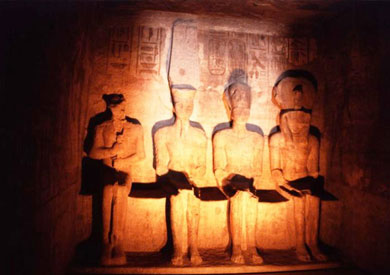
The Great Temple of Abu Simbel was built by Pharaoh Ramses II on the west bank of the Nile in Nubia, in the far south of Egypt. Four colossal statues of the king, each about 20 metres high, guard the entrance. Behind them, a pillared hall leads to a second hall and then to a small sanctuary at the very back, where four seated figures wait in the dark: Ptah, Amun-Ra, Ramses II himself and Ra-Horakhty.
On two mornings each year the rising sun lines up with the temple’s axis. The light enters through the entrance, crosses both halls and reaches the sanctuary. For about twenty minutes the faces of Amun-Ra, Ramses II and Ra-Horakhty glow gold. Ptah, a god linked with craftsmanship, creation and also with the dark underworld, stays in shadow. Many visitors describe the moment as quiet, almost reverent, even with thousands of people packed around the entrance.
Today the event is a celebration as well as an astronomical curiosity. The days around it bring crowds of Egyptian and international visitors, local officials and photographers, and the governorate often arranges music and Nubian cultural performances nearby. The temple itself stays the main attraction.
When Is the Sun Festival in 2026 and 2027?
The two alignments fall on 22 February and 22 October. In 2026, 22 October is a Thursday, so the autumn event is only days away if you are reading this in mid-October. The next one after it is on Monday, 22 February 2027.
You may see older sources quoting 21 February and 21 October. Those were the dates before the temple was moved in the 1960s. After the relocation, the alignment shifted by a single day, and the 22nd is the date used today. Always confirm the exact date and timing with the Ministry of Tourism and Antiquities, your operator or the local authorities, because the schedule of the celebration can change from year to year.
The exact moment depends on the sunrise time on the day, which also depends on whether Egypt is on summer time. Plan to be at the site long before the light arrives, and treat any single minute-by-minute time you read online with caution unless it comes from an official announcement.
How the Alignment Works
The Great Temple faces east and is cut straight back into the sandstone cliff. Its main axis is almost perfectly straight, so on certain mornings the low sun can shine along it like a spotlight. The sun rises at slightly different points on the horizon through the year, moving north and south between the winter and summer extremes. On two mornings, the sunrise point lines up with the axis of the temple, and the light can reach the back.
Three details make the effect so striking. The first is the depth: the sanctuary lies roughly 60 metres inside the rock, so the light must travel a long, narrow corridor. The second is the precision: the doorways and halls line up so well that the ray is not blocked by a pillar or a wall. The third is the placement of the statues. The sanctuary is small, and the seated figures sit close together, so the beam sweeps across several faces in a short time.
The light does not reach Ptah. This is often explained by his link to the underworld and to darkness, and the alignment seems to respect it. Egyptologists generally accept that the builders understood the sun’s path and planned the orientation of the temple around it. What we do not have is an ancient text that describes the alignment or explains why these two dates were chosen, so some of the popular explanations are interpretation rather than proof.
Why These Two Dates? Separating Myth From Evidence
A very popular story says that the two dates mark the birthday of Ramses II and the day of his coronation. It is repeated in many guidebooks and by many guides. The story is attractive, and it fits the idea of a king whose power was tied to the sun. But there is no surviving inscription that confirms either date, so it should be presented as a tradition rather than a proven fact.
Another suggestion is that the dates are about half a year apart for astronomical reasons, because the sun passes the same point on its way north and on its way south. That part is simply geometry. What is less clear is whether the builders chose specific festival days or just built a temple whose axis they knew would catch the sun twice a year. Either way, the result shows a sophisticated understanding of the sky, and the temple’s message is clear: the king is in the company of the sun gods, and the light confirms it.
The Relocation: How a Temple Was Moved Without Losing the Sun
The sun alignment exists today partly because of one of the greatest rescue projects in archaeology. In the 1960s, the construction of the Aswan High Dam threatened to flood Nubia under the waters of Lake Nasser, and Abu Simbel would have been lost. UNESCO launched an international campaign, and between 1964 and 1968 engineers cut the temples into large blocks, numbered them, lifted them out and rebuilt them on a higher site on the cliff.
The temples were reassembled roughly 65 metres higher and about 200 metres back from the river, inside a new artificial structure that supports the rock above. Teams worked to rebuild the temple with the same orientation as the original, so that the sunrise would still reach the sanctuary. They did not manage to reproduce it exactly: the alignment moved by one day, which is why the dates are now 22 February and 22 October instead of the 21st. Considering the scale of the operation, a one-day shift is a remarkable result.
Many visitors find that this story adds to the experience. You are not only watching an ancient design at work, you are watching a modern engineering effort that preserved it.
What You Will See on the Morning
The morning follows a rough pattern, although details change from year to year.
- Before dawn: the area outside the temple fills with people. It is dark and cool, and there is a queue of visitors waiting for the doors to open or for their group to be admitted.
- Sunrise: the sky lightens in the east, and the four colossal statues of Ramses II appear out of the darkness. This is also the best time for photographs of the facade, because the light falls directly on it.
- Entering the temple: visitors move through the pillared hall and the second hall in a slow stream. The reliefs, including the famous Battle of Kadesh scenes, are worth a look on the way.
- The alignment: as the sun climbs, a beam of light moves into the sanctuary. It touches Amun-Ra, Ramses II and Ra-Horakhty, and Ptah remains in shadow.
- The end: after about twenty minutes the light moves off the statues and the sanctuary returns to darkness. Most visitors leave the temple and walk to the small Temple of Nefertari nearby.
Inside the sanctuary, space is limited and visitors are moved through in turn, so you may only get a short time right in front of the statues. If seeing the faces lit is your priority, follow the staff’s instructions and be patient. Remember that rules about photography and flash inside the temple can change, so check on the day.
How to Get to Abu Simbel for the Sun Festival
Abu Simbel is far from everything else. The nearest large city is Aswan, about 280 km away by road. Your main options are:
- By road from Aswan: the usual choice, taking about three to four hours each way. For the festival, departures from Aswan are in the very early hours, so that you arrive before sunrise. Tourist travel on this desert road is regulated, so use a licensed operator who handles the permits and checkpoints.
- By air: there are short flights between Aswan and Abu Simbel, taking around 45 minutes. Seats are limited around the festival and sell out early, so book well ahead and check that the schedule suits the sunrise.
- By Lake Nasser cruise: cruises on the lake stop at Abu Simbel and let you reach the temple without a long drive, although the timing depends on the itinerary.
- Staying overnight: there are a few hotels in Abu Simbel village. They fill quickly around 22 October and 22 February, so book as early as you can. Staying in the village gives you the shortest journey on the morning itself.
If you travel by road, plan the rest of the day as well. The drive back is long, and many visitors continue to Luxor or stay another night in Aswan. Egyptian authorities restrict tourists from travelling some roads at night for safety reasons, so a day that combines Abu Simbel and an onward transfer can take twelve hours or more. Ask your operator for realistic times before you commit to a tight schedule.
Tickets, Prices and Opening Times
At the time of writing, the Ministry of Tourism and Antiquities lists a standard foreign adult ticket for Abu Simbel at EGP 750 (EGP 375 for students), and a higher price of EGP 1,200 (EGP 600 for students) on 22 February and 22 October. Vehicles pay a separate fee. Prices are updated from time to time, so check the official page or ask your operator before you travel.
Entrance tickets are normally not included in a driver-only transfer, so find out in advance whether your booking covers them. Bring your passport or a copy, as you may be asked for ID at the checkpoints on the road, and carry some cash for small purchases and tips.
Practical Tips for the Day
- Arrive early: be at the site well before sunrise. Spots near the entrance fill up first, and late arrivals may end up at the back.
- Dress in layers: the desert is cool before dawn and gets hot quickly. Bring a light jacket, a hat, sunglasses and comfortable shoes.
- Carry water and a snack: there are limited options before dawn.
- Charge your phone and camera: you may use them heavily, and the night start drains batteries.
- Be flexible: crowds, security checks and timing can change at short notice, and staff decisions on the day come first.
- Respect the temple: do not touch the reliefs or statues, and follow the guidance about photography.
- Allow time for the Small Temple: the Temple of Nefertari is just a short walk away and is worth a visit once the crowd thins.
- Plan your return: decide in advance whether you are driving back, flying or staying overnight, and book accordingly.
Beyond the Alignment: What Else to See at Abu Simbel
Do not leave straight after the light fades. The Great Temple has wall reliefs worth studying, including the Battle of Kadesh scenes that show Ramses II in his chariot, and a colossal statue whose fallen head still lies at its feet. A short walk away is the Small Temple, dedicated to the goddess Hathor and to Queen Nefertari, Ramses II’s favourite wife. Its facade has six standing figures, and its hall has pillars topped with the head of Hathor. It is unusual because the queen is shown at the same size as the king.
If you have time, you can also look at the artificial dome behind the temple, which supports the cliff, and the view over Lake Nasser. For a longer trip, combine Abu Simbel with the temples of Philae, the Aswan High Dam and the Nubian villages near Aswan. Our complete Abu Simbel temples guide covers the history and the inside of the temples in more detail.
Can’t Be There on the 22nd?
Many visitors go to Abu Simbel on an ordinary day and still find it unforgettable. The crowds are smaller, the prices are lower and you can spend more time inside. Some operators say that the days immediately before and after the festival give a similar, though less complete, effect, but the official dates remain the 22nd. If seeing the light on the statues is the main goal, plan for the festival date itself and have a backup in case of delays. If the light is not essential, choose a quieter day for a calmer visit.
Frequently Asked Questions
When is the Abu Simbel sun festival in 2026?
The October alignment falls on Thursday, 22 October 2026. The other yearly alignment is on 22 February.
How long does the sun stay on the statues?
The illumination lasts roughly 20 minutes, starting shortly after sunrise.
Which statue stays in the dark?
Ptah, the god linked with darkness and the underworld, remains in shadow. The other three statues are lit.
Is the sun festival really the birthday of Ramses II?
That is a popular tradition, but no ancient inscription confirms it. Treat it as a story rather than an established fact.
How far is Abu Simbel from Aswan, and how long does it take?
It is about 280 km by road, roughly three to four hours each way, or around 45 minutes by plane.
Do I need a guide?
No, a driver is enough, and it is the most flexible choice. A guide adds historical context and helps you in the crowds, but it costs more and is not required. Ask whether tickets are included in your booking.
Plan Your Abu Simbel Sun Festival Trip With Atum Trip
Atum Trip arranges private, air-conditioned transfers from Aswan to Abu Simbel with licensed drivers, and we handle all the travel permits ourselves. We also offer onward transfers to Luxor, Hurghada and Marsa Alam. Tell us your date, your hotel and how many people are travelling, and we will confirm availability. Dates around the festival fill quickly, so message us as early as you can.
Message us on WhatsApp to check availability.
to discover the treasures of ancient Egyptian kingdoms through time.
ead more in the Atum Trip blogs:
- Abu Simbel Temples
- Philae Temple
- Unfinished Obelisk
- Kom Ombo Temple
- Edfu Temple
- Qubbet el-Hawa
- Elephantine Island
- Kalabsha Temple
- Ancient Egyptian Medicine
- Who Is Atum?
- Things to Do in Aswan
- Airport Taxi Transfer Service Booking Guide
- Esna Temple, Khnum and Elephantine
- Aswan to Hurghada or Marsa Alam