
Esna Temple: Khnum, the Creator God, and Elephantine
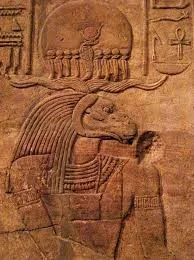
Khnum was the ram-headed Egyptian creator god who fashioned life on a potter’s wheel and was closely associated with the Nile’s life-giving water. Understanding him makes Esna Temple far more than a beautiful columned hall: its carvings become a record of creation, kingship, and the renewal of the world.
This guide begins with Khnum himself, then explores his standing temple at Esna, before turning to the older sacred landscape of Elephantine Island in Aswan. These are two different places, not alternative names for one monument. Together they show how one god could inspire distinct local traditions along the Nile.
Who Was the God Khnum?
Khnum was one of ancient Egypt’s oldest deities. Egyptian artists usually represented him as a man with the head of a ram, although the form of the horns could change over time. In religious images he appears beside a potter’s wheel, shaping a human body or its spiritual double from clay. The image made him an intimate creator: life was not simply commanded into existence but carefully formed.
The ram itself carried ideas of vigor, fertility, and divine power. Khnum’s ram-headed form should not be confused automatically with every Egyptian ram deity. Amun could also take a ram form, as could Banebdjedet and other local gods. Their identities sometimes overlapped in later theology, but each possessed distinct cult centres, traditions, and divine relationships.
Khnum as a creator at the potter’s wheel
Temple reliefs show Khnum creating kings, gods, or ordinary human beings on his wheel. In some scenes he forms both the body and the ka, the vital spiritual force that accompanies a person. The potter’s clay was an especially powerful metaphor in Egypt because fertile mud arrived with the Nile flood. Water, silt, growth, and human birth could therefore be understood as parts of one continuous process.
Khnum was not the only creator god. Ancient Egyptian religion allowed several creation traditions to coexist. The Heliopolitan tradition centered on Atum and the beginning of creation, while Memphis emphasized Ptah’s creative thought and speech. Khnum’s theology focused on skilled formation. Rather than replacing these traditions, Egyptian priests connected and reinterpreted them.
Khnum and the Nile flood
At Elephantine, Khnum was closely associated with the Nile’s inundation. The First Cataract, granite islands, channels, and turbulent water made the region feel like a natural threshold. Ancient Egyptians regarded the southern frontier as one of the places from which the life-giving flood entered Egypt. Khnum could be imagined as guarding or releasing the water and ensuring its abundance.
This ancient explanation was religious rather than geographical in the modern scientific sense. The Nile’s great sources lie much farther south, but Elephantine was the point where the river entered the traditional Egyptian heartland from Nubia. Its landscape therefore gave the flood a visible sacred doorway.
Esna Temple: The Standing Temple of Khnum
Esna lies south of Luxor and north of Aswan. Its Temple of Khnum is located within the modern town, at a level lower than the surrounding streets because centuries of settlement accumulated around it. What survives most impressively is the great pronaos, or columned vestibule. Its massive façade and twenty-four richly decorated columns create an architectural experience very different from the open ruins of Elephantine.
When was the Temple of Esna built?
Esna possessed an older sacred history, and temples stood in the area before the surviving monument. The present structure developed during the Ptolemaic and Roman periods. Work on the inner temple is associated with Ptolemaic rulers, while the monumental pronaos was built and decorated mainly under Roman emperors from the first to third centuries AD.
Inscriptions and reliefs name emperors including Claudius, Vespasian, Titus, Domitian, Trajan, Hadrian, and later Roman rulers. They appear in traditional pharaonic form, presenting offerings to Egyptian gods. This does not mean they personally carved the walls or regularly visited Esna. The images expressed the continuing ritual idea that the legitimate ruler maintained harmony by serving the gods.
The surviving hall is therefore not an Old Kingdom building and should not be described as contemporary with Egypt’s pyramids. It belongs mainly to the Graeco-Roman age, when Egyptian priests continued to compose complex hieroglyphic texts and preserve local religious knowledge under foreign imperial rule.
The twenty-four columns
The pronaos contains twenty-four columns. Their capitals display varied plant forms rather than one repeated design. Palm, papyrus, and other vegetal patterns turn stone into an idealized garden. The decoration reflects abundance and the regenerative power of the created world.
Because the hall long stood below the level of the town and accumulated soot and dirt, many colors were hidden. Modern Egyptian-German conservation work has cleaned parts of the ceiling, columns, and walls, revealing vivid pigments and details that were difficult to recognize before. These restored surfaces allow visitors to appreciate the Roman-period temple as a painted environment, not simply a collection of brown stone carvings.
Astronomy, festivals, and sacred texts
Esna’s ceiling includes astronomical imagery, constellations, decans, planets, and representations of the sky. The walls and columns preserve ritual calendars, hymns, festival texts, geographical lists, and theological compositions. Some inscriptions are written with unusual hieroglyphic spellings and learned wordplay, demonstrating the expertise of the temple’s priestly scholars.
Festival scenes show divine boats, offerings, processions, and the king’s ritual service. The temple’s sacred barque imagery provides an important setting for understanding Khnum’s festivals. Such images help reconstruct how the building functioned: statues of the gods were kept in sacred spaces and carried in processions on ceremonial barques during festivals.
Khnum’s theology at Esna
At Esna, Khnum could be celebrated as a creator of gods, people, animals, and the ordered world. Priests developed multiple forms of the deity, and texts describe his cosmic roles with remarkable richness. His ram form remained central, but the theology was not limited to the Nile flood. He could embody primeval creative power, solar life, breath, fertility, and the organization of existence.
Neith also occupied an important place in Esna’s creation traditions. Some texts present her as a primeval creator and mother, showing again that Egyptian temples did not insist on a single exclusive creation narrative. Khnum and Neith could both receive universal roles within the same intellectual landscape.
Khnum, Heka, and Neith at Esna
Esna developed its own complex theology. Khnum remained the principal local god, but he was worshipped with goddesses including Menhit, Nebtu, and Neith, and with Heka, the personification of magical power. The surviving inscriptions present sophisticated creation accounts in which Khnum’s creative activity could be linked with Neith, an ancient mother and creator goddess.
Heka was more than magic in the modern sense. He represented the divine force that made creation and ritual effective. At Esna, relationships among Khnum, Neith, Menhit, Nebtu, and Heka reveal how temple theologians built a local vision of the cosmos while remaining connected with wider Egyptian traditions.
Khnum Temple on Elephantine Island
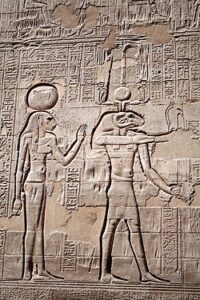
The remains of Khnum’s temple occupy part of the archaeological zone on the southern end of Elephantine Island. Today the visitor encounters foundations, reconstructed architectural elements, blocks, gateways, and evidence from many building phases. It does not resemble the complete monumental hall at Esna. Its importance lies in its deep history and in the way archaeology reveals a sanctuary that changed with the island itself.
Why Elephantine was sacred
Elephantine stood at Egypt’s ancient southern border and controlled movement through the First Cataract. Trade routes brought ivory, incense, animal products, minerals, and other goods from Nubia and farther south. Military expeditions and diplomatic contacts passed through the region. The island was therefore simultaneously a settlement, fortress, trading centre, administrative station, and sacred landscape.
Khnum’s role matched this setting. As master of the cataract and the inundation, he protected the water on which Egypt depended. His temple stood close to the sanctuaries of Satet and other religious buildings, forming a complex ritual environment rather than an isolated monument.
When was the Elephantine Temple of Khnum built?
There is no single construction date for the Elephantine temple. Religious activity on the island reaches back to Egypt’s earliest periods, and the sanctuary of Satet preserves especially early phases. Evidence connected with Khnum developed across the Pharaonic era. Middle Kingdom and New Kingdom rulers contributed to the sacred complex, while major rebuilding and enlargement continued under the Late Period and the Ptolemaic rulers.
The temple whose later remains are best documented was therefore the product of successive kings rather than one founder. Pharaohs added gateways, courts, reliefs, shrines, and inscriptions because building for a god proclaimed royal legitimacy. The Ptolemies, Macedonian rulers who governed Egypt after Alexander the Great, continued to present themselves through Egyptian ritual forms and supported Khnum’s cult.
Much of the complex was dismantled in later centuries, and blocks were reused. Archaeologists have recovered and studied fragments that allow portions of the temple’s history to be reconstructed. When visitors see scattered stone and partial architecture, they are looking at the survival of a long sequence—not evidence that the site was originally small or unimportant.
Walking through the archaeological site
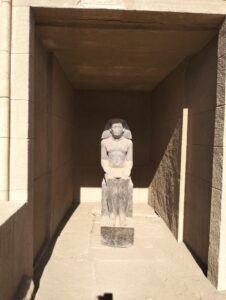
Approaching the southern island by boat, the visitor first senses the relationship between water and stone. Inside the archaeological zone, the ground is uneven and the monuments require imagination. The Nilometer descends toward the river; the remains of Satet’s sanctuary reveal repeated rebuilding; museum objects and inscribed blocks explain the island’s long occupation.
Khnum’s precinct becomes most meaningful when viewed as part of this whole landscape. Pause beside the reliefs, look toward the cataract, and consider why water control, frontier protection, and creation became inseparable here. Elephantine rewards slow observation more than a hurried checklist.
Satet, Anuket, and the Elephantine triad
On Elephantine, Khnum belonged to a divine family usually called the Elephantine triad. He was joined by Satet and Anuket. Satet was an ancient goddess of the southern frontier, Elephantine, and the inundation. Her cult on the island is extremely old, and her sanctuary was repeatedly rebuilt around a natural granite feature. Anuket, often connected with the cataract region and the flowing river, completed the group.
The family relationships assigned to these deities could vary between texts and periods; a single family tree cannot describe every Egyptian religious tradition. Together they expressed a sacred geography: the guardian deities of the frontier, cataract, river, and annual renewal.
Planning Your Esna Temple and Elephantine Visits
Start with Esna’s hall, then look closely
Allow roughly an hour for an unhurried look inside Esna Temple, and longer if you enjoy inscriptions or plan to explore the town. This is a suggested visiting allowance, not a timed admission rule. Begin near the entrance to understand the hall’s scale, then look up at the capitals and ceiling before examining individual offering scenes. Give your eyes time to adjust between the bright street and the shaded interior.
Bring water and comfortable shoes. The temple sits below street level, so ask about the current entrance arrangement and steps if anyone in your group has limited mobility. Do not assume that every historic site has a step-free route. Restoration work may affect specific viewing positions; follow barriers and staff directions rather than trying to reach a better camera angle.
Give Elephantine its own time in Aswan
Reach Elephantine by ferry or an arranged boat crossing from Aswan. Confirm the landing point, return arrangements, and whether the fare is one-way before departure. The boat journey and archaeological admission are separate planning items. Allow around ninety minutes to two hours for the archaeological zone; museum access and the pace of your group can change that estimate.
The island also has living communities. Stay on established paths, ask before photographing residents, and avoid treating homes as part of the archaeological attraction. For a broader introduction, read our Elephantine Island travel guide and things to do in Aswan.
Combine destinations without rushing
Esna can fit a journey between Luxor and Aswan, while Elephantine works naturally on a separate Aswan day. A transfer is not automatically a sightseeing tour: agree on any stop, waiting time, guide, and entry fees before booking. If you also want Edfu Temple or Kom Ombo Temple, leave enough daylight for meaningful visits rather than collecting brief photo stops.
At both sites, look without touching carved or painted surfaces. Follow current photography notices and staff instructions. A phone photograph can record an overall scene, but a guide’s explanation of the figures, offerings, and inscriptions often gives that photograph its lasting meaning.
Historical Sources and Further Reading
The University of Tübingen’s Esna research project documents the temple and its conservation with the Egyptian Ministry of Tourism and Antiquities. Its 2024 restoration report explains how cleaning revealed painted details. For Elephantine, the German Archaeological Institute’s account of research on the island places the temples within a long settlement history. The Global Egyptian Museum’s Khnum entry introduces his creator and inundation roles.
Tickets, Opening Hours, and How to Book
Checked 30 August 2026: consult the linked official listings again near your visit. Admission categories, hours, and access arrangements may change; last entry is not necessarily the same as closing time.
Esna Temple tickets and opening hours
The official Esna Temple ticket page lists foreign adult admission at EGP 200 and foreign student admission at EGP 100. Egyptian adult and student rates are EGP 20 and EGP 10 respectively.
- Saturday, Monday, Wednesday, and Thursday: opens at 7:00 am; the listing specifies last entry at 4:00 pm, without separately stating closing time.
- Sunday, Tuesday, and Friday: listed hours are 7:00 am–6:00 pm.
Use the official page’s “Book Now” option to select the available visit date and ticket category, or ask the site ticket office about on-site admission. Check eligibility before selecting a student ticket and bring supporting identification. Keep your booking confirmation accessible. Mobile-phone photography is listed as free; ask separately about other equipment.
Elephantine tickets and opening hours
The Ministry’s Elephantine listing shows daily hours of 8:00 am–4:00 pm, foreign tickets of EGP 200 for adults and EGP 100 for students, and Egyptian tickets of EGP 20 for adults and EGP 10 for students. Confirm the ticket office and which museum areas are accessible when arranging your crossing. Boat fares are not included in the figures quoted here.
Frequently Asked Questions About Esna Temple and Khnum
Who was Khnum?
Khnum was an ancient Egyptian ram-headed creator god associated with forming life on a potter’s wheel. At Elephantine he was also closely connected with the First Cataract, the Nile inundation, and the southern frontier.
Was Khnum worshipped only on Elephantine Island?
No. Elephantine was one of his most important cult centres, but Khnum was worshipped elsewhere, especially at Esna. His theology and divine companions varied according to the local temple tradition.
Who were Khnum’s wife and daughter?
Khnum, Satet, and Anuket formed the Elephantine triad, although their family relationships were not described identically in every tradition. At Esna, Khnum was associated with deities including Menhit, Nebtu, Neith, and Heka.
When was Khnum Temple on Elephantine built?
It was not built in one campaign. The sanctuary developed through multiple Pharaonic periods, with contributions and rebuilding under Middle Kingdom, New Kingdom, Late Period, and Ptolemaic rulers. Its surviving remains represent many historical layers.
When was Esna Temple built?
Esna had earlier sacred buildings, but the surviving temple structure is mainly Ptolemaic and Roman. Its great pronaos was built and decorated principally during the Roman Period, from roughly the first through third centuries AD.
Are Elephantine’s Khnum Temple and Esna Temple the same place?
No. Elephantine’s temple remains are in Aswan, while Esna Temple is in the town of Esna south of Luxor. Both honour Khnum, but their dates, architecture, associated gods, and visitor experiences differ.
Can I use one ticket for Esna and Elephantine?
No. They are separate sites in different towns. Plan separate admission arrangements, and budget independently for transport and any guide. Check the official listings above before travel.
How long should I spend at Elephantine?
Allow about ninety minutes to two hours for the archaeological zone, temple remains, Satet sanctuary, Nilometer, museum, and river setting. Add more time if you also want to explore the island’s living Nubian communities respectfully.
Is Esna Temple worth visiting?
Yes, especially for travelers interested in Graeco-Roman religion, painted temple decoration, astronomy, and hieroglyphic texts. The twenty-four-column pronaos is very different from the ruined archaeological landscape at Elephantine.
to discover the treasures of ancient Egyptian kingdoms through time.
Read more in the Atum Trip blogs:
- Airport Taxi Transfer Service Booking Guide 2026: Travel Comfortably and Arrive on Time
- Things to Do in Aswan: Complete Travel Guide 2026
- Edfu Temple: An Unforgettable Walk Through the House of Horus 2026
- The greatness of Ancient Egyptian Medicine: Its Remarkable Development, Surgery, and Medical Papyri
- Kalabsha Temple: The Hidden Nubian Treasure of Aswan You Must Discover 2026
- Elephantine Island: A Mesmerizing Journey Through Living History in Aswan 2026
- Explore Qubbet el-Hawa / Dome of the Winds: A Rare Ancient Site Off the Beaten 2026
- The unique Kom Ombo Temple – Horus and Sobek
- Philae Temple
- Abu Simbel Temples: Complete Visitor Guide (2026)
- Who is Atum according to the ancient Egyptians?