
The Unfinished Obelisk in Aswan: Ancient Egyptian Engineering
The Unfinished Obelisk in Aswan is one of the clearest surviving records of ancient Egyptian engineering. Instead of standing at a temple entrance, it remains attached to the rose-granite bedrock of its quarry. Its abandoned form, working trenches, guide marks, and fracture reveal how a colossal monument moved from design to extraction—and why even highly skilled quarry workers sometimes had to stop.
Unfinished Obelisk at a Glance
- Location: The ancient granite quarries of Aswan, on the east bank of the Nile.
- Probable date: The reign of Queen Hatshepsut, around 1473–1458 BC.
- Material: Aswan granite, often described as pink or rose granite.
- Estimated finished size: About 42 metres long and approximately 1,168 tonnes.
- Why it was abandoned: Flaws and several fissures appeared in the stone during quarrying.
- Why it matters: The quarry preserves direct evidence of ancient stone-working methods and is part of the UNESCO World Heritage property “Nubian Monuments from Abu Simbel to Philae.”
Why Is the Unfinished Obelisk Important?
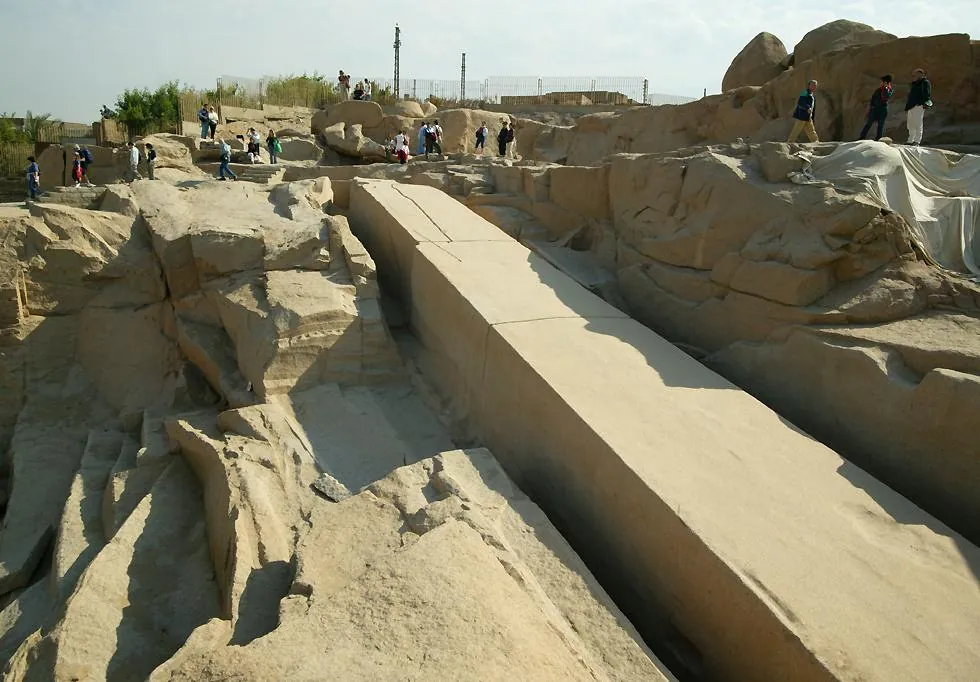
Finished obelisks display the final achievement: a single stone shaft with four tapering sides and a pyramid-shaped top. The Aswan quarry preserves the process instead. Visitors can look down into the channels cut around the monument, follow the outline of its intended form, and see where the granite failed.
UNESCO describes Aswan’s stone quarries and unfinished monuments as fundamental evidence for understanding ancient Egyptian quarrying technology. The site therefore works like an open-air record of labour. It connects the monuments seen at temples with the choices, tools, risks, and physical effort that came before transport and erection.
Was the Obelisk Made for Queen Hatshepsut?
The Egyptian Ministry of Tourism and Antiquities states that the obelisk is believed to have been commissioned by Queen Hatshepsut for the Temple of Amun at Karnak. This is a strong and widely accepted attribution, but it is best expressed with care because the monument was never completed or inscribed with the royal texts that often identify a finished obelisk.
Hatshepsut was one of the most important rulers of Egypt’s Eighteenth Dynasty and commissioned major works at Karnak. The unfinished project fits the scale of her building programme. However, the quarry itself should be read as archaeological evidence rather than used to support speculative stories. The surviving archaeological evidence is more informative than an unsupported connection to a particular monument now standing elsewhere.
What Would the Obelisk Have Looked Like?
Ancient Egyptians called an obelisk a tekhen. It was cut from a single piece of stone, with a rectangular shaft that narrowed toward a pyramidion at the top. Finished examples were normally erected in pairs before temple entrances. The pyramidion could be covered with a reflective metal so that it caught the sunlight.
Obelisks were associated with solar religion and the benben, the primeval mound linked with creation and the first appearance of the sun. Kings used their four faces for names, titles, and religious dedications. If the Aswan example had been finished, the Ministry estimates that it would have measured around 42 metres and weighed about 1,168 tonnes—larger than any other known ancient Egyptian obelisk.
How Ancient Egyptians Quarried Aswan Granite
Aswan granite was valued for its hardness, appearance, and durability. It was used for obelisks, statues, columns, sarcophagi, and architectural elements throughout Egypt. Quarrying a single stone of this scale required planning long before it could be moved toward the Nile.
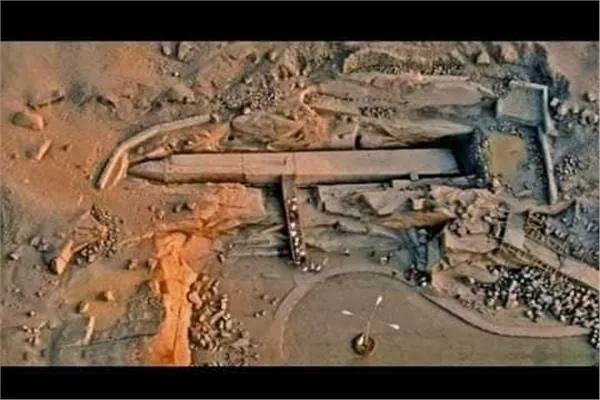
Workers first established the outline and proportions on the exposed granite surface. They then opened trenches around the sides, gradually working downward so that the block remained attached beneath. The quarry preserves repeated marks from pounding and dressing the stone. Dolerite pounders—hard, rounded stones found in quarry contexts—were used to strike and break the granite surface. Ochre-coloured guide lines reported at the site also help visitors imagine how teams controlled the intended shape.
The surviving evidence does not provide a complete instruction manual, and researchers continue to study the organisation and sequence of ancient quarry work. What the visitor can see is more valuable than a simplified legend: an unfinished operation with marks left by many stages of labour.
The Crack That Stopped the Project
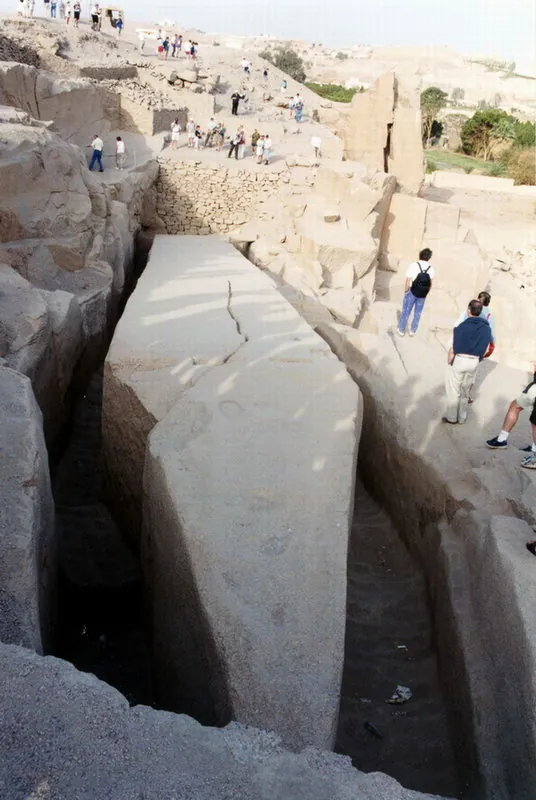
The obelisk was abandoned after flaws and fissures became apparent in the stone. A fracture in a monument this large was not a minor cosmetic problem. The stone had to withstand quarrying, separation from the bedrock, movement to the river, transport by barge, hauling on land, and the enormous stresses of being raised upright.
Continuing after serious cracking would have risked a catastrophic break after even more labour had been invested. The decision to stop therefore shows careful judgement as well as failure. Ancient engineers worked with natural material whose hidden weaknesses could only become clear as extraction progressed.
From the Quarry to the Nile
A completed obelisk would still have faced a difficult journey. After separation and initial dressing, the stone had to be moved from the quarry toward the Nile, loaded onto a specially prepared vessel or barge, transported downstream, and transferred to its destination. It then had to be hauled into position and raised without modern lifting machinery.
The Unfinished Obelisk makes this chain of work easier to appreciate. Its mass explains why granite from Aswan linked quarry workers, surveyors, transport crews, sailors, engineers, and temple administrators. The monument is not simply the product of one ingenious technique; it represents coordinated knowledge across many trades.
What to Look for During Your Visit
- The overall outline: Step back where the visitor path allows and follow the taper from the broad base toward the upper end.
- The working trenches: Notice how closely workers had to operate beside the stone as they cut downward.
- The fracture: Look at its direction and consider the risks it would have created during transport and raising.
- Tool marks: Changes in surface texture help distinguish worked areas from the natural quarry face.
- The surrounding quarry: The obelisk is the main attraction, but the wider landscape is part of the archaeological evidence.
Reading the Quarry as an Engineering Workplace
Begin by separating three questions: how the monument was shaped, how it would have been freed, and how it could have been transported. They are related operations, but evidence for one does not automatically explain the others. A pounding mark can reveal how a surface was worked; it cannot, by itself, prove the exact arrangement of ropes or boats that would have moved the finished stone. This distinction makes the visit more interesting because it turns an impressive object into a problem that can be explored carefully.
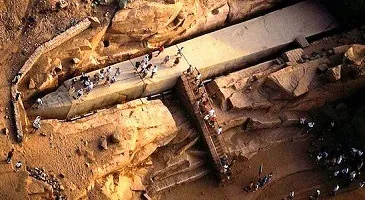
Look first at the narrow channels beside the shaft. Their depth helps convey the limited space available to a worker as the operation progressed. Then compare the comparatively even upper surface with rougher areas nearby. Finally, step back to consider the stone that still joins the monument to its geological setting. Unlike a temple obelisk, this one has never been separated from the landscape that supplied it.
It is tempting to look for a single ingenious secret behind Egyptian construction. The quarry suggests a more substantial achievement: repeated skilled actions, measurement, familiarity with materials, and coordination over time. A team had to keep a large intended shape consistent while responding to the actual stone. The abandoned project is therefore evidence of practical judgement as well as ambition.
What the unfinished surface can and cannot tell us
Not every mark visible today should be assigned to the same operation or date. An ancient quarry could be used repeatedly, and its surfaces have also experienced weathering, excavation, and visitor management. Site labels and specialist explanations are valuable because a casual observer may mistake a natural irregularity for a tool mark or assume that neighboring cuts belong to the same monument.
The surviving shaft has no completed royal inscription giving a full account of its commission. That is why the association with Hatshepsut should remain a probable attribution. Explaining this uncertainty does not diminish the monument. It shows how archaeologists work: the object, its location, related building projects, and the wider history of quarrying are considered together, rather than replaced with an attractive but unproven story.
Granite, Scale, and the Meaning of a Single Stone
Granite gives the visit a distinctive visual character. Look at its grains, variations in color, and changing appearance under direct light and shadow. The material is not a uniform manufactured substance. Its natural structure matters to the story because the builders were trying to obtain one continuous block large enough for a monumental shaft. A problem in one part could affect the usefulness of the whole piece.
The estimated weight and length are helpful, but they become more meaningful when related to a person standing beside the quarry. The visible stone lies horizontally; the planned monument would have risen vertically above a temple approach. Imagine its broad lower end as a base and follow the taper toward the top. This simple change of perspective explains why a visit to an unfinished object can be as memorable as seeing a completed monument.
Do not assume that the published dimensions describe a finished object that once stood here. They express what the abandoned project would have become. Its present condition is the evidence: partly shaped, cracked, and still attached. Captions, guide explanations, and photographs are clearest when they distinguish the intended monument from the surviving work in progress.
Quarry, Temple, and Museum: Three Different Views of Ancient Work
A quarry visit and a temple visit answer different questions. At the quarry, attention falls on extraction, material, and physical constraints. At a temple, the finished stone participates in an architectural and religious setting. In a museum, labels and objects can help explain the historical context. None is a substitute for the others, and combining them gives a more complete understanding than treating the quarry as a brief stop between famous buildings.
For a traveler based in Aswan, the Unfinished Obelisk is especially useful early in an itinerary. Afterwards, large stone doorways, statues, and columns become easier to appreciate as products of quarrying and transport. The comparison should remain careful: not every stone at every temple is granite, and different materials required different working methods. The lesson is to ask what each monument is made from and what that choice allowed its builders to do.
A Comfortable Visit for Different Travelers
Families and curious first-time visitors
With children, concentrate on a few visible ideas rather than a long list of dates. Can they find the outline of the intended shaft? Where is the crack? Which side would have pointed upwards? These questions make the site understandable without pretending that every detail of ancient engineering has been solved. Keep the group on the visitor route and avoid using the monument itself as a climbing or demonstration surface.
Photography and slower observation
Start with a wide photograph showing the obelisk in its quarry, then take a closer image of a visible working surface from the permitted path. A final image with the surrounding landscape records the setting. Do not step into restricted areas to reproduce a dramatic aerial photograph: the useful ground-level view is the one you can reach safely and legally. A few accurately captioned pictures are more informative than many nearly identical shots.
Heat, walking, and realistic timing
Build the visit around the least mobile member of your group. A short distance on a map may still involve steps, changes of level, and reflective stone under strong sun. Ask about the current route before buying a combined excursion if accessibility is important. Your driver’s arrival time should leave room for admission and a comfortable walk, not just a hurried photograph before closing.
The quarry is best understood when there is time to pause. Even a visitor who is not especially interested in engineering can leave with a clearer sense of the decisions behind Egypt’s monuments: choosing the material, recognizing its limits, and knowing when continued work was no longer worthwhile.
Planning a Visit to the Unfinished Obelisk
The archaeological site is close to central Aswan and is normally visited by road. It is an exposed granite quarry, so the heat and glare can be strong even when the visit is not long. Early morning is generally the most comfortable time and often provides softer light for photography.
- Suggested duration: Allow around 45–60 minutes for a comfortable circuit with explanation and photographs.
- Footwear: Wear shoes with a secure grip. Paths, steps, and stone surfaces may be uneven.
- Sun protection: Carry water, a hat, and sunscreen, especially outside the cooler winter months.
- Accessibility: The sloping quarry landscape and steps can be difficult for visitors with limited mobility. Confirm current access arrangements before travelling.
- Photography: Follow signs and staff instructions. Do not leave the marked route or climb on archaeological surfaces.
How to Combine the Unfinished Obelisk with Aswan Highlights
The site fits naturally into a half-day route with Philae Temple and the Aswan High Dam. Together, the three stops connect ancient stone working, temple history, the UNESCO rescue campaign, and modern engineering. Visitors with more time can continue to Elephantine Island or explore the wider selection in our guide to things to do in Aswan.
A guide can make the quarry easier to read because much of its importance lies in subtle marks and the sequence of work rather than decoration. If you are arriving by air, plan enough time between your Aswan airport transfer and the site’s closing time.
Authoritative Sources
- Egyptian Ministry of Tourism and Antiquities: The Unfinished Obelisk
- UNESCO World Heritage Centre: Nubian Monuments from Abu Simbel to Philae
How to Obtain Tickets and Check Opening Hours
The Egyptian Ministry of Tourism and Antiquities listing, checked on 30 August 2026, gives daily opening hours of 7:00 am to 4:00 pm. Listed admission is EGP 220 for foreign adults and EGP 110 for foreign students, with separate Egyptian visitor categories. These are site admission prices, not the cost of a private car or guide.
Before travelling, consult the official Unfinished Obelisk visitor page for the latest categories and any available official booking link. If arranging an excursion, ask whether admission is included in the written quotation or paid separately at the site. Students should confirm eligibility and accepted identification before relying on a discounted ticket.
Opening hours and fees can change. Confirm last admission, current payment arrangements, and any temporary restrictions close to your visit. Arriving well before the listed closing time allows a proper circuit rather than a rushed stop. Keep your ticket available for inspection, and follow the marked visitor route after entering.
Frequently Asked Questions
Why is it called the Unfinished Obelisk?
It was abandoned while still attached to the quarry bedrock. The intended outline had been formed, but the stone was never fully separated, transported, inscribed, or erected.
Who commissioned the Unfinished Obelisk?
It is widely believed to have been commissioned during the reign of Queen Hatshepsut for the Temple of Amun at Karnak. Because the monument was never finished or inscribed, responsible descriptions present this as a probable attribution rather than absolute certainty.
How big is the Unfinished Obelisk?
According to Egypt’s Ministry of Tourism and Antiquities, it would have stood around 42 metres high and weighed approximately 1,168 tonnes if completed.
Why did the ancient workers abandon it?
Flaws and several fissures appeared in the granite. Those weaknesses could have caused the stone to break during extraction, transport, or erection.
Can visitors see ancient tool marks?
Yes. Worked surfaces, pounding marks, trenches, and reported guide lines make the quarry especially valuable for understanding the process of shaping granite.
Is the Unfinished Obelisk part of a UNESCO World Heritage Site?
Yes. The stone quarries and obelisk form one component of the UNESCO World Heritage property “Nubian Monuments from Abu Simbel to Philae.”
How long should I spend at the site?
Most visitors need about 45–60 minutes. Allow more time if you want a detailed archaeological explanation or need to move slowly on the uneven route.
What is the best time to visit?
Early morning is usually best for cooler temperatures and gentler light. Always check the current official schedule before travelling.
to discover the treasures of ancient Egyptian kingdoms through time.

Read more in the Atum Trip blogs:
- Esna Temple: Khnum, the Creator God, and Elephantine
- Airport Taxi Transfer Service Booking Guide 2026: Travel Comfortably and Arrive on Time
- Things to Do in Aswan: Complete Travel Guide 2026
- Edfu Temple: An Unforgettable Walk Through the House of Horus 2026
- The greatness of Ancient Egyptian Medicine: Its Remarkable Development, Surgery, and Medical Papyri
- Kalabsha Temple: The Hidden Nubian Treasure of Aswan You Must Discover 2026
- Elephantine Island: A Mesmerizing Journey Through Living History in Aswan 2026
- Explore Qubbet el-Hawa / Dome of the Winds: A Rare Ancient Site Off the Beaten 2026
- The unique Kom Ombo Temple – Horus and Sobek
- Philae Temple
- Abu Simbel Temples: Complete Visitor Guide (2026)
- Who is Atum according to the ancient Egyptians?