
What Is Edfu Temple and Why Is It Important?
Edfu Temple, also called the Temple of Horus at Edfu, stands on the west bank of the Nile between Aswan and Luxor. The surviving monument was built mainly during the Ptolemaic period, when Egypt was ruled by a dynasty of Macedonian Greek origin that adopted the public language and religious traditions of Egyptian kingship. Its importance comes from more than its impressive preservation. Many Egyptian temples survive only in fragments: a gateway, scattered columns, foundations, or isolated reliefs. At Edfu, visitors can still follow a remarkably complete sequence from the monumental entrance through the courtyard and columned halls to the sanctuary and surrounding ritual chambers. The inscriptions are equally valuable. They preserve extensive information about ceremonies, the temple calendar, priestly duties, sacred geography, and the rituals through which the Egyptians maintained order in the divine and human worlds. These texts must still be interpreted with care—they describe an ideal sacred system rather than an ordinary day witnessed by a modern observer—but they provide exceptional evidence for late Egyptian religion.Who Built Edfu Temple?
The first stone of the Ptolemaic temple was laid in 237 BC under Ptolemy III Euergetes. Construction and decoration continued under successive rulers for generations. The inner portion was formally consecrated in 142 BC, while work on the pronaos, pylon, enclosure, and decoration continued afterward. The completed temple was consecrated in the first century BC, more than 170 years after construction began. That long timeline matters. Edfu Temple was not the creation of one king or one architectural campaign. It was a multigenerational project in which rulers repeatedly presented themselves in the traditional role of pharaoh: offering to the gods, defeating disorder, and protecting Egypt. Although the Ptolemies came from outside Egypt, the imagery on these walls places them within a much older Egyptian ideology of sacred kingship. The Ptolemaic building also did not appear on an empty site. Edfu had been an important settlement and cult center long before 237 BC. Inside the sanctuary stands a granite naos bearing the name of Nectanebo II, a ruler of Egypt’s Thirtieth Dynasty. It predates the visible Ptolemaic structure and connects the later temple with an earlier sacred building.Horus of Edfu: The Falcon God at the Center of the Temple
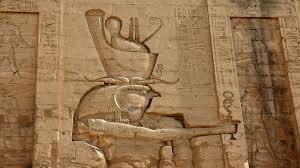
Walking Through Edfu Temple Step by Step
The Mammisi and the Approach
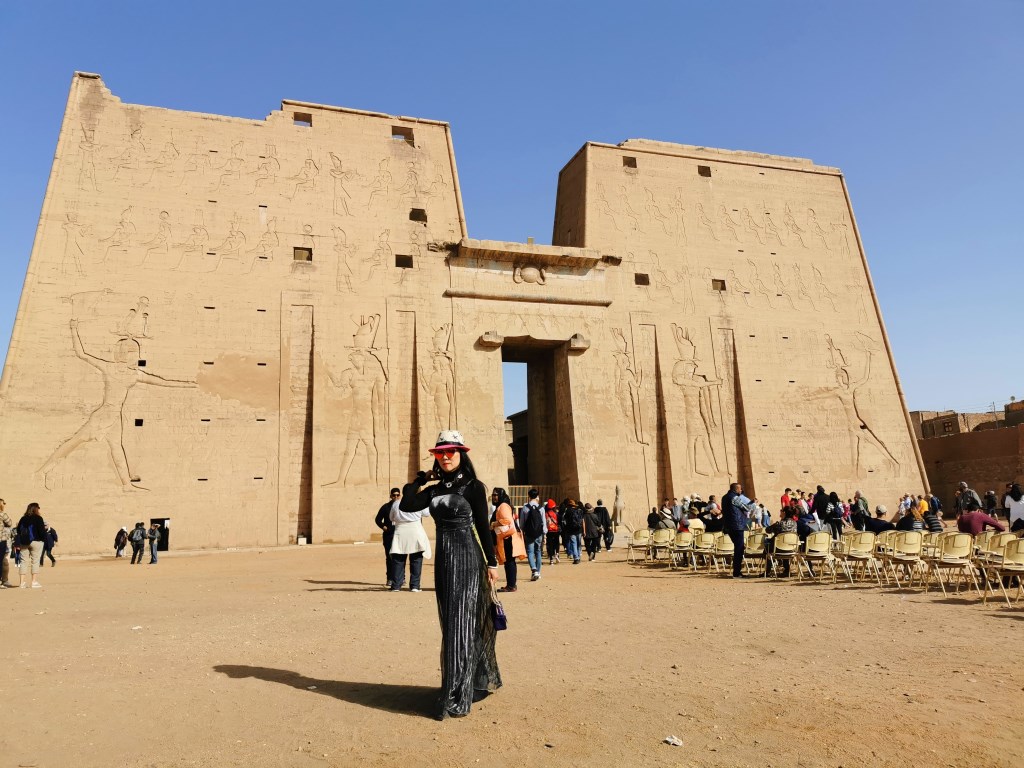
Before reaching the principal gateway, you encounter the remains of a mammisi, or birth house. Such buildings were associated with divine birth and the renewal of royal legitimacy. Its position outside the central temple reminds you that the sanctuary once belonged to a larger sacred complex rather than standing alone as it appears in many photographs. Then your attention is pulled upward to the pylon. Roughly symmetrical towers frame the central entrance, their broad surfaces covered with reliefs of the king before the gods. The scale deliberately reduces the human visitor. You stand below a world in which rulers and deities are monumental, while the gateway offers the only path forward.The Great Pylon
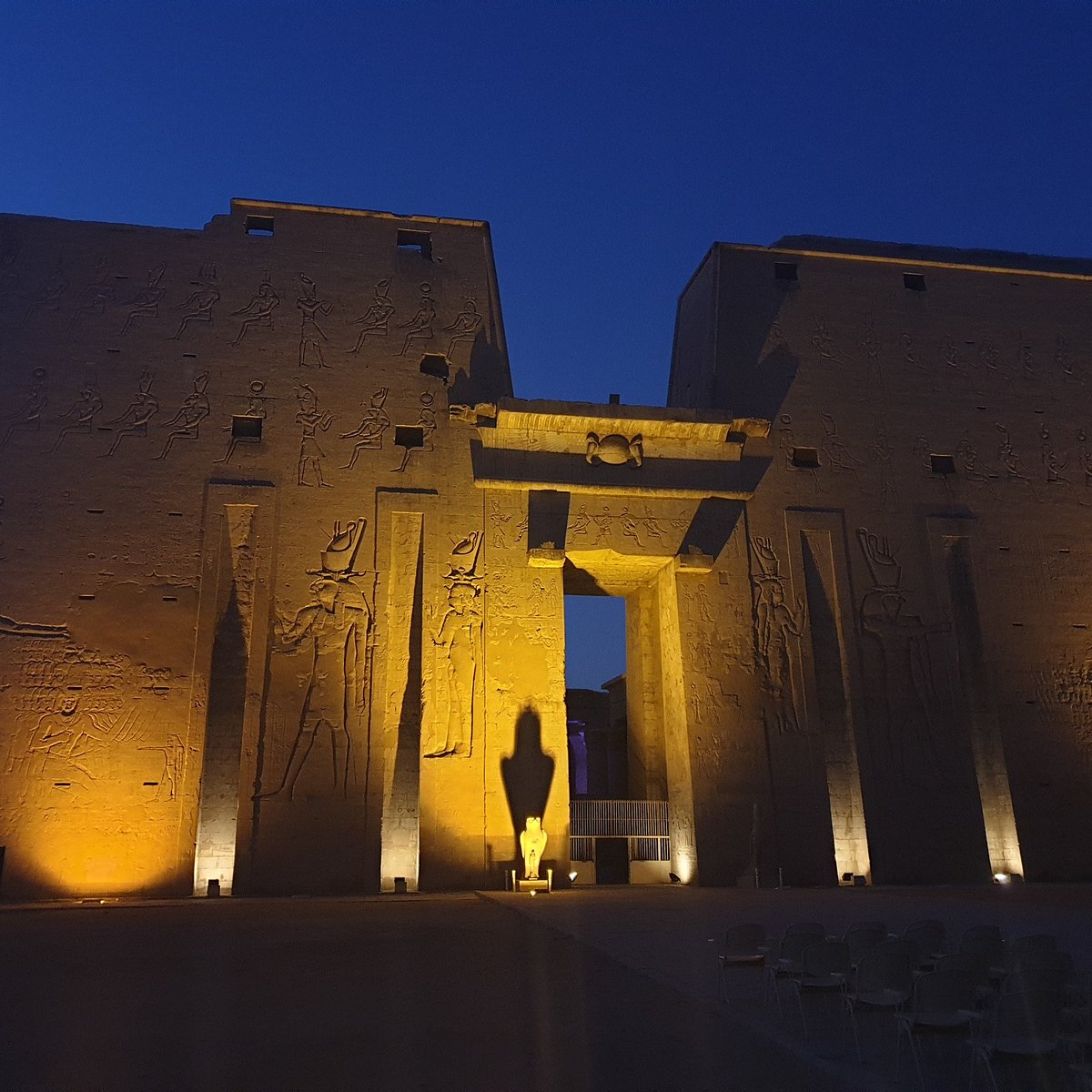
The Open Courtyard
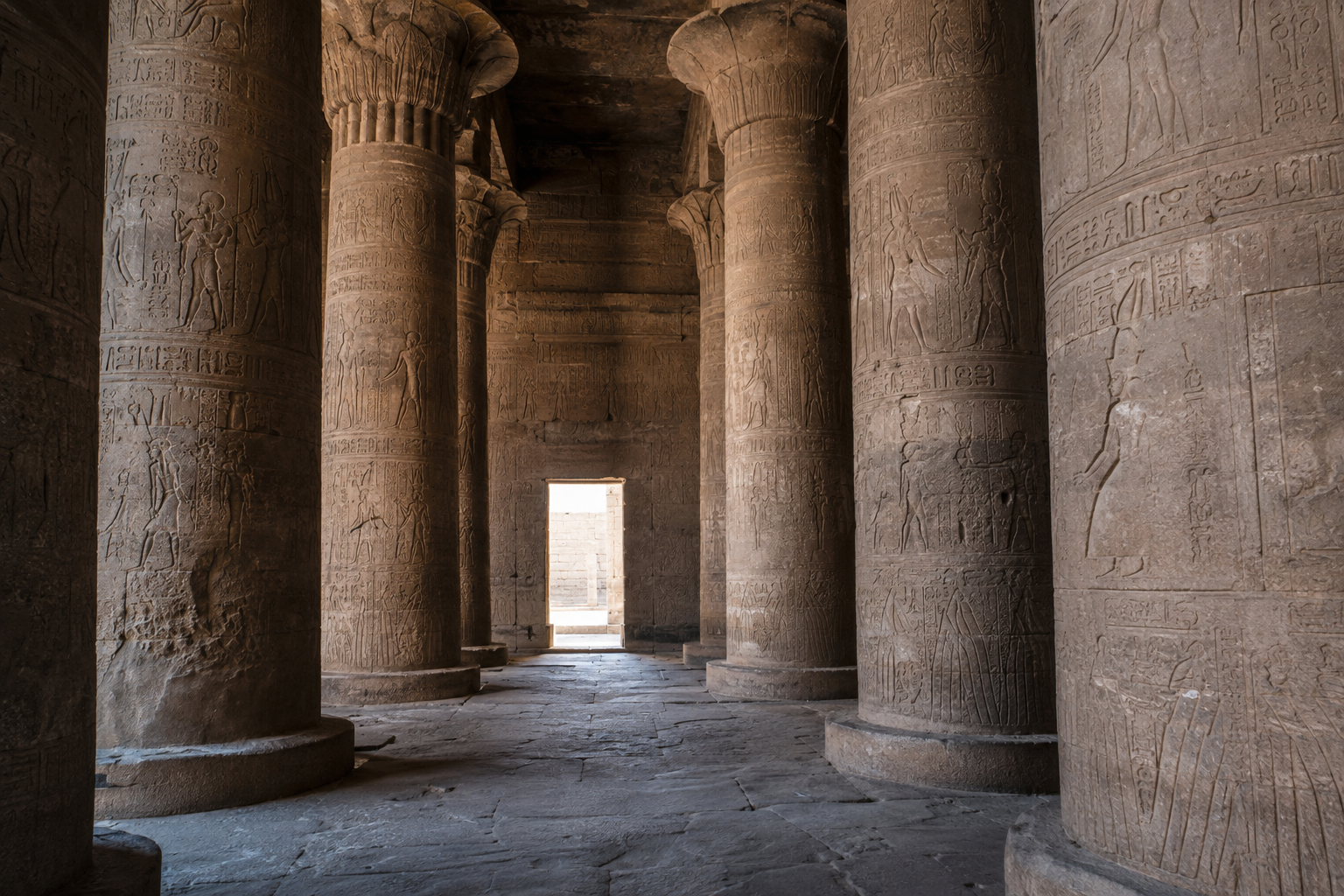
The First Hypostyle Hall
The Inner Halls and Offering Rooms
As you continue, the architectural axis becomes more intimate. A second hypostyle hall and a sequence of vestibules lead toward the sanctuary. Rooms were associated with offerings, preparation, ritual purity, and the storage of objects required for cult practice. Here it becomes easier to understand that an Egyptian temple was not primarily a congregational building. Daily service centered on the divine image and was carried out by authorized priests. Food, drink, linen, incense, oils, and symbolic objects moved through a carefully ordered system. The building functioned as the god’s earthly residence and as an institution supported by land, labor, and administration.The Sanctuary and Granite Naos
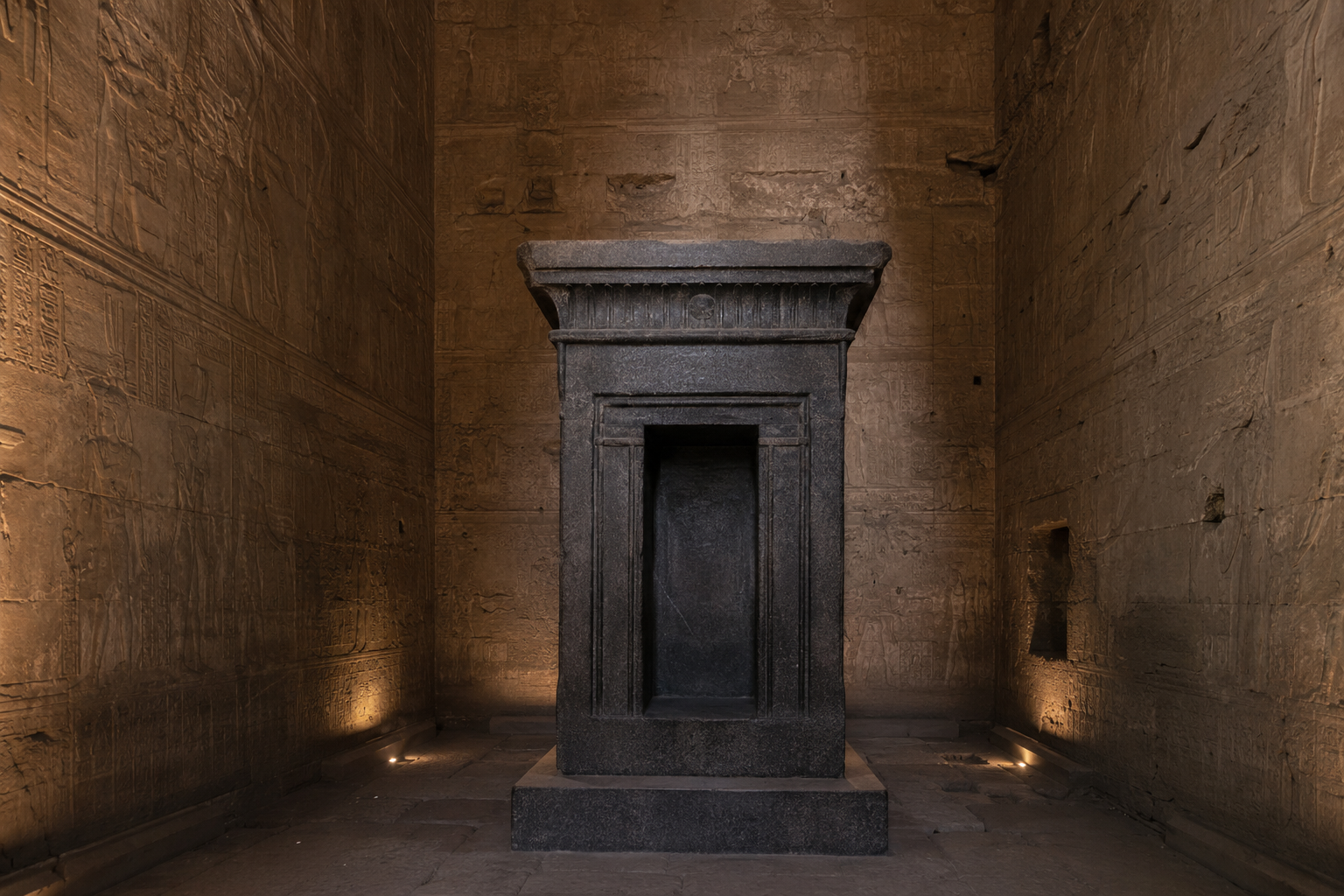
The Horus and Seth Reliefs
One of the most memorable areas lies along the inner enclosure, where reliefs present the ritual drama of Horus overcoming Seth. Horus and accompanying figures spear a hippopotamus, a form connected here with the defeated adversary. Repeated action emphasizes that disorder was not conquered once and forgotten; it had to be ritually controlled again and again. These scenes are sometimes described loosely as the world’s first comic strip or as a straightforward historical battle. Both labels are misleading. The sequence certainly tells a story visually, but it belongs to a complex union of myth, performance, temple ritual, and kingship. Its power comes from this combination, not from forcing it into a modern category.How Was Edfu Temple Preserved?
The temple’s survival was partly the result of burial. Over centuries, accumulating debris and settlement covered much of the structure. Houses were built above and around the buried monument, while sand and material helped shield lower walls from prolonged exposure. During the nineteenth century, Auguste Mariette directed clearance work at Edfu. Calling this simply a “discovery” would erase the fact that local people already lived around and above the visible remains. Archaeological clearance revealed the monument on an extraordinary scale, but it also belonged to an era whose methods and effects on communities differed from modern practice. Some reliefs show damage to divine faces and figures, often associated with changing religious use in late antiquity. Soot-darkened ceilings and other traces also reveal that the temple continued to exist within later human lives. Preservation does not mean the building was frozen after the Ptolemies; its stones carry several histories.Practical Guide to Visiting Edfu Temple
Where Is Edfu Temple?
The temple is in the city of Edfu on the west bank of the Nile, approximately between Luxor and Aswan. Nile cruises commonly include it, and it can also be visited during an overland journey. Travelers using an Aswan to Luxor private transfer can arrange Edfu as an optional stop, often together with Kom Ombo Temple. Allowing enough time matters: Edfu rewards a slower walk far more than a hurried photograph at the pylon.Opening Hours and Tickets
Egypt’s official monument-ticket platform currently lists seasonal working hours for the Temple of Horus at Edfu, with opening from 7:00 AM and earlier last entry in winter than in summer. Hours, ticket categories, and prices can change, so check the official Egyptian monuments booking page shortly before your visit rather than relying on an old price copied into a blog post.Best Time to Visit
Early morning is generally the most comfortable choice, particularly during hot months. Temperatures are lower, the stone receives softer light, and you may have more space before large groups arrive. Visitor patterns change with cruise schedules, however, so there is no guaranteed empty hour.What to Bring
- Comfortable shoes for stone and uneven surfaces
- Water, especially during warmer months
- Sun protection for the exposed courtyard and approach
- A camera or phone, while respecting current photography rules
- Enough time to look beyond the main entrance
What Most Visitors Should Not Miss
If time is limited, focus on the spatial journey rather than racing between isolated highlights:- Step back far enough to understand the full scale of the pylon.
- Examine how the courtyard changes from sun to shade.
- Compare the varied column capitals.
- Notice the shift in light through the hypostyle halls.
- Spend time with the granite naos in the sanctuary.
- Find the ritual reliefs showing Horus defeating Seth.
- Look for smaller rooms and inscriptions that reveal the temple’s practical functions.
Why Edfu Temple Still Matters
Edfu gives modern visitors an unusually coherent view of an Egyptian temple, but its completeness should not tempt us to treat it as a perfect model for every period. It is a late temple shaped by Ptolemaic politics, older Egyptian traditions, local theology, and centuries of ritual development. Earlier temples could differ in plan, material, scale, and religious emphasis. That qualification makes Edfu more interesting, not less. Its rulers were Greek-speaking monarchs presenting themselves through Egyptian sacred forms. Its priesthood preserved and developed complex traditions. Its festivals joined towns through river journeys. Its inscriptions looked backward to creation while its builders worked across generations in a changing Mediterranean world. When you finally walk back toward the courtyard, the movement reverses. Darkness loosens its hold, columns separate, and the blue sky returns above the pylon. The town waits outside, full of engines, voices, and ordinary life. Yet the temple has changed the way you see the stone behind you. You have not merely entered an old building. You have followed a path designed to transform space into meaning—from public power to sacred mystery, from the king’s monumental image to the quiet naos of Horus. That is why Edfu Temple remains unforgettable: it allows the architecture of ancient Egyptian belief to be felt one threshold at a time.Frequently Asked Questions About Edfu Temple
Who was Edfu Temple built for?
Edfu Temple was principally dedicated to Horus of Edfu, a falcon-form deity associated with the sky, solar power, protection, divine order, and legitimate kingship.When was Edfu Temple built?
Construction of the surviving Ptolemaic temple began in 237 BC and continued in stages for more than 170 years, with completion and final consecration in the first century BC.Is Edfu Temple worth visiting?
Yes. Its unusually complete sequence of pylons, courtyard, hypostyle halls, inner rooms, sanctuary, and ritual inscriptions makes it one of Egypt’s clearest places for understanding how a temple was organized.How long should I spend at Edfu Temple?
Around 90 minutes allows a useful first visit, while two hours or more is better for travelers who want to study the reliefs and smaller chambers without rushing.Can I visit Edfu while traveling between Aswan and Luxor?
Yes. Edfu is a practical cultural stop on the overland route between Aswan and Luxor and is also included in many Nile-cruise itineraries.Also Read Our Other Blog Posts
- The Unique Kom Ombo Temple — Horus and Sobek
- Kalabsha Temple: The Hidden Nubian Treasure of Aswan
- Elephantine Island: A Journey Through Living History
- Qubbet el-Hawa / Dome of the Winds
Official Opening Hours and Ticket Prices
The Ministry of Tourism and Antiquities currently lists Edfu Temple as closing at 5:00 pm every day. The official weekly schedule shows opening at 6:00 am on Sunday and Wednesday and at 7:00 am on the other listed days. Tickets are listed at EGP 550 for foreign adults and EGP 275 for foreign students. Egyptian admission is listed at EGP 40 for adults and EGP 20 for students.
Schedules and admission prices can change, and the ticket window may close before the monument itself. Check the official Edfu Temple page and the official Egypt monuments ticket portal shortly before visiting.
What are the current Edfu Temple opening hours and ticket prices?
Edfu currently closes at 5:00 pm daily, opening at 6:00 am on Sunday and Wednesday and 7:00 am on the other days shown by the Ministry. Foreign adult/student tickets are listed at EGP 550/275. Verify current details through the official links above.
Edfu Temple Location
Use the interactive map below to view Edfu Temple, Edfu, Egypt and open directions in Google Maps.