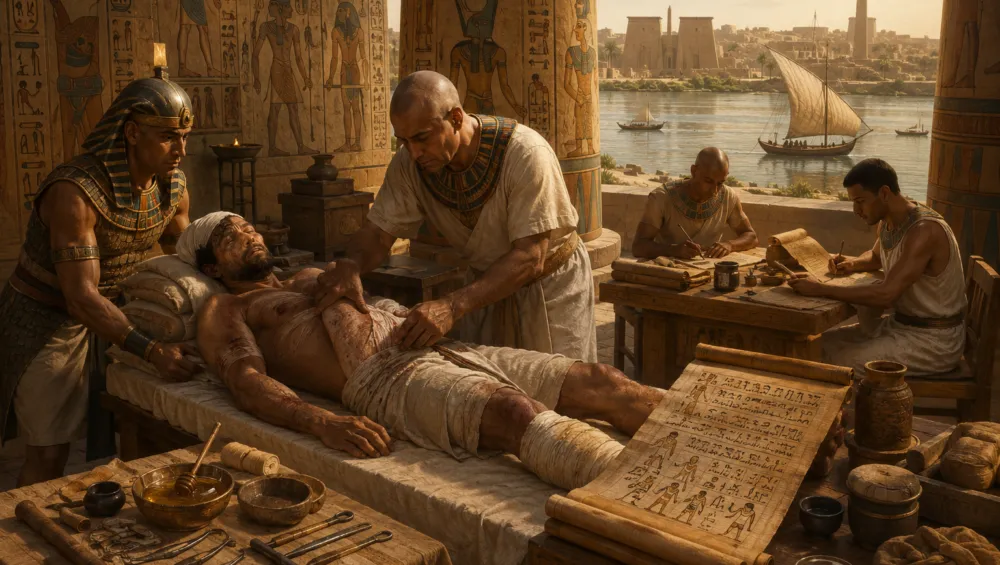
Ancient Egyptian medicine was one of the most sophisticated healing traditions of the ancient world. Across more than three millennia, Egyptian physicians learned to observe symptoms, examine wounds, set fractures, prepare medicines, and record their methods on papyrus. Their practice was never identical to modern medicine: practical treatment existed beside religious ritual and magic. Yet surviving texts reveal an impressive movement toward systematic examination, diagnosis, prognosis, and treatment.
This article follows the development of medicine from the Early Dynastic Period and Old Kingdom to the Greek and Roman eras. It also explains the most important medical papyri, the operations and procedures ancient Egyptian healers performed, and the evidence left by mummies, tomb scenes, and temple reliefs.
When Did Medicine Become Advanced in Ancient Egypt?
There was no single moment when Egyptian medicine suddenly became advanced. Knowledge accumulated gradually. Evidence for specialist physicians appears in the Old Kingdom, while important surviving manuscripts were copied during the Middle Kingdom and New Kingdom. Many of these papyri probably preserve ideas that were already centuries old.
The Old Kingdom, especially the Third to Sixth Dynasties (about 2686–2181 BC), produced some of the earliest named physicians and medical titles. The Middle Kingdom (about 2055–1650 BC) is represented by specialist texts such as the Kahun Gynaecological Papyrus. The early New Kingdom, particularly the Eighteenth Dynasty, gave us copies of the Ebers Papyrus and the Edwin Smith Papyrus. Later, during the Ptolemaic and Roman periods, Egyptian traditions interacted with Greek medical learning in centres such as Alexandria.
The Earliest Physicians: Medicine in the Old Kingdom
One of the best-known early medical figures is Hesy-Ra, who lived during the reign of King Djoser of the Third Dynasty, around the twenty-seventh century BC. His wooden tomb panels identify him with high-ranking titles commonly translated as “chief of dentists and physicians.” The exact interpretation of ancient professional titles is debated, but the inscription clearly shows that medical occupations had status and organisation at the royal court.
Another famous figure is Imhotep, Djoser’s official and the architect traditionally associated with the Step Pyramid at Saqqara. Modern popular accounts often call Imhotep the first doctor, but no contemporary inscription securely identifies him as a physician. Centuries after his death, however, he was worshipped as a divine healer and was later associated by the Greeks with Asclepius. His reputation illustrates how medicine, wisdom, religion, and royal authority could merge in Egyptian memory.
Old Kingdom evidence also indicates specialisation. Egyptian titles refer to physicians connected with the palace, the army, labour forces, and particular parts of the body. Some practitioners may have focused on eyes, teeth, the abdomen, or other complaints. This does not mean specialisation functioned exactly like a modern hospital department, but it proves that Egyptian healing was more organised than a single undifferentiated craft.
How Ancient Egyptian Medicine Worked
Egyptian healers did not divide science and religion as sharply as we do. Illness might be attributed to injury, diet, parasites, environmental conditions, divine displeasure, malevolent forces, or the action of a deceased person. A treatment could therefore combine a physical remedy with a spoken spell.
Three broad roles appear in the evidence. The swnw is usually translated as physician and was associated with practical treatment. Priests of Sekhmet were linked with healing and ritual knowledge. Specialists connected with the goddess Serqet dealt particularly with dangerous bites and stings. One person could possibly possess more than one kind of expertise.
Despite the magical dimension, many Egyptian medical instructions are strikingly methodical. A healer might question the patient, smell or inspect a discharge, feel the pulse, examine movement, compare both sides of the body, and monitor changes over several days. Some texts divide cases into three outcomes: “an ailment I will treat,” “an ailment with which I will contend,” and “an ailment not to be treated.” This is an early form of prognosis and triage.
The Edwin Smith Papyrus: A Landmark in Trauma and Surgery
The Edwin Smith Papyrus is the strongest evidence for rational trauma medicine in ancient Egypt. The surviving manuscript was copied around 1600 BC, during the Second Intermediate Period, but its language suggests that it derives from a considerably older work, perhaps composed around 1900 BC or earlier.
The papyrus presents 48 cases arranged anatomically from injuries of the head downward to the shoulders and chest, where the surviving text ends. Each case generally follows a recognisable sequence: title, examination, diagnosis, prognosis, and treatment. The injuries are consistent with accidents on building sites or wounds sustained in combat.
Its authors observed anatomy with remarkable care. They described skull fractures, wounds exposing bone, injuries to the spine, dislocations of the jaw, broken collarbones, chest injuries, and neurological symptoms. The text connects damage to the brain with effects elsewhere in the body, such as impaired movement or speech. It also contains an early written reference to the brain and describes the membranes and fluid surrounding it.
Treatments include bandaging, suturing, applying fresh meat to control bleeding during the first day, using honey and grease in later dressings, immobilising fractures, and repositioning certain dislocations. Not every remedy would meet modern medical standards, but the clinical organisation is extraordinary for its age.
What Surgical Procedures Were Performed?
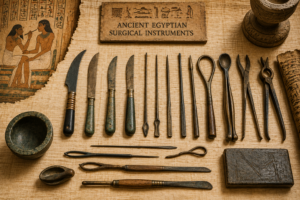
The Egyptian evidence supports several forms of minor surgery and trauma care:
- Suturing wounds: The Edwin Smith Papyrus recommends drawing together the edges of some wounds with stitches.
- Bandaging: Linen was used to protect wounds, maintain dressings, and provide support.
- Setting fractures: Injured bones could be aligned and immobilised with splints made from wood, bark, linen, and other materials.
- Reducing dislocations: The papyrus gives practical instructions for treating a dislocated jaw and some shoulder or collarbone injuries.
- Draining swellings or abscesses: Other medical texts mention cutting certain swellings and treating the opening afterward.
- Cauterisation: Heat could be used in selected cases to destroy tissue or control a lesion.
- Circumcision: Old Kingdom tomb scenes, especially the relief traditionally identified as a circumcision scene in the tomb of Ankhmahor at Saqqara, are often cited as evidence of the procedure.
- Dental intervention: Egyptian remains show heavy tooth wear and dental disease. Treatments probably focused more on pain relief and stabilisation than complex restorative dentistry.
Claims that Egyptians routinely performed major abdominal operations or brain surgery should be treated cautiously. Trepanation has been reported in a small number of skulls, but evidence that it was common or performed successfully during life is limited. Mummification gave embalmers knowledge of the body, yet embalmers and physicians were not necessarily the same profession.
The Ebers Papyrus: Medicine, Drugs, and Internal Disease
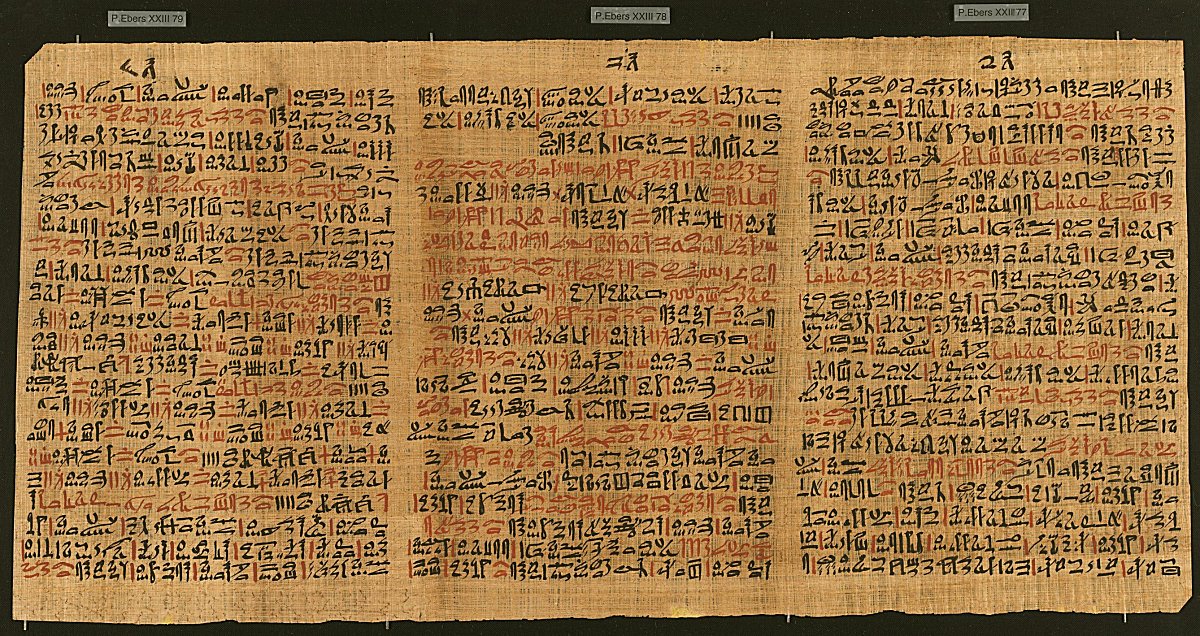
The Ebers Papyrus, copied around 1550 BC in the early Eighteenth Dynasty, is the largest and most wide-ranging surviving Egyptian medical manuscript. Its 110 columns contain hundreds of passages, including prescriptions and discussions of diagnosis. It covers digestive complaints, skin disease, eye conditions, burns, wounds, parasites, dental pain, pregnancy, contraception, and disorders associated with the heart.
Its remedies draw on plants, minerals, and animal products. Ingredients include honey, resins, oils, dates, figs, onions, garlic, natron, ochre, and many herbs. Preparations could be swallowed, inhaled, applied as an ointment, placed in a bandage, used as a wash, or administered by other routes.
Honey was particularly valuable. Modern research confirms that some kinds of honey can inhibit bacterial growth, although ancient Egyptians did not understand microbes. They used honey in wound dressings because experience showed that it helped protect and soothe injured tissue. Resins and oils could also form barriers, while linen kept a dressing in place.
The Ebers Papyrus includes a famous “treatise on the heart.” Egyptian writers believed that vessels connected the heart to the body. Their model was not modern circulation, and they sometimes imagined that air, blood, tears, urine, and other substances travelled through a common network. Nevertheless, feeling the pulse and relating it to the heart demonstrates careful physiological observation.
The Kahun Gynaecological Papyrus
The Kahun Gynaecological Papyrus comes from the Middle Kingdom town of Lahun and dates to around 1850–1700 BC. It is among the earliest surviving texts devoted to women’s health. Its cases discuss fertility, pregnancy, contraception, and gynaecological symptoms.
The manuscript usually presents a complaint, a diagnosis, and a remedy. Treatments include fumigation, drinks, oils, and plant-based preparations. Some explanations reflect now-obsolete ideas about the womb, but the specialised focus is historically important. It shows that women’s health was recognised as a distinct field of medical practice almost four thousand years ago.
Other Important Medical Papyri
The Hearst Papyrus
Usually dated to the early New Kingdom, the Hearst Papyrus contains prescriptions for urinary problems, digestive complaints, bites, wounds, and pain. Several passages resemble material in the Ebers Papyrus, showing that scribes copied, adapted, and circulated bodies of medical knowledge.
The Berlin Medical Papyrus
The Berlin Papyrus 3038 includes diagnostic and therapeutic material, fertility tests, and remedies. Although the surviving copy is later, portions may preserve Middle Kingdom traditions.
The Chester Beatty Medical Papyrus
This Ramesside manuscript includes treatments associated with headaches and disorders of the anus. Its existence alongside literary texts at Deir el-Medina suggests that medical writings circulated among the highly skilled community that built and decorated royal tombs.
The London and Leiden Papyri
These manuscripts contain a stronger concentration of magical spells and ritual treatments. They remind us that practical observation and supernatural explanation remained intertwined rather than replacing one another in a simple progression.
Medicines and Pharmacy in Ancient Egypt
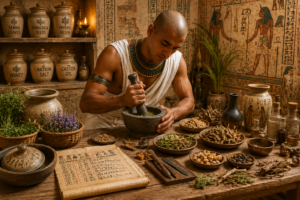
Egyptian healers developed a sophisticated tradition of compounding medicines. A prescription could specify ingredients, quantities, preparation, timing, and duration. The same substance might be ground, boiled, strained, mixed with beer or wine, combined with fat, or formed into a suppository or poultice.
Some ingredients had plausible therapeutic effects. Honey could support wound care; willow contains compounds related to salicylates; castor oil has a laxative action; and aromatic resins may have helped preserve preparations. Beer and wine could act as solvents or carriers. Other ingredients were ineffective, symbolic, or potentially harmful. Historical importance should not be confused with a recommendation to use ancient recipes today.
Diet was also part of treatment. Bread and beer were staples, while onions, garlic, dates, figs, fish, and meat supplied different nutrients. Physicians linked some discomforts to food and waste inside the body, although their explanations were framed through Egyptian concepts rather than modern pathology.
Dentistry and Eye Medicine
Dental disease was widespread. Stone particles introduced during grain grinding wore down enamel, exposing sensitive tissue and increasing the risk of infection. Mummies display severe abrasion, abscesses, missing teeth, and periodontal disease. Medical papyri contain remedies for toothache and loose teeth, often using pastes or mouth treatments.
There are intriguing examples of teeth joined with wire, but scholars debate whether these were therapeutic procedures performed during life or funerary repairs made after death. Evidence for fillings and advanced dental prostheses remains limited.
Eye complaints also received considerable attention. Dust, glare, insects, and infection made eye disease common. Egyptian texts prescribe washes and ointments containing minerals, plant products, and honey. Some treatments might have soothed irritation, while others carried risks. Specialist titles connected with eye care reinforce the idea of organised medical expertise.
Pregnancy, Childbirth, and Family Health
Women usually gave birth in a squatting or kneeling position, supported by birth bricks and assisted by female attendants. Deities such as Taweret and Bes were invoked to protect mother and child. Medical texts propose fertility and pregnancy tests using grains and other materials. Their reliability varies, but they demonstrate an effort to predict pregnancy through observable changes.
Contraceptive recipes are also recorded. Some ingredients may have formed a physical barrier, while others were symbolic or unsafe. Childbirth was dangerous, and religion provided reassurance where practical medicine had limited power. Archaeological evidence from settlements helps historians understand maternal and infant health, but the surviving written record was produced mainly by literate elites.
Public Health, Cleanliness, and the Environment
Egyptians valued washing, shaving, clean linen, and scented oils. Priests followed especially strict purification routines. Natron was useful for cleaning and drying, while cosmetics could protect the skin and eyes to some degree. However, ancient communities still faced parasites, contaminated water, respiratory irritation, occupational injuries, and infectious disease.
The Nile made agriculture possible but also exposed people to waterborne parasites. Evidence from mummies has contributed to the study of schistosomiasis and other diseases. Workers suffered fractures, arthritis, and spinal stress, while desert sand and smoke affected lungs and eyes. Egyptian medicine developed in direct response to these everyday conditions.
Medicine Under the Ptolemies and Romans
After Alexander the Great conquered Egypt in 332 BC, Alexandria became an international centre of scholarship. Egyptian, Greek, and later Roman traditions interacted. Greek physicians gained opportunities to study anatomy, and writers associated with Alexandria, such as Herophilus and Erasistratus, made influential anatomical observations.
Egyptian temple healing continued, and Imhotep’s cult flourished. Visitors sought cures through prayer, ritual, dreams, and practical remedies. Knowledge did not flow in only one direction: Greek authors admired aspects of Egyptian specialisation, while Egyptian practitioners absorbed and adapted ideas from the wider Mediterranean world.

A famous relief at Kom Ombo Temple shows a group of instruments that are often described as surgical tools. The relief belongs to the Graeco-Roman temple context, much later than the Edwin Smith Papyrus. Some objects resemble forceps, probes, knives, cups, and scales, although interpretations differ and they may also represent ritual equipment. The scene is valuable, but it should not be used by itself to prove that every modern-looking operation was performed in pharaonic Egypt.
What Mummies Reveal
Modern imaging has transformed the study of Egyptian health. X-rays and CT scans can identify fractures, arterial calcification, dental disease, arthritis, and evidence of trauma without unwrapping a mummy. Laboratory analysis has also investigated parasites and pathogens.
Mummies must still be interpreted carefully. Many belonged to elites, preservation can alter tissues, and a condition observed in one mummy cannot represent the whole population. Yet when physical evidence is compared with papyri, tomb scenes, and archaeological context, it provides an unusually rich picture of ancient disease and treatment.
How Scientific Was Ancient Egyptian Medicine?
Calling Egyptian medicine either “fully scientific” or “merely magical” creates a false choice. The Edwin Smith Papyrus demonstrates disciplined observation, case classification, and practical treatment. The Ebers Papyrus combines useful remedies with spells and theories that modern medicine rejects. Both belong to the same culture.
The most important achievement was not a single operation. It was the habit of recording cases and organising knowledge. Egyptian healers recognised patterns: a particular injury produced particular symptoms; some wounds could be treated; some required caution; and some were beyond help. This approach placed experience beside tradition and helped preserve medical knowledge over generations.
Frequently Asked Questions
Which period was the golden age of medicine in ancient Egypt?
Medical knowledge developed throughout Egyptian history. The Old Kingdom provides early evidence of professional physicians, the Middle Kingdom produced specialist traditions such as the Kahun Papyrus, and the early New Kingdom preserved the major Ebers and Edwin Smith manuscripts. Therefore, the Middle and early New Kingdoms are especially important for surviving texts, but they built on older practice.
Did ancient Egyptians perform brain surgery?
The Edwin Smith Papyrus accurately describes skull and brain injuries, but this does not prove routine brain surgery. Evidence for trepanation is rare and debated. Egyptian trauma care was advanced in observation and treatment, yet claims of frequent neurosurgery should be approached cautiously.
Did they use anaesthesia?
There is no secure evidence for anaesthesia comparable to modern surgical practice. Alcoholic drinks and sedating or pain-relieving plants may have reduced discomfort, but dosage and effects would have been unpredictable.
Who was the first Egyptian doctor?
Hesy-Ra is one of the earliest named people associated with physicians and dentistry. Imhotep later became a divine patron of healing, but contemporary evidence does not securely identify him as a practising doctor.
What is the most important ancient Egyptian medical text?
The Edwin Smith Papyrus is crucial for trauma and surgical practice, while the Ebers Papyrus is the broadest source for medicines and internal disease. Neither replaces the other; together they show the range of Egyptian healing.
Conclusion
The development of medicine in ancient Egypt was a long process shaped by royal institutions, temples, trained practitioners, scribal learning, warfare, construction, and everyday illness. From the specialist titles of the Old Kingdom to the clinical cases of the Edwin Smith Papyrus and the vast pharmacological collection of the Ebers Papyrus, Egyptian healers created one of antiquity’s most enduring medical traditions.
Their achievements should be described accurately, without exaggeration. They sutured wounds, bandaged injuries, reduced some dislocations, immobilised fractures, drained selected swellings, prepared complex medicines, and developed methods of examination and prognosis. At the same time, they relied on ritual and theories that do not match modern anatomy or disease. That combination is precisely what makes the subject so fascinating: ancient Egyptian medicine stands at the meeting point of close observation, accumulated experience, religion, and humanity’s timeless search for healing.
Also Read Our Other Blog Posts
- Kalabsha Temple: The Hidden Nubian Treasure of Aswan You Must Discover 2026
- Elephantine Island: A Mesmerizing Journey Through Living History in Aswan 2026
- Explore Qubbet el-Hawa / Dome of the Winds: A Rare Ancient Site Off the Beaten 2026
- The unique Kom Ombo Temple – Horus and Sobek
- Philae Temple
- Abu Simbel Temples: Complete Guide, History (2026)
- Who is Atum according to the ancient Egyptians?
Selected Sources and Further Reading
- The Metropolitan Museum of Art: The Edwin Smith Papyrus
- UCL Digital Egypt: Healing Papyri
- UCL Digital Egypt: Titles of Healers
- U.S. National Library of Medicine: Ebers Papyrus
- Traditional Ancient Egyptian Medicine: A Scholarly Review

Your gateway to discovering Egypt