
Kalabsha Temple
Temple of Mandulis
Where Silence Speaks and Stones Remember
There are places in Egypt where history does not simply exist—it breathes. Where every carved line in stone carries echoes of forgotten prayers, distant battles, and shifting empires. Kalabsha Temple is one of those places.
Standing quietly near the High Dam in Aswan, overlooking the shimmering waters of Lake Nasser, Kalabsha Temple is often overshadowed by more famous monuments. Yet those who step into its vast, sunlit courtyard quickly realize something extraordinary: this is not just a temple—it is a survivor.
A survivor of time.
A survivor of empires.
A survivor of water itself.
From its origins in the age of pharaohs to its rebirth under Roman rule, and finally to its dramatic relocation in the 20th century, Kalabsha Temple carries within its walls one of the most fascinating stories in all of Egypt.
Where Is Kalabsha Temple Located Today?
Today, Kalabsha Temple rests in a place known as New Kalabsha, just west of the Aswan High Dam.
It overlooks Lake Nasser, one of the largest man-made lakes in the world, where the deep blue water stretches endlessly into the horizon. The temple often appears as if it is floating between desert and water—a powerful visual reminder of its dramatic past.
But this is not where Kalabsha Temple originally stood.
Its first home was in Lower Nubia, at a site called Talmis (Bab al-Kalabsha), around 50 kilometers south of Aswan. There, it stood for nearly two thousand years, watching the Nile flow beside it—until the river itself changed forever.
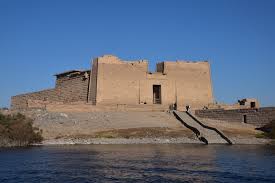
The Birth of Kalabsha Temple: A Story Older Than It Seems
When people ask, “When was Kalabsha Temple built?” the answer is layered.
The structure we see today dates to around 30 BC, during the reign of the Roman emperor Augustus. But the story of Kalabsha Temple begins long before that.
Beneath the Roman stones lies the memory of an older sacred place—one that dates back to the New Kingdom of ancient Egypt, particularly the reign of the great pharaoh Ramesses II.
This earlier temple was part of Egypt’s effort to establish control over Nubia, a land rich in gold, trade, and cultural exchange.
So while Kalabsha Temple is technically Roman, its soul is unmistakably Egyptian.
Which God Was the Temple Dedicated To?
The Temple of Kalabsha was dedicated primarily to the Nubian sun god:
- Mandulis (also known as Merul)
Mandulis was associated with:
- The sun
- fertility
- renewal
He was often linked with Egyptian gods such as:
- Isis
- Osiris
- Horus
This fusion of Nubian and Egyptian deities highlights the cultural blending in southern Egypt during ancient times.
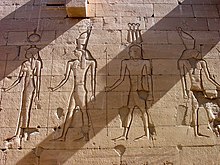
The Forgotten Sanctuary of Ramesses II
Before Kalabsha Temple rose in its current form, the site was home to an earlier sanctuary connected to Ramesses II.
Nearby, this legacy survives most clearly in the remarkable Beit el-Wali Temple, a rock-cut temple that offers a vivid window into that earlier era.
A Temple of Power and Propaganda
Beit el-Wali was dedicated to:
- Amun
- Khnum
- Anuket
It later became known as “The House of the Holy Man,” a name given during its later use as a hermit’s dwelling.
But its original purpose was far more political.
Inside its walls, Ramesses II is immortalized as a warrior king:
- Charging into battle against Nubian tribes
- Leading his sons in military campaigns
- Receiving tribute from conquered lands
The tribute scenes are especially striking:
- Giraffes and exotic animals
- Ivory tusks
- Gold and precious goods
These were not just artistic depictions—they were messages of dominance, carefully crafted to reinforce Egypt’s authority over Nubia.
Religious Grandeur
Alongside scenes of conquest, the temple also presents moments of devotion:
- Ramesses II offering gifts to the gods
- Rituals performed before Amun
- Sacred ceremonies carved with exquisite precision
Even today, many of these reliefs retain their colors, giving visitors a rare glimpse into the vibrancy of ancient Egyptian art.
The Roman Vision: Rebuilding Kalabsha Temple
Centuries later, under Roman rule, the site was transformed.
The Romans, rather than imposing their own religious systems, chose a different approach: they embraced Egyptian traditions.
Thus, Kalabsha Temple was built in classical Egyptian style, despite being commissioned by Emperor Augustus.
The God of Kalabsha Temple
The temple was dedicated to Mandulis, a Nubian solar deity associated with:
- The sun
- fertility
- divine protection
Mandulis represents a fascinating blend of cultures—a Nubian god worshipped in an Egyptian-style temple under Roman authority.
This fusion defines Kalabsha Temple.
Several historical records were inscribed on the temple walls of Kalabsha such as “a long inscription carved by the Roman Governor Aurelius Besarion in AD 250, forbidding pigs in the temple” as well as an inscription of “the Nubian king Silko, carved during the 5th century and recording his victory over the Blemmyes and a picture of him dressed as a Roman soldier on horseback.” Silko was the Christian king of the Nubian kingdom of Nobatia . When Christianity was introduced to Egypt, the temple was used as a church
Architecture of Kalabsha Temple: Monumental Elegance
Walking through Kalabsha Temple reveals a layout that feels both familiar and grand:
The Pylon
A massive gateway that once marked the boundary between the human and divine worlds.
The Courtyard
An open space filled with sunlight, where rituals and gatherings took place.
The Hypostyle Hall
A forest of columns, their capitals carved with intricate designs, supporting the sacred roof above.
Inner Chambers
Dark, cool rooms where priests once moved in silence.
The Sanctuary
The most sacred space, where the statue of Mandulis once stood.
The temple stretches approximately 76 meters in length, making it the largest free-standing temple in Nubia.
The Granite Stela and Its Journey to Berlin
One of the most intriguing aspects of Kalabsha is the story of a granite stela (inscribed slab) that was removed from the site and is now housed in the Neues Museum in Berlin.
This stela contains:
- Important inscriptions
- Historical records related to the temple and its administration
Why Was It Taken?
During the 19th century, many European expeditions removed artifacts from Egyptian sites. The Kalabsha stela was among these pieces.
In 1971, Egypt gave one of the temple’s gates to the Federal Republic of Germany out of gratitude for Germany’s participation in the rescue of the Nubian temples.
Where Is It Now?
Today, it is preserved in the Neues Museum, one of the most important museums for Egyptian antiquities in Europe.
Since 1977 the gate has been located in the annex of Berlin’s Egyptian Museum in Berlin-Charlottenburg.
The gate will be moved to become the monumental entrance to the fourth wing of the Pergamon Museum in Berlin, which is currently being constructed.
Why It Matters
The stela provides:
- Historical context about Kalabsha
- Evidence of religious practices
- Insight into Nubian-Egyptian relations
The Kiosk of Qertassi: A Jewel Beside Kalabsha Temple
Near Kalabsha Temple stands a smaller but elegant structure: the Kiosk of Qertassi.
Though modest in size, it is rich in beauty.
Architectural Charm
- Four Hathor-headed columns
- Delicate carvings
- A harmonious blend of Egyptian and Roman styles
Purpose
The kiosk likely served as:
- A ceremonial gateway
- A resting place for religious processions
Its simplicity contrasts beautifully with the grandeur of Kalabsha Temple, creating a balanced architectural landscape.
The Great Rescue: Saving Kalabsha Temple from the Waters
In the 1960s, everything changed.
The construction of the Aswan High Dam led to the creation of Lake Nasser, threatening to submerge vast areas of Nubia—including Kalabsha Temple.
A Global Effort
UNESCO launched an international campaign to save these monuments.
The Relocation Process
Kalabsha Temple was:
- Cut into over 13,000 blocks
- Carefully numbered
- Transported to higher ground
- Reassembled stone by stone
This operation took place between 1961 and 1963.
It was not just engineering—it was preservation on a monumental scale.
Kalabsha Temple Through the Ages
Kalabsha Temple has lived many lives:
- New Kingdom – Early sanctuary under Ramesses II
- Roman Period – Reconstruction and dedication to Mandulis
- Christian Era – Conversion into a church
- Modern Era – Relocation and preservation
Each layer added new meaning, new markings, new stories.
What Makes Kalabsha Temple Unique?
Kalabsha Temple is unique because it is:
- The largest free-standing Nubian temple
- A fusion of Egyptian, Nubian, and Roman cultures
- A monument that survived relocation
- A site rich with inscriptions from multiple eras
- A peaceful alternative to crowded attractions
Why Kalabsha Temple Matters
Kalabsha Temple is more than a historical site.
It is:
- A bridge between cultures
- A testament to resilience
- A symbol of global cooperation
It reminds us that history is not fixed—it can be saved, moved, and reborn.
Visiting Kalabsha Temple Today
Arriving at Kalabsha Temple is part of the experience.
Visitors drive to the temple’s private dock near the High Dam, then take a boat for a short trip across Lake Nasser.
Sometimes, a special permit from the Egyptian authorities is required to visit the temple, as it is located in a border area.
Tickets for Kalabsha Temple.
Where to Buy Tickets
Tickets are purchased at the entrance gate of the archaeological site on the island
Or through the official government website to purchase tickets for museums and temples: https://egymonuments.com/
Ticket Prices (Approximate)
Egyptians: low-cost entry
Foreign visitors: 200 Egyptian pounds
Students (with ID): discounted tickets
📌 Note: Prices may change, so it’s always good to check locally.
Opening Hours
Typically from 7:00 AM to 5:00 PM
Last entry is usually before closing time by about an hour
Visitor Tips
Wear comfortable shoes (the site involves walking on sand and stones)
Bring water, especially in summer
Contact us to arrange a private tour of Kalabsha Temple and experience a journey to another world, far removed from the hustle and bustle of modern life.
A Journey Through Kalabsha Temple: An Immersive Ending
Imagine this:
The sun is beginning to soften as you step off a small boat onto the quiet shore of New Kalabsha.
The air is still.
Ahead of you, Kalabsha Temple rises in warm sandstone, glowing under the golden light of late afternoon.
You walk slowly toward the massive pylon. Each step echoes faintly against the stone.
Crossing the entrance, you leave the modern world behind.
The courtyard opens before you—vast, silent, filled with sunlight. The wind moves gently through the columns, carrying whispers of a time long past.
You step into the hypostyle hall.
The temperature drops. Shadows stretch across the floor. The columns rise around you like ancient guardians.
Your fingers brush against the carved walls.
Here is Ramesses II—frozen in victory.
There, Mandulis—eternal and watchful.
Every surface tells a story.
You move deeper.
The sanctuary awaits—quiet, sacred.
For a moment, everything stands still.
No crowds. No noise. Just you… and thousands of years of history.
Outside, the light begins to fade. Lake Nasser reflects the sky like a mirror, and Kalabsha Temple stands between water and desert, exactly where it was meant to be—again.
And as you leave, one thought lingers:
Some places are visited.
Others are experienced.
Kalabsha Temple is remembered.
Contact us
to discover the treasures of ancient Egyptian kingdoms through time.
Atum Trip

Read more in the Atum Trip blogs:
Abu Simbel Temple, Philae Temple, Kom Ombo Temple, Edfu Temple, Tombs of the Nobles, Elephantine Island
Official Opening Hours and Ticket Prices
The Ministry of Tourism and Antiquities currently lists Kalabsha Temple as open daily from 7:00 am to 4:00 pm. Tickets are listed at EGP 200 for foreign adults and EGP 100 for foreign students. Egyptian admission is listed at EGP 10 for adults and EGP 5 for students. Because New Kalabsha is reached by water, boat transport is arranged separately and is not included in the archaeological-site ticket.
Opening hours, admission prices, and boat arrangements can change. Check the official Kalabsha Temple page and the official Egypt monuments ticket portal close to your visit.
What are the current Kalabsha Temple opening hours and ticket prices?
Kalabsha Temple is currently listed as open from 7:00 am to 4:00 pm daily. Foreign adult/student admission is listed at EGP 200/100; boat transport is separate. Verify the latest information through the official links above.
New Kalabsha Temple Location
Use the interactive map below to view New Kalabsha Temple, Lake Nasser, Aswan, Egypt, at its relocated site behind the Aswan High Dam, and open directions in Google Maps.