
Abu Simbel Temples: A Monument of Eternal Majesty (2026 Guide)
As you step through the vast sands of southern Egypt and the shimmering edge of Lake Nasser comes into view, the monument begins to rise from the ground like a revelation. From afar, you first notice four colossal statues seated solemnly at the façade—each one an image of Ramses II, measuring over 20 meters (66 feet) high. Their sheer size is overwhelming. Each statue wears the double crown of Upper and Lower Egypt, symbolizing his dominion over the entire land. Even time itself has bowed to these statues—despite the damage to one of them (destroyed by an ancient earthquake), its head lies reverently at its base, still guarding the temple. Beneath these statues runs a row of baboon carvings, arms raised in praise to the rising sun—a nod to the solar deity Ra-Horakhty. Above the entrance is a bas-relief of Ra-Horakhty himself, seated in a shrine with a falcon head, crowned with the sun disk, holding the ankh (life) and scepter of power. Now you walk toward the entrance, under the shadow of these giants. You are about to step inside a mountain carved with divine intention.Stepping into the Hypostyle Hall
As you cross the threshold, the outside world fades. You’re now standing in the Great Hypostyle Hall, a vast chamber about 18 meters deep and 16 meters wide. It’s dim, cool, and hushed. The air is thick with history. You immediately face eight colossal Osirid pillars, each carved as a mummified figure of Ramses II, arms crossed over his chest, holding the crook and flail—the emblems of kingship. These statues line both sides of the hall in two rows, four on each side, and rise about 10 meters tall. Their presence is not merely structural but deeply symbolic. Ramses appears as Osiris, the god of the afterlife, declaring his divine connection and eternal life. As you walk deeper between these massive pillars, you see that the walls of the hall are alive with scenes.Reliefs on the Right Wall: The Battle of Kadesh
On the right side, the temple becomes a war chronicle. Here, in intricate detail, the famous Battle of Kadesh unfolds before your eyes. Chariots race. Horses rear. Ramses II stands at the center, larger than life, pulling back his bow with precision, his muscles tensed. This battle, fought against the Hittites around 1274 BCE, was one of the largest chariot battles in history. Though it ended in a stalemate, Ramses declared it a triumph. Here, it is presented not as history but as divine conquest. You see the enemies fleeing in disarray, while Ramses charges into their midst with the confidence of a god-king. His inscriptions boast: “I alone defeated millions of enemies!”Left Wall: Religious Rituals and Offerings
Turning to the left wall, you are immersed in a quieter, more spiritual world. Here Ramses is shown making offerings to various gods:- Pouring wine before Ra-Horakhty
- Burning incense for Amun-Ra
- Kneeling in prayer before Ptah, the god of craftsmen
- The ankh, the sign of life
- The was scepter, power
- The djed pillar, stability
The Small Vestibule (Second Hall)
You proceed deeper into the temple. The Hypostyle Hall gives way to a second, smaller hall, supported by four square pillars. This space is quieter, more intimate. The decoration here emphasizes Ramses’s role in the divine order. One scene shows him standing beside the sacred barques—portable shrines for the gods—used in religious processions. Another shows him performing the ritual of the Sed Festival, a ceremonial renewal of kingship celebrated after 30 years of rule. Ramses, here, is no longer just a mortal leader—he is transforming into a god among gods.Entering the Sanctuary
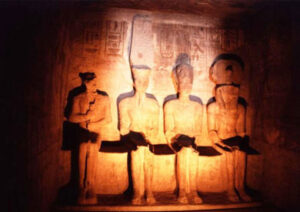
At last, you arrive at the Holy of Holies—the sanctuary, the most sacred room of the temple. The room is small and dark, about 3 meters wide and 7 meters deep. At the far end are four enthroned statues, carved directly into the back wall:- Ra-Horakhty – the rising sun, falcon-headed, god of light and justice
- Ramses II – seated as a god beside the gods
- Amun-Ra – the hidden one, king of the gods
- Ptah – the god of creation, shrouded in darkness
The Ceiling and Hidden Details
Look up—the ceilings of the halls are covered in vibrant, though faded, star patterns and representations of the vulture goddess Nekhbet, spreading her protective wings. In corners and along side chambers, you may find niches, likely used for ritual storage or offerings. There are also graffiti left by early explorers, including Greek and Roman visitors, who stood where you now stand and left their names behind.Side Rooms and Storage Chambers
Flanking the halls are smaller side rooms—six in total. Scholars believe these were used to house:- Ritual tools
- Statues of gods
- Sacred texts or scrolls
- Offerings made by priests or pilgrims
The Small Temple of Nefertari: A Brief Step Aside
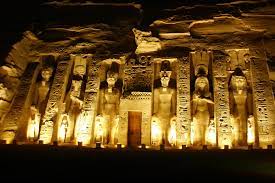
A short distance away stands the Temple of Hathor and Nefertari. Its façade features six standing statues—four of Ramses and two of his queen, Nefertari. What makes this unique is that Nefertari is carved the same height as Ramses, a rare honor in ancient Egypt. Inside:- Columns adorned with images of Hathor-cows and musical instruments
- Reliefs of Nefertari playing the sistrum, an instrument sacred to Hathor
- Intimate, artistic scenes emphasizing fertility, beauty, and love
The Abu Simbel Temples are among the most breathtaking monuments of ancient Egypt, standing proudly in the golden sands of southern Egypt near Lake Nasser. These iconic temples are not just architectural masterpieces—they are a timeless story carved in stone, reflecting power, faith, and scientific brilliance.
In this complete guide, we explore everything about the Abu Simbel Temples—from their location and history to their incredible solar phenomenon and why they are a must-visit destination.
Where Are the Abu Simbel Temples Located?
The Abu Simbel Temples are located in southern Egypt, about 230 km southwest of Aswan, near the Sudanese border.
Originally carved into a sandstone cliff on the west bank of the Nile, the temples were relocated in the 1960s to higher ground near Lake Nasser after the construction of the Aswan High Dam.
Today, their dramatic setting—surrounded by desert and water—adds to their legendary beauty.
Why Are They Called Abu Simbel Temples?
Interestingly, the name Abu Simbel is not ancient Egyptian.
It dates back to the 19th century when Swiss explorer Johann Ludwig Burckhardt discovered the site with the help of a local Nubian boy named Abu Simbel. Later, Italian explorer Giovanni Belzoni officially explored the temples in 1817 and kept the name in honor of the boy.
Who Built the Abu Simbel Temples?
The Abu Simbel Temples were built by Pharaoh Ramses II, one of the most powerful rulers in ancient Egypt.
The temples are dedicated to:
-
Ramses II himself (as a divine ruler)
-
Gods:
-
Ra-Horakhty
-
Amun-Ra
-
Ptah
-
Next to the Great Temple is the Small Temple, dedicated to:
-
Queen Nefertari
-
Goddess Hathor
This makes Abu Simbel unique, as it honors both divine kingship and royal love.
What Is Inside the Abu Simbel Temples?
The Great Temple
-
Four colossal statues of Ramses II (20 meters tall)
-
A massive hypostyle hall with Osirid pillars
-
Detailed wall carvings of battles like the Battle of Kadesh
-
Religious scenes and offerings
At the sanctuary:
-
Statues of Ramses II, Amun-Ra, Ra-Horakhty, and Ptah
The Small Temple
-
Six statues on the façade (including Queen Nefertari)
-
Unique equality in statue size between king and queen
-
Interior scenes of music, worship, and devotion to Hathor
Why Are the Abu Simbel Temples So Famous?
The Abu Simbel Temples are famous for several reasons:
-
Massive scale reflecting ancient Egyptian power
-
Precise solar alignment (astronomical genius)
-
Artistic perfection in carvings and design
-
Unique dedication to both a king and his queen
-
UNESCO relocation project, one of the greatest rescue operations in history
The Sun Festival: A Unique Astronomical Phenomenon
One of the most incredible features of the Abu Simbel Temples is the solar alignment phenomenon.
Twice a year:
-
February 22
-
October 22
The sun penetrates the temple and illuminates:
-
Ramses II
-
Amun-Ra
-
Ra-Horakhty
While Ptah remains in darkness, symbolizing the underworld.
This phenomenon highlights the advanced astronomical knowledge of ancient Egyptians.
The Relocation of the Abu Simbel Temples
In the 1960s, the construction of the Aswan High Dam threatened to submerge the temples.
Between 1964 and 1968:
-
The temples were cut into over 1,000 blocks
-
Each block weighed up to 30 tons
-
They were moved 65 meters higher and 200 meters back
This massive project, led by UNESCO, is considered one of the greatest engineering achievements in history.
Who Was Ramses II?
Ramses II, also known as Ramses the Great, ruled Egypt from 1279 to 1213 BCE.
He was known for:
-
Military leadership (Battle of Kadesh)
-
Massive construction projects
-
Diplomatic achievements (first peace treaty in history)
He ruled for 66 years and had over 100 children, leaving behind a powerful legacy.
Is Visiting Abu Simbel Temples Worth It?
Absolutely. The Abu Simbel Temples are one of the top tourist attractions in Egypt.
Highlights:
-
Giant statues up close
-
Ancient hieroglyphics
-
The Sun Festival experience
-
Unique desert landscape
Visiting Abu Simbel is not just a trip—it’s a journey through history.
Conclusion
The Abu Simbel Temples are more than just monuments—they are a symbol of human brilliance, artistic mastery, and eternal legacy.
From their colossal statues and sacred alignment with the sun to their dramatic rescue from flooding, they continue to inspire millions of visitors every year.
If you are passionate about history, culture, or architecture, the Abu Simbel Temples should be at the top of your travel list.
For more information, please contact us.
Who is Atum according to the ancient Egyptians?Official Opening Hours and Ticket Prices
According to the Egyptian Ministry of Tourism and Antiquities, Abu Simbel is currently open daily from 6:00 am to 5:00 pm. Standard tickets are listed at EGP 750 for foreign adults and EGP 375 for foreign students. On the solar-alignment dates, 22 February and 22 October, foreign tickets are listed at EGP 1,200 for adults and EGP 600 for students. Egyptian tickets are EGP 30 for adults and EGP 10 for students, rising to EGP 60 and EGP 20 on the alignment dates. Separate vehicle-entry fees may apply.
Opening times and prices can change. Check the official Abu Simbel page and the official Egypt monuments ticket portal shortly before visiting.
What are the current Abu Simbel opening hours and ticket prices?
Abu Simbel is currently listed as open from 6:00 am to 5:00 pm daily. The standard foreign adult/student prices are EGP 750/375, with special prices on 22 February and 22 October. Always verify through the official links above before travel.
Abu Simbel Temples Location
Use the interactive map below to view Abu Simbel Temples, Abu Simbel, Egypt and open directions in Google Maps.