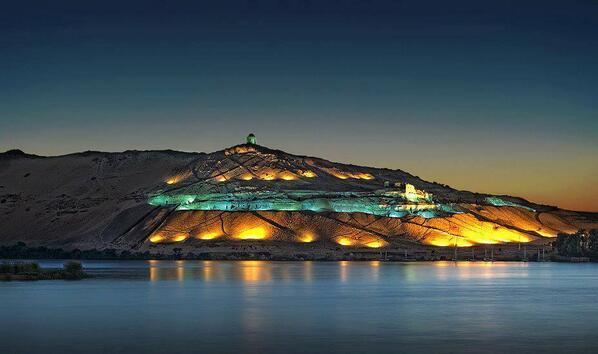
Qubbet el-Hawa / Dome of the Winds
The Hidden Tombs of Aswan You Shouldn’t Miss
High above the golden west bank of the Nile in Aswan lies one of Egypt’s most underrated archaeological treasures—Qubbet el-Hawa / Dome of the Winds. While most travelers rush toward temples and monumental landmarks, this hillside necropolis quietly preserves thousands of years of human stories carved into stone.
If you’re searching for a destination that blends history, breathtaking views, and authentic discovery, then Qubbet el-Hawa / Dome of the Winds should be at the top of your list.
Where is Qubbet el-Hawa / Dome of the Winds Located?
Qubbet el-Hawa is located on the west bank of the Nile, directly opposite Aswan city and near Elephantine Island.
It sits atop a high sandstone hill, rising roughly 130 meters above the river, offering panoramic views of:
- The Nile River
- Lush islands
- Desert landscapes
- The skyline of Aswan
This strategic location was not random—it reflects ancient Egyptian beliefs about the afterlife, where the west symbolized the land of the dead.
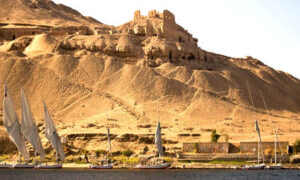
Visual Experience of the Site
As you approach Qubbet el-Hawa / Dome of the Winds, the experience begins with a peaceful boat ride across the Nile. Once you reach the west bank, a long stone staircase leads you upward.
With every step:
- The breeze becomes stronger (true to its name, Dome of the Winds)
- The view becomes more dramatic
- The silence deepens
At the top, small openings carved into the mountain reveal a hidden world—ancient tombs waiting to be explored.
Why is it Called Qubbet el-Hawa / Dome of the Winds?
The name has two origins:
- “Qubbet” (Dome) refers to a small Islamic shrine at the summit dedicated to a local saint.
- “El-Hawa” (The Winds) reflects the strong, constant breeze at the hilltop.
Thus, the English translation “Dome of the Winds” perfectly captures both its physical and cultural identity.
Interestingly, this name is relatively modern—the tombs themselves date back over 4,000 years.
What Does Qubbet el-Hawa Contain?
The site is a vast necropolis featuring more than 80 tombs carved directly into the rock, dating from:
- The Old Kingdom
- The Middle Kingdom
- Later periods including the Roman era
Inside the Tombs
Each tomb typically includes:
- A carved entrance
- Pillared halls
- Burial chambers
- Walls covered with hieroglyphs and artwork
Unlike royal tombs, these belong to governors, officials, and nobles—giving us rare insight into everyday elite life in ancient Egypt.
Famous Tomb Owners
Harkhuf
Harkhuf
A governor and explorer known for expeditions deep into Africa. His tomb inscriptions describe trade missions and even mention bringing a “dancing dwarf” for the king.
Sabni
Sabni
Famous for avenging his father’s death in Nubia and retrieving his body—one of the most emotional and human stories ever recorded in Egyptian tombs.
Sarenput I & II
Sarenput I
Sarenput II
Their tombs are among the most artistically refined, featuring detailed carvings and elegant architectural layouts.
Stories Carved in Stone
What makes Qubbet el-Hawa / Dome of the Winds extraordinary is not just its age—but its stories.
A Story of Loyalty and Revenge
Sabni’s inscriptions tell how he:
- Traveled south after his father was killed
- Retrieved his body
- Led a campaign of justice
This is not mythology—it is a real, personal narrative preserved for over 4,000 years.
Journeys to Africa
Harkhuf’s tomb reveals:
- Trade expeditions into Nubia and middle of Africa
- Diplomatic missions
- Cultural exchange
These inscriptions prove that Aswan was once Egypt’s gateway to Africa.
Daily Life Scenes
Inside the tombs, you’ll see depictions of:
- Farming
- Hunting
- Religious rituals
- Family life
These scenes provide a vivid picture of ancient Egyptian society beyond kings and pyramids.
What Makes Qubbet el-Hawa Special?
- Breathtaking Views
Few places in Egypt offer such a stunning panoramic view of the Nile.
- Authentic Experience
It’s less crowded than major tourist sites, allowing a peaceful and immersive visit.
- Human Stories
Unlike temples, these tombs focus on real people and their lives.
- Ongoing Discoveries
Archaeologists continue to uncover new tombs and artifacts here, making it a living historical site.
How to Visit Qubbet el-Hawa / Dome of the Winds
(Access)
- Take a felucca or motorboat from Aswan
- Or reach it by car via the west bank
Climbing
- Expect a 15–25 minute climb
- Wear comfortable shoes
- Bring water, especially in summer
Opening Hours
- 7:00 Am up to 5:00 Pm.
Tickets
- Affordable entry fees
- Separate tickets may apply for specific tombs
Archaeological Importance
Qubbet el-Hawa / Dome of the Winds is invaluable for historians because it offers:
- Firsthand autobiographical inscriptions
- Evidence of Egypt’s southern relations
- Insight into non-royal elite society
- Evolution of tomb architecture
It bridges the gap between royal history and everyday life.
Why is Qubbet el-Hawa Not Well Known?
Despite its significance, it remains under the radar.
Reasons include:
- Limited global promotion
- Focus on famous sites like Luxor and Giza
- Physically demanding access (the climb)
- Lack of monumental structures visible from afar
Yet, this is exactly what makes it a hidden gem.
A Journey Worth Taking
Visiting Qubbet el-Hawa / Dome of the Winds is not just about seeing tombs—it’s about experiencing history in its rawest form.
Standing at the top, with the wind around you and the Nile stretching below, you begin to understand why ancient Egyptians chose this place as their eternal resting ground.
Deeper Archaeological Insights into
Qubbet el-Hawa / Dome of the Winds
To fully understand the significance of Qubbet el-Hawa / Dome of the Winds, we need to go beyond its surface beauty and explore the deeper archaeological layers that make this site one of the richest yet most overlooked necropolises in Egypt.
️ The Origin of the Name Revisited
While the modern name Qubbet el-Hawa / Dome of the Winds comes from the Islamic dome of Sheikh Ali Abu el-Hawa at the summit, archaeologists interpret the name in a broader sense.
It refers not only to the visible dome but to the entire funerary landscape beneath it—a vast arrangement of tombs built on artificial terraces carved into the hillside overlooking the Nile.
This layered structure reflects centuries of continuous burial activity, making the site a multi-period historical archive rather than a single-era cemetery.
Geological and Geographical Setting
The necropolis of Qubbet el-Hawa is located in West Aswan, just south of the Nubian village of Gharb Aswan.
At first glance, the site appears like a massive sand dune rising from the desert. However, beneath this sandy surface lies a huge formation of Nubian Sandstone, which provided the perfect material for carving tombs.
This natural formation became home to one of the most densely occupied cemeteries in ancient Egypt, with burials spanning from around 2500 BC through the Roman period.
A Multi-Layered Necropolis
The central part of Qubbet el-Hawa / Dome of the Winds is composed of four distinct levels of rock-cut tombs, each reflecting different social classes and historical periods.
️ The Upper Level
Located just below the Islamic dome, this level contains a small number of relatively simple tombs.
The Middle Terraces
Further down, the quality of the rock improves, allowing for large, elaborate tombs built by high-ranking officials and governors—particularly those connected to Elephantine Island.
These individuals gained wealth and power through:
- Trade with Nubia
- Military expeditions
- Administrative control of Egypt’s southern frontier
The Lower Necropolis
Below the main terraces lies a vast, long-overlooked burial zone extending toward the ancient floodplain of the Nile.
Social Stratification in Ancient Aswan
During the Old and Middle Kingdoms, burial locations clearly reflected social hierarchy:
- Lower classes were buried on Elephantine Island
- Administrative elites occupied the lower necropolis of Qubbet el-Hawa
- The highest-ranking officials were buried on the upper terraces
This spatial organization offers rare physical evidence of social stratification in ancient Egyptian society, especially in the strategically important First Cataract region.
History of Exploration and Excavation
Although parts of the site were known earlier, modern archaeological interest began in the late 19th century.
- During the French campaign in Egypt and Syria, early explorers documented features like the causeway leading to Tomb QH 34h.
- In 1885, British General Francis Grenfell conducted one of the first formal explorations.
- Around 15 years later, Lady Cecil began systematic excavations.
Throughout the 20th century:
- Labib Habachi focused on key tombs (1946–1952)
- Elmar Edel expanded research (1959–1984)
By 2008, archaeologists had identified 209 tombs, though large parts of the site remained unexplored.
Modern Discoveries and Research
A major breakthrough came in 2016 with the Qubbet el-Hawa Research Project (QHRP), led by international teams including:
- University of Birmingham
- Egypt Exploration Society
- Later joined by Macquarie University
Key Discoveries:
- Identification of a second terrace of tombs
- Discovery of monumental structures supported by retaining walls
- Excavation of a lower cemetery (Site C)
By 2019, researchers uncovered:
- Nine mastaba tomb superstructures
- A grid-like road system connecting burial complexes
- Evidence of continuous use from the Old Kingdom to the Middle Kingdom
Recent Archaeological Finds
In January 2020, the QHRP team led by Martin Bommas discovered:
- Six mastaba tombs
- Two shaft graves
- One rock-cut tomb with multiple burials
Some tombs were remarkably well preserved, with dimensions reaching up to 352 × 635 cm.
Interestingly, one tomb had:
- A sealed mudbrick entrance
- Evidence of ancient looting through a rear wall
This highlights a timeless reality: even in antiquity, tomb robbers were active.
Number and Types of Tombs
As of July 2022, around 100 tombs have been fully documented and studied in detail, though the total number is higher.
Most date back to the Old Kingdom, providing valuable insights into burial traditions in Upper Egypt’s First Nome.
Notable Figures Buried at Qubbet el-Hawa
Beyond the well-known figures already mentioned, the site includes tombs of:
- Mekhu and Sabni – known for their dramatic father-son story
- Sobekhotep – a royal seal-bearer
- Heqaib – later venerated as a local god
- Ishemai
Later burials include:
- Setka (a chanting priest from the First Intermediate Period)
- Kakm (a New Kingdom high priest)
- User Wadjat (a ruler of Elephantine)
- Amenhotep (a high priest and royal official)
Even kings such as Senusret I and Senusret II are associated with the site.
What the Inscriptions Reveal
According to Egyptian Ministry of Tourism and Antiquities, the inscriptions inside the tombs highlight:
- Trade expeditions to foreign lands
- Military campaigns
- Administrative responsibilities
- Religious practices
One of the most important roles documented is that of expedition leaders, such as Harkhuf, who were sent to distant regions to acquire rare goods for the royal court.
Religious Importance
During the Middle Kingdom, a sanctuary dedicated to figures like Heqaib emerged near Elephantine Island.
These individuals were not just officials—they became locally revered figures, blurring the line between history and religious worship.
Ongoing Development and Future Access
In July 2022, officials from the Aswan and Nubian Antiquities Sector announced plans to:
- Restore and prepare more tombs for public access
- Improve roads leading to the site
- Install signage and visitor guidance systems
- Introduce modern lighting
These efforts aim to transform Qubbet el-Hawa / Dome of the Winds into a more accessible and engaging destination without compromising its authenticity.
Final Insight
What makes Qubbet el-Hawa / Dome of the Winds truly exceptional is its depth—both physically and historically.
It is not just a collection of tombs, but a layered narrative of:
- Power and politics
- Trade and exploration
- Family, loyalty, and memory
Every terrace you descend…
Every inscription you read…
Reveals another chapter of a story that has been unfolding for over 4,000 years.
Contact us to discover more secrets that many people overlook in Aswan.
Philae Temple – Abu Simbel Temple – The Unfinished Obelisk – Kalabsha Temple – Elephantine Island – Nubian Village – Edfu Temple – Kom Ombo Temple – Khnum Temple