
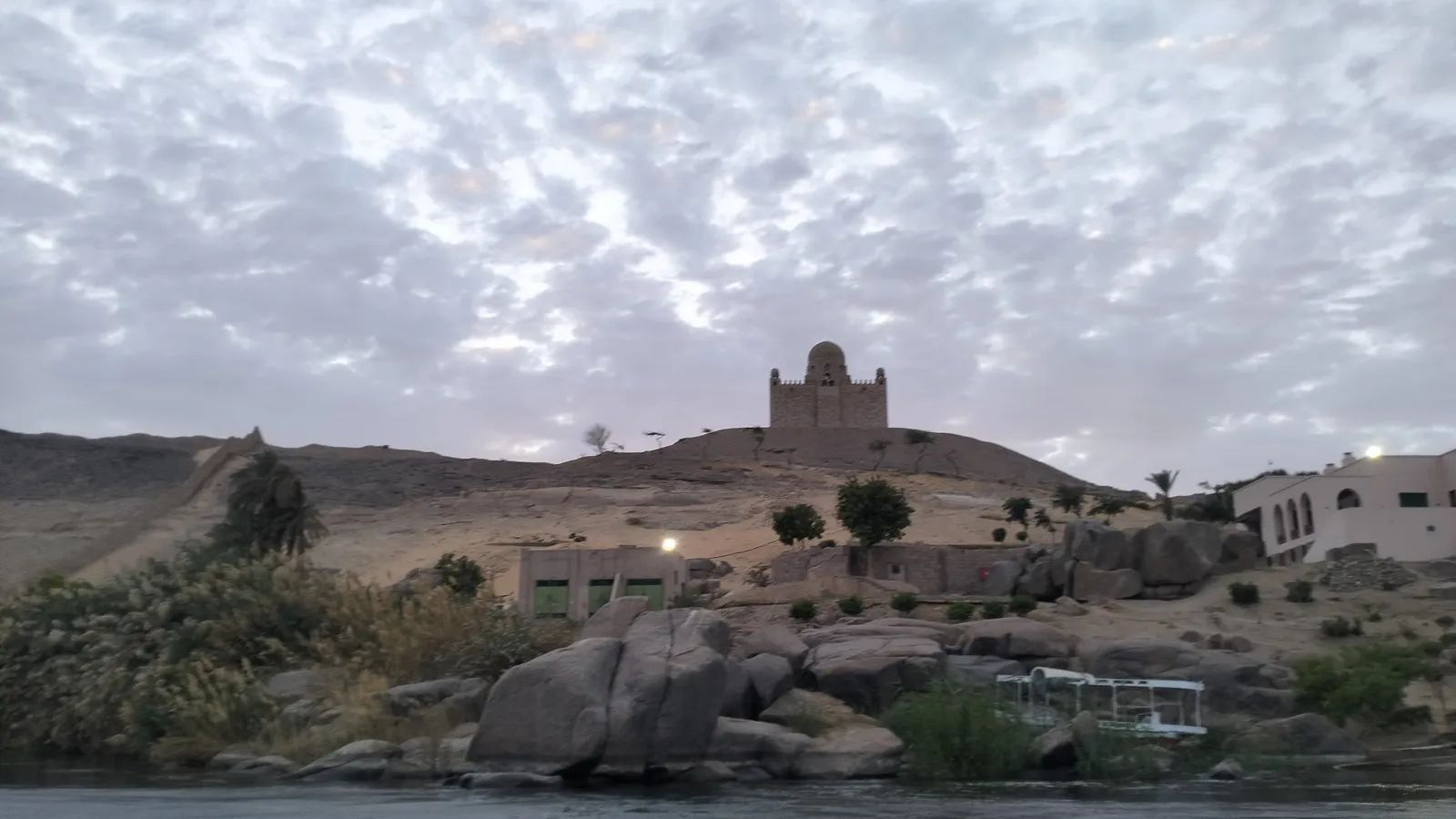
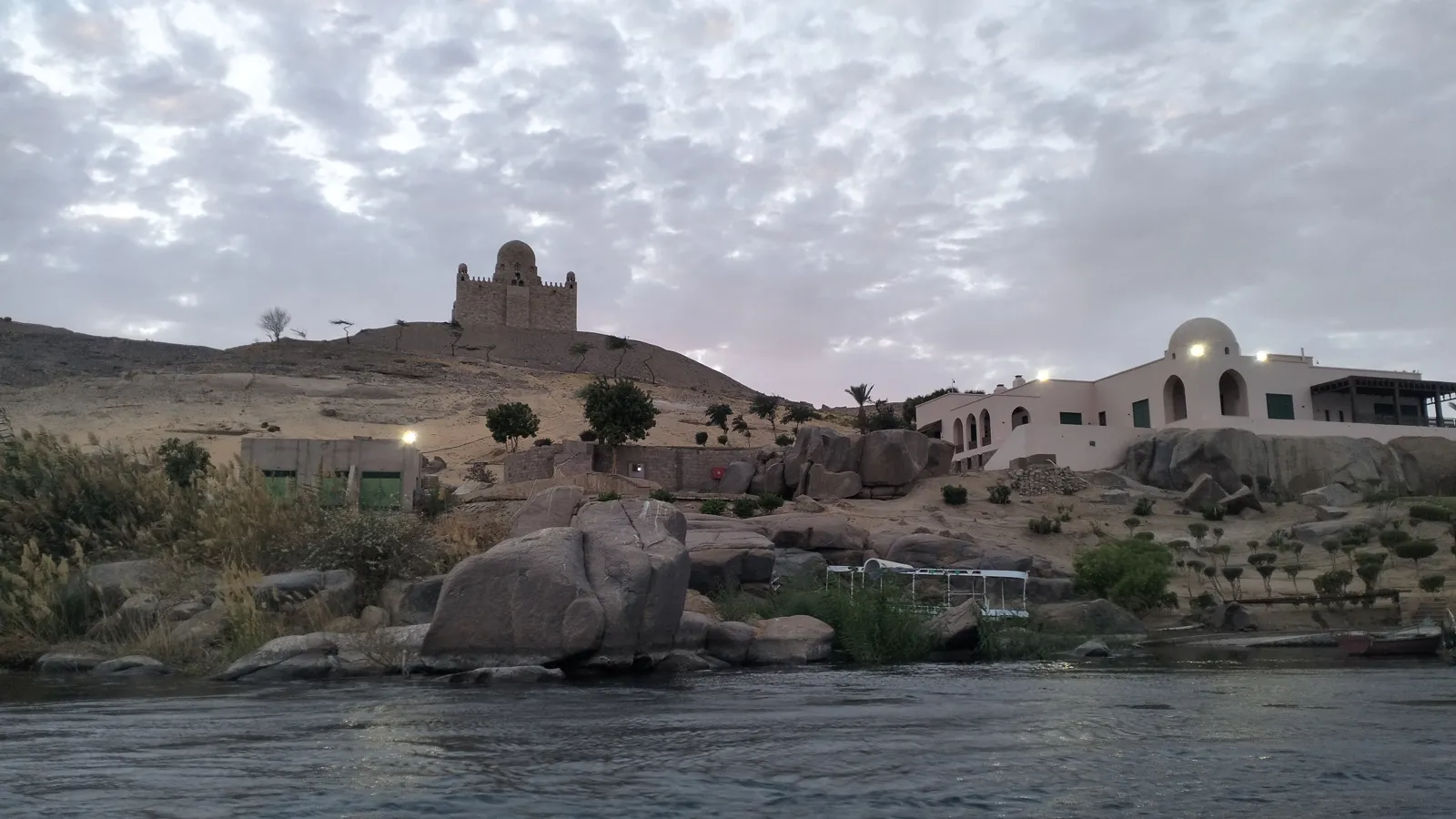
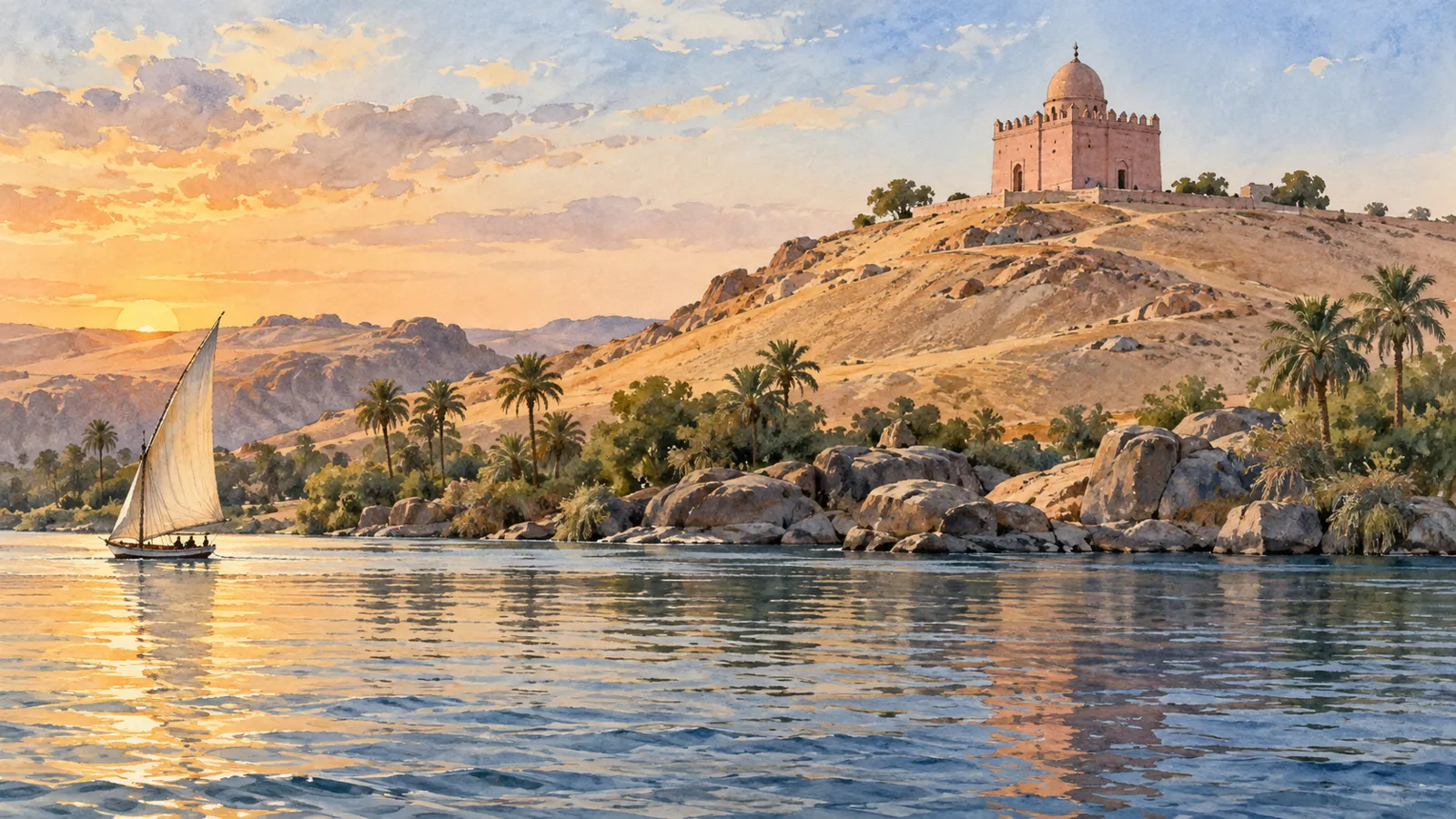
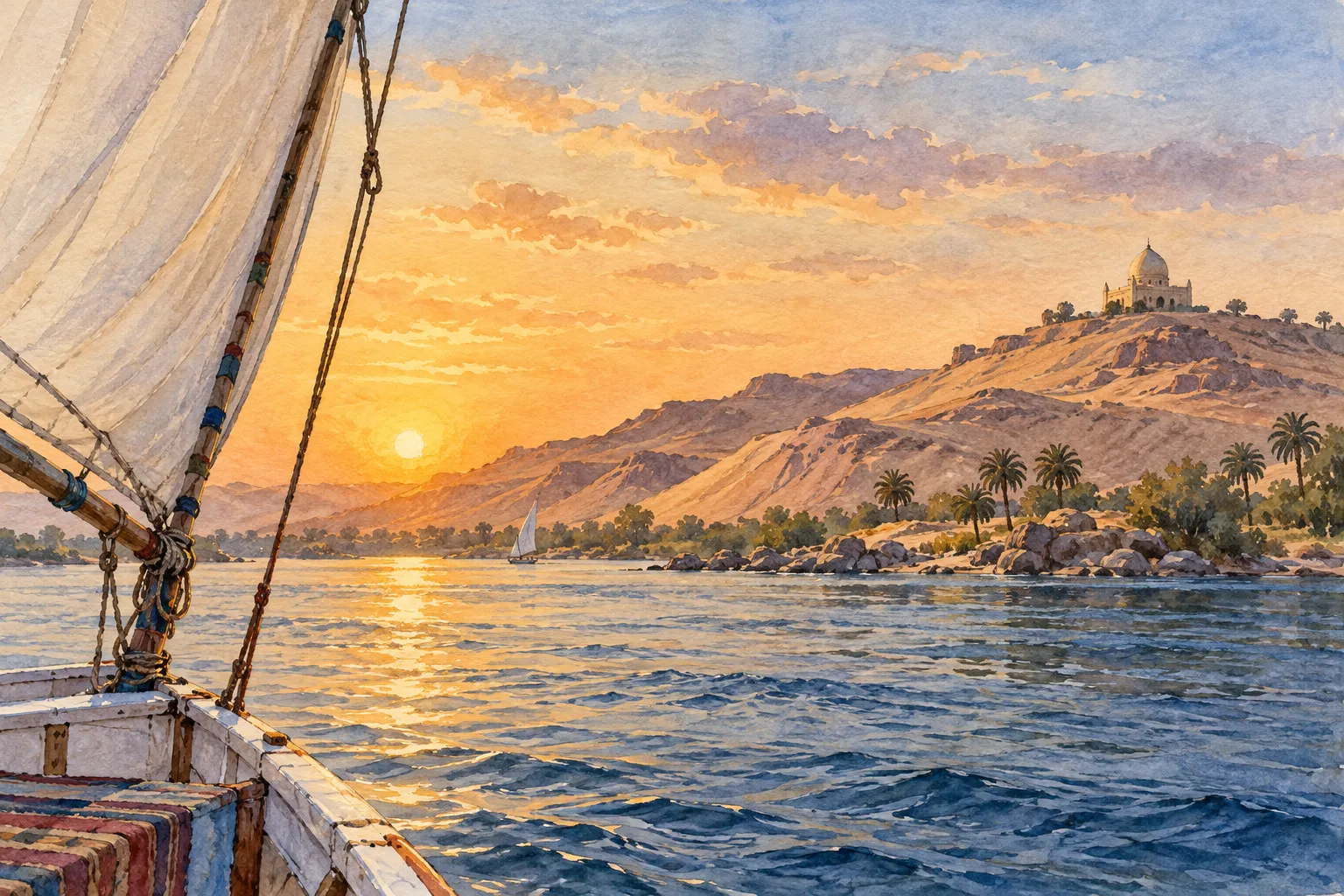
From the Nile, the Aga Khan Mausoleum appears high on Aswan’s western ridge, its pale rose-colored dome catching the changing light. It is one of the city’s most recognizable modern landmarks, yet it is also a private resting place whose story should be approached with restraint.
The mausoleum was created for Sultan Muhammed Shah Aga Khan III, the 48th hereditary Imam of the Nizari Ismaili Muslims. He died in 1957 and was reinterred at Aswan in 1959. The building was commissioned by his wife, Begum Om Habibeh, and completed around 1960.
Why Aswan?
Aga Khan III valued Aswan’s dry winter climate and spent time there for health and rest. The location also carried historical resonance because the Fatimid dynasty, founded by Ismaili Imams, ruled Egypt and established Cairo as a major capital in the tenth century.
The hilltop site gave the mausoleum a calm relationship with the Nile, desert, and the family residence below. It was designed not as a tourist spectacle but as a dignified place of burial and remembrance.
Who Was Aga Khan III?
Born Sultan Muhammed Shah in 1877, Aga Khan III served as Imam from 1885 until 1957. He played roles in international diplomacy, Muslim educational initiatives, social reform, and the development of Ismaili institutions. His life crossed colonial, nationalist, and international political worlds.
Begum Om Habibeh and the Mausoleum
Begum Om Habibeh, born Yvette Blanche Labrousse, supervised the memorial project and remained closely associated with Aswan. Tradition holds that she arranged for a red rose to be placed at her husband’s tomb. She died in 2000 and was buried nearby.
Architecture and Setting
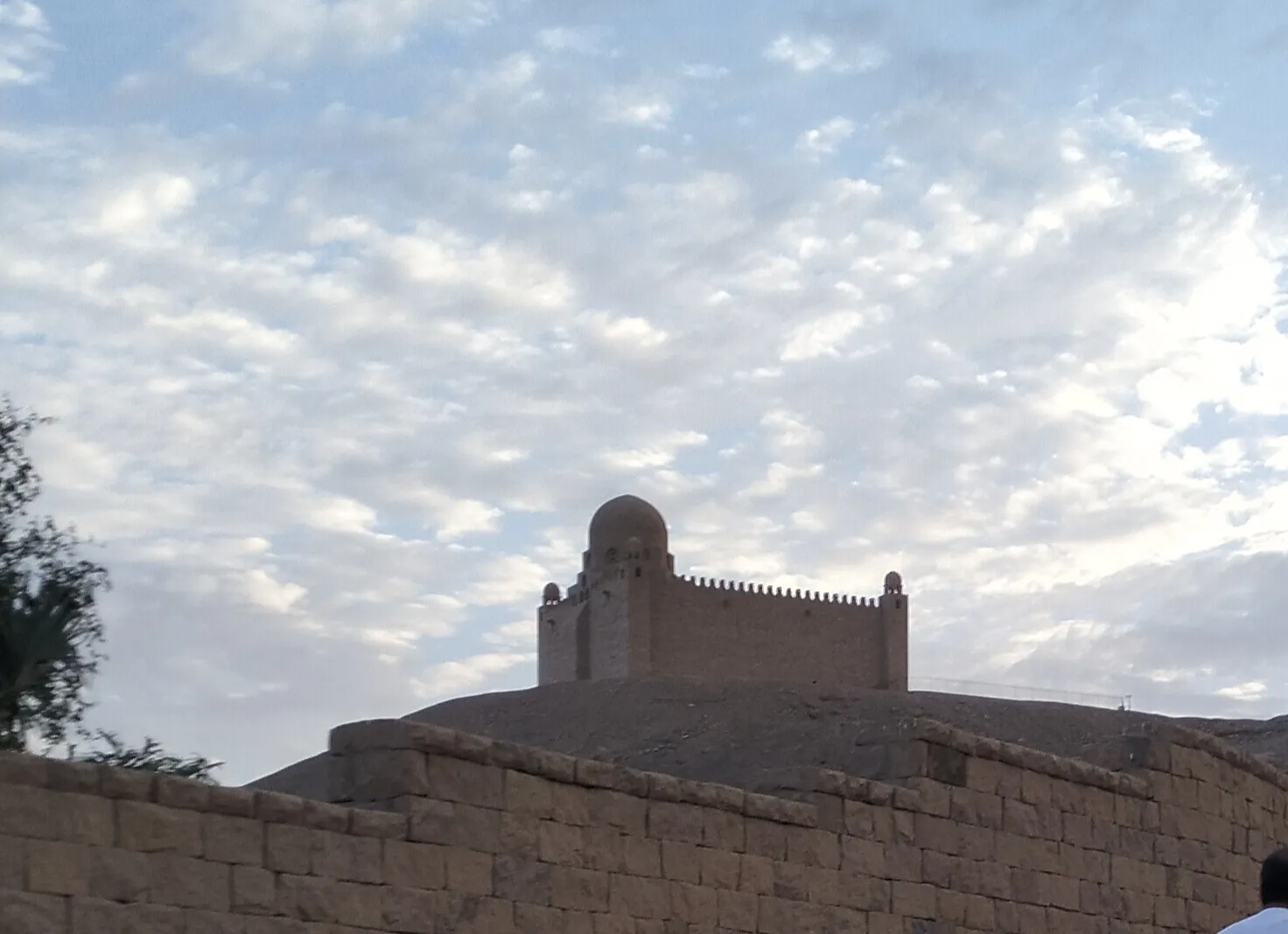
Egyptian architect Farid Shafie designed the mausoleum with a central dome, carefully proportioned walls, and elements inspired by historic Islamic architecture. Its rose-colored stone harmonizes with the western desert at sunrise and sunset.
The building should be admired from a distance unless formal access has been granted. The interior has long been closed to ordinary tourism, and private or security arrangements can change.
Aga Khan IV’s Burial in Aswan
Prince Karim Al-Hussaini, Aga Khan IV and the 49th hereditary Ismaili Imam, died in Lisbon in February 2025. According to the Aga Khan Development Network, he was laid to rest in Aswan on 9 February 2025 during a private burial ceremony. His son, Prince Rahim Al-Hussaini, became Aga Khan V.
This recent event reinforces the mausoleum’s status as an active family and religious memorial, not an abandoned monument. Articles and local visits must respect that privacy.
Can You Visit the Aga Khan Mausoleum?
Travelers should not assume public entry. The safest expectation is that the mausoleum is viewed from the Nile or other public viewpoints. Any exceptional access requires current, explicit authorization from the responsible authorities and representatives. Do not enter private land or rely on outdated reports.
The west-bank silhouette can be appreciated during a felucca or motorboat journey and combined visually with the landscape around Qubbet el-Hawa.
Frequently Asked Questions
Who is buried in the Aga Khan Mausoleum?
It was built for Aga Khan III. Begum Om Habibeh was buried nearby, and Aga Khan IV was laid to rest in Aswan in February 2025.
When was it built?
Construction began in the 1950s and the building was completed around 1960.
Is the mausoleum open to tourists?
Ordinary public entry should not be assumed. Access has long been restricted, and visitors should rely only on current official authorization.
Who designed it?
It was designed by Egyptian architect Farid Shafie.
Conclusion
The Aga Khan Mausoleum is most meaningful when understood as a place of faith, family, architecture, and remembrance. Its distant position above the Nile is not an invitation to intrude. It asks the traveler to look carefully, learn accurately, and respect the boundary between a landmark and a private memorial.
Questions Worth Asking
A strong visit is guided by questions rather than a list of famous facts. Why was this particular location chosen? Which resources, beliefs, political decisions, or communities made it possible? What has disappeared, and how do researchers know it once existed? Which features are original, which were repaired, and which belong to modern visitor management? Asking these questions turns passive sightseeing into historical observation.
It is equally useful to ask whose perspective is missing. Royal inscriptions emphasize authority; official engineering narratives may emphasize achievement; picturesque travel photographs may hide displacement or daily work. Community memory, archaeology, environmental study, and conservation records can reveal different parts of the same story. At Aga Khan Mausoleum, no single viewpoint explains everything, but careful comparison produces a more honest and memorable understanding.
Finally, consider how the place should be protected. Respect barriers, keep litter out of the river and desert, avoid touching decorated surfaces, and support responsible local services. Heritage survives through daily choices as well as major restoration projects. The traveler’s role is temporary, but the effect of respectful behavior can last beyond the visit.
Before You Arrive
Good preparation makes Aga Khan Mausoleum easier to understand. Read a short historical outline before leaving, save the official visitor link on your phone, and check whether payment is accepted by card, cash, or an online ticket. Ask about the exact meeting point because place names may refer to a broad district rather than one entrance. If boats are involved, confirm whether the quoted fare is one way, return, private, or shared.
Do not build the schedule from driving time alone. Security checks, ticket queues, river crossings, walking, heat, and conversation with a guide all require time. A realistic itinerary creates space to look carefully and avoids pressuring drivers, boat crews, staff, or residents. If accessibility matters, ask in advance about steps, slopes, sand, uneven stones, toilets, shade, and vehicle access, because conditions vary considerably across Aswan attractions.
Experiencing the Site Step by Step
Begin at the widest available viewpoint and orient yourself before focusing on individual details. Locate the Nile, town, desert, island edge, entrance, or principal architectural axis. This first pause establishes scale. Move next to the feature that best explains the place’s function, then follow the story in chronological or spatial order rather than walking randomly between photo opportunities.
At the Aga Khan Mausoleum, look for evidence of change: repaired masonry, reused stone, new paths, missing roofs, cultivated areas, modern infrastructure, or labels describing excavation. These transitions reveal how the location survived. Listen as well as look. Wind, water, voices, birds, traffic, and silence affect the experience and remind us that heritage is encountered in the present, not inside an imaginary world separated from modern life.
After the Visit
Review photographs while the sequence is still fresh and identify anything you did not understand. Official museum and monuments pages can clarify names and dates, while specialized books can provide deeper interpretation. Avoid sharing uncertain claims as facts merely because they appeared in a social-media caption. A useful travel record distinguishes personal impressions from historical information.
The visit can also guide the next stage of the journey. Questions about Ismaili history, private family memory, modern Islamic architecture, Aswan’s healing reputation, and the boundary between viewing a landmark and entering a private site may lead naturally to another Aswan site, a museum gallery, or a longer article. This is how individual attractions become a connected understanding of the region. Aswan is not a collection of disconnected stops; it is a landscape shaped by the Nile, Egypt’s relationship with Nubia, successive religious traditions, modern development, and communities that continue to give the city its character.
Understanding Aga Khan Mausoleum in Its Wider Setting
Aga Khan Mausoleum becomes more meaningful when it is placed within a hill above the west bank of the Nile in Aswan. A visitor sees more than a single attraction: the surrounding river, settlement, desert, roads, and patterns of movement explain why this location mattered. The central historical frame is that it was built as the burial place of Sultan Muhammad Shah Aga Khan III, who died in 1957; Aga Khan IV was buried there in February 2025. That chronology should guide the visit, because later alterations and modern expectations can otherwise blur very different periods.
The site also opens a larger conversation about Ismaili history, private family memory, modern Islamic architecture, Aswan’s healing reputation, and the boundary between viewing a landmark and entering a private site. These themes are not decorative background. They explain why people created, used, protected, altered, remembered, or returned to this place. Reading the landscape patiently helps travelers distinguish what survives physically from what historians reconstruct through inscriptions, excavation, photographs, and oral memory.
A Deeper Historical Journey
No important place in Aswan belongs to only one moment. Political authority changed, religious traditions developed, communities moved, and the Nile continually shaped daily life. Evidence must therefore be read in layers. Some features are ancient, others medieval or modern, and still others are results of conservation. A careful guide identifies those layers instead of presenting every visible element as contemporary with the site’s foundation.
Built as the burial place of Sultan Muhammad Shah Aga Khan III, who died in 1957; Aga Khan IV was buried there in February 2025. This history connects local experience with larger transformations in Egypt and Nubia. It also explains why the place can carry several meanings at once: achievement and loss, beauty and labor, sacred memory and modern tourism. That complexity is part of its value rather than a problem to simplify.
What to Look for During the Visit
Slow down and focus on the distant Nile view, pale stone silhouette, surrounding landscape, and respectful understanding of restricted access. Details often communicate more than a quick panoramic photograph. Observe materials, scale, wear, restoration, shadows, and the relationship between built space and the Nile. Ask which parts were functional, ceremonial, domestic, defensive, commemorative, or created for visitors in a later period.
Photography is most useful when it supports attention rather than replacing it. Take a wide view to record setting, a medium view to show spatial relationships, and close views only where photography is permitted. Avoid blocking paths or photographing residents and staff without consent. At indoor or sensitive sites, follow restrictions on flash, tripods, and commercial equipment.
Landscape, Climate, and the Nile
Aswan’s intense sun, dry air, granite, sand, and blue water create unforgettable contrasts, but the landscape is also historical evidence. The river determined transport, agriculture, settlement, trade, and ritual life. Islands and cataracts channel movement, while the desert preserves buildings and archaeological traces in ways that humid environments rarely do.
Season changes the experience. Winter mornings can be cool, while midday remains bright. Summer heat may make exposed sites demanding. Carry water where permitted, use sun protection, and choose clothing and footwear suited to uneven ground. The most comfortable time is not always the quietest, so travelers should balance temperature, light, crowds, and transport arrangements.
People Behind the Place
Monuments and landscapes are created, maintained, studied, and remembered by people. Administrators, craftspeople, priests, workers, gardeners, engineers, monks, residents, archaeologists, conservators, boatmen, and museum staff may all belong to different chapters of this story. Recognizing their work prevents history from becoming a list of rulers and dates.
Modern communities are not props for an ancient narrative. Their privacy, livelihoods, and interpretation of local heritage deserve respect. Buying crafts directly when appropriate, asking before taking portraits, using local services transparently, and listening to community explanations can make a visit more responsible and more memorable.
Archaeology, Evidence, and Responsible Interpretation
Archaeologists combine architecture, pottery, inscriptions, objects, environmental evidence, archival records, and comparison with related sites. Their conclusions can change as new evidence appears. Popular stories sometimes compress uncertainty into a dramatic claim, but responsible travel writing separates documented fact, plausible interpretation, later tradition, and legend.
Visitors can use the same discipline. Read official signs, compare dates, notice when a wall has been reconstructed, and avoid touching fragile surfaces. Do not remove stone, pottery, plants, or soil. Even an apparently ordinary fragment may have archaeological value because its exact position provides information that disappears once it is moved.
Planning a Meaningful Visit
Allow enough time to experience the Aga Khan Mausoleum without rushing immediately to the next stop. Transport in Aswan often involves boats, riverbank meeting points, desert roads, or walks through living neighborhoods. Build a margin into the schedule and confirm the pickup point, return arrangement, inclusions, and payment expectations beforehand.
Combine nearby places by theme rather than simply by quantity. A history-focused day may connect the site with the Nubian Museum or Elephantine. A landscape day may include a felucca journey or botanical island. A modern-history day may connect the High Dam with the Nubian rescue campaign. Thoughtful combinations reduce travel time and help each stop illuminate the next.
Opening Hours and Ticket Prices
The mausoleum is a private religious and family site and is not generally open as a ticketed public monument. There is no standard visitor ticket on the official monuments portals. Respect closure notices and never attempt entry without permission.
Prices and opening hours can change without older travel articles being updated. Check the relevant official monument or museum information and the Egypt monuments ticket portal close to the visit. Student reductions normally require valid identification, and the last ticket may be sold before closing time.
How This Place Fits an Aswan Itinerary
Aga Khan Mausoleum works best when the rest of the day leaves room for the journey as well as the destination. Begin early for exposed places, reserve indoor museums for hotter hours, and avoid planning distant attractions with no travel allowance. A private transfer can simplify road-based combinations, while islands require realistic boat timing.
Travelers can continue with Atum Trip’s other Aswan and Egypt travel guides. Those planning arrivals or departures can also review the Aswan Airport transfer service. These links are useful planning tools; the historical article itself remains focused on understanding the destination.
Frequently Asked Questions
Why is Aga Khan Mausoleum important?
It helps visitors understand Ismaili history, private family memory, modern Islamic architecture, Aswan’s healing reputation, and the boundary between viewing a landmark and entering a private site. Its significance comes from both the visible place and the wider historical landscape around it.
How much time should I allow?
Most travelers should allow at least ninety minutes, with additional time for transport, interpretation, photography, rest, and any nearby attraction. Complex museums or landscapes may reward two hours or more.
What are the current opening hours and ticket prices?
The mausoleum is a private religious and family site and is not generally open as a ticketed public monument. There is no standard visitor ticket on the official monuments portals. Respect closure notices and never attempt entry without permission. Always verify shortly before traveling through the official information page and official ticket portal.
Can information change?
Yes. Seasonal schedules, Ramadan hours, restoration, security arrangements, private access rules, and government ticket revisions can all affect a visit.
What should I bring?
Bring water where permitted, sun protection, comfortable footwear, valid student identification if claiming a discount, and a respectful approach to photography and local communities.
Final Reflection
Aga Khan Mausoleum is most rewarding when approached as a living part of Aswan rather than an isolated object. Its story joins landscape, human work, memory, and change. The visible attraction is only the beginning; the deeper experience comes from understanding the people and historical forces that gave it meaning.
Leave time for one final look before departing. Notice how the light changes the stone, vegetation, water, architecture, or desert. That quiet moment often becomes the clearest memory of the visit—and the best reason to continue exploring Aswan with patience and curiosity.
Plan carefully, verify current information, and travel responsibly.